No dumping
Lingering questions lead commission to reject landfill expansion plan
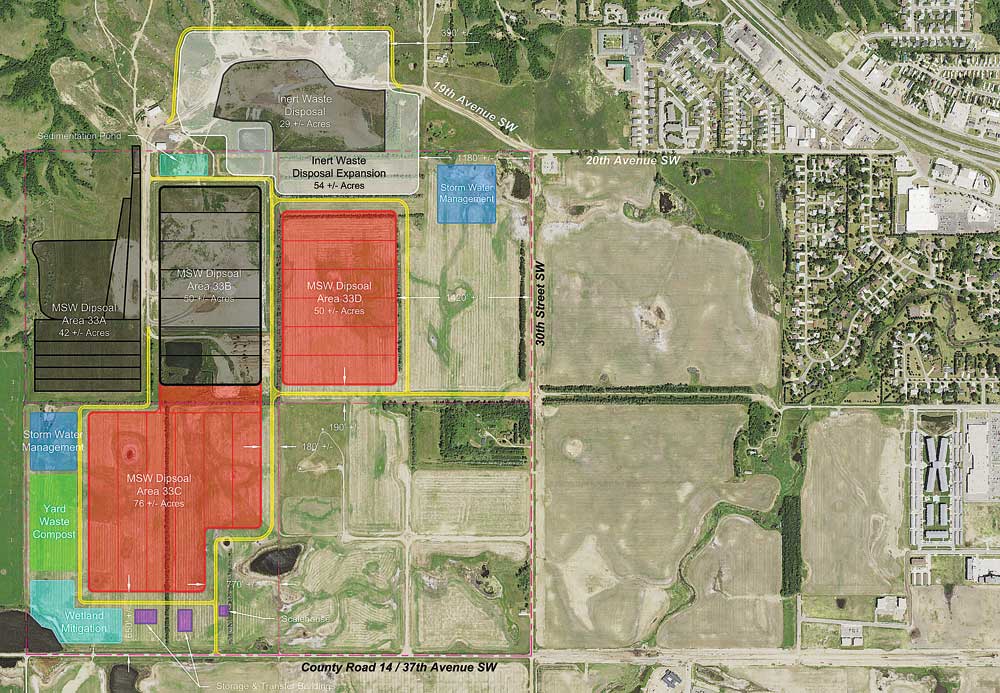
Submitted Art This schematic from the City of Minot shows the proposed landfill expansion and the nearest residences to the east.
Minot’s garbage disposal plans would go back to start if the city council accepts the recommendation of its planning commission to deny a proposed landfill expansion.
The Minot Planning Commission voted 8-2 Monday to reject the Minot Public Works Department’s proposal to extend the landfill to the south and east. Commission Chairman Tyler Neether said he must see more details on landscaping, buffering and other specifics before he can approve an expansion.
“We need to get to a well-rounded plan,” he said.
The commission also heard from residents in the Elk Meadows and Green Acres subdivisions, who opposed bringing the landfill nearer their homes and preferred the city open a landfill at a new site farther from town. They called for a thorough analysis of the costs of expansion versus the costs of a new site, indicating the city is premature in rejecting alternative sites without getting solid numbers.
The commission’s recommendation to deny goes to the Minot City Council next Monday.
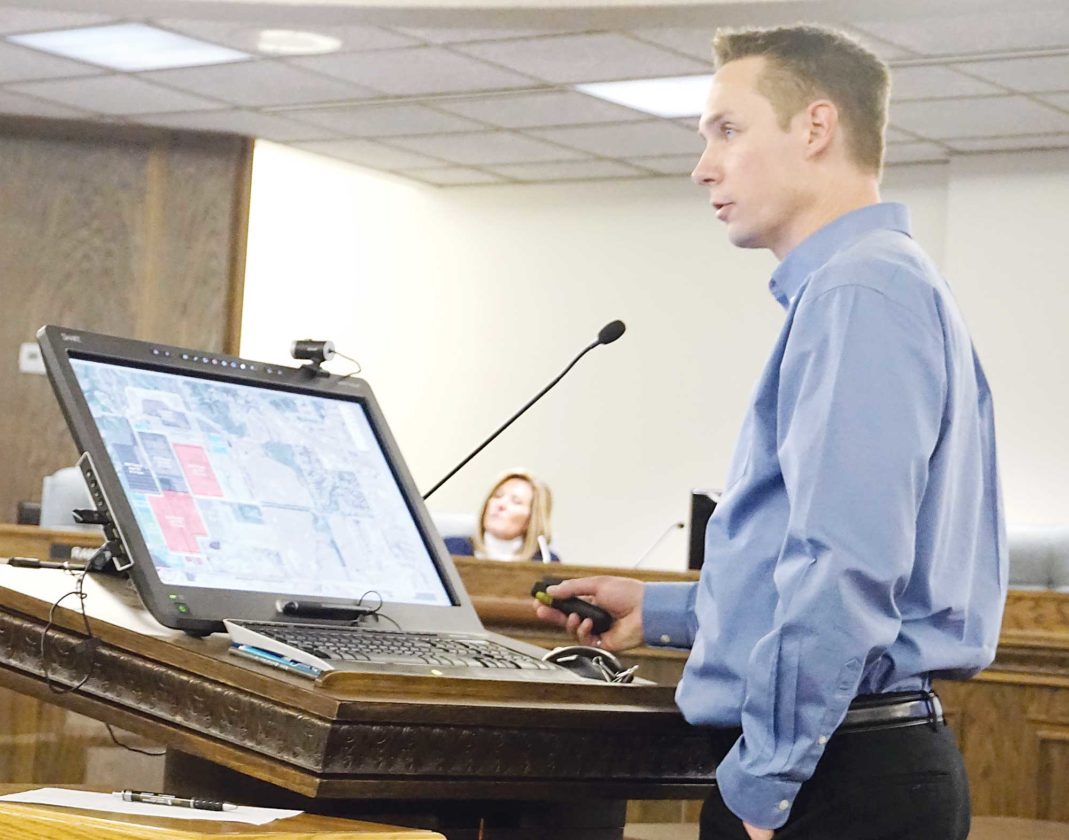
Jill Schramm/MDN Assistant Public Works Director Jason Sorenson talks about landfill expansion plans at the Minot Planning Commission meeting Monday in City Hall.
Jason Sorenson, Minot’s assistant public works director, said the department will be working on a stronger cost-analysis report to present to the council.
“Obviously, we have done some rough kind of estimates. We will spend some time here over the next few days and we will bolster those numbers. People kind of wanted to see the cost-benefit analysis. We are trying to go through that in a little more detail,” he said.
He added, though, that any new site is likely to generate similar opposition from neighbors. Even property remote from residences may be difficult to buy and still can be expected to be opposed by neighboring landowners, he said.
City Council President Mark Jantzer, who attended the planning commission meeting, said the council will want the cost-analysis information to make the right decision.
“We want to make sure that we have the process right,” he said. “I guess I would certainly be willing to look at, again, some alternatives for a different approach to try and confirm that expansion where we are is the most cost effective and most practical solution.”
He said there is time to get more information if more information is needed. The current landfill does have several years of cell capacity left.
Sorenson said the city has millions of dollars invested in infrastructure at the existing landfill. Expansion would enable the city to keep using a scale house, equipment building, roads, leachate collection and other systems rather than building new. The added cost of transitioning to a new landfill over a three- to five-year period was estimated at $5 million to $7 million. A move to a landfill farther away would mean more trucking and labor costs, Sorenson said.
“In my opinion, we weren’t going to have a cost-effective sanitation service,” he said in explaining the reasons for rejecting a new site.
Brian Hankla, a resident of Elk Meadows, suggested the cost of transitioning to a new landfill would be minor in the overall scheme.
“If we are talking about a new landfill for the next 70 to 100 years, personally, I think an extra $3 million or $5 million would be worth it as opposed to having the landfill in this area,” he said.
But Hankla also said costs of alternatives need to be better defined.
“I just don’t think the proper study or the cost-benefit analysis is really here,” he said. He also said city ordinance requires more plan specifics than have been presented. Rezoning before examining the specifics of the proposed use is backwards, he said.
“This is just kind of a hurried decision,” he added. “We purchased property and we are no where near ready to rezone or do anything with it.”
The Public Works Department seeks a zone change from agricultural to public on about two quarters, one south and one east of the existing landfill. Although without a specific design plan, the proposal included some possible areas for storm water detention, structures and tree buffers.
Residents weren’t impressed by the plan to move the landfill entrance to a location along 37th Avenue Southwest. City staff argued the move would shift peak traffic of 500 trucks a day from a residential street to a five-lane road designated as a future arterial capable of handling 25,000 vehicles a day. Residents objected because 37th Avenue runs past Trinity Health’s new medical complex.
The city has room left in its existing landfill cells before it would need to move to the new property in eight to 10 years, Sorenson said. The operation would move south first.
It would be about 40 years before the east quarter would be needed. The plan is to only use the west half of that quarter, although the city seeks to rezone the entire quarter to public.
Bob Hale, who owns property to the northeast of the existing landfill, questioned spending $4 million to buy land appraised at $1.27 million for the purpose of putting a landfill on prime development property. He also questioned the city’s estimated costs for alternatives.
“I think those numbers are there to scare us. Let’s not be scared. Let’s get the information,” he said. “Spending almost 315 percent of appraised value for a piece of land doesn’t make sense, but it’s been done. Let’s not compound that and have us and our children and our grandchildren live with it for the next 100-plus years.”
Dusty Wald, vice president of the Green Acres Home Owners Association, said moving the current landfill closer to residences and changing the landscape is not acceptable.
“It affects 157 homes’ property values,” he said.
-

- Submitted Art This schematic from the City of Minot shows the proposed landfill expansion and the nearest residences to the east.
-

- Jill Schramm/MDN Assistant Public Works Director Jason Sorenson talks about landfill expansion plans at the Minot Planning Commission meeting Monday in City Hall.
Local News

Time capsule, sculpture highlight pioneer reunion
Defendant in Spirit Lake shooting pleads guilty
A Fort Totten man has pleaded guilty to two separate counts of assault and voluntary manslaughter in U.S. District ...

Moen Family musicians return to Frozen Fingers Festival
Accommodating growth

Discovery well anniversary