DAKOTADATEBOOK: Sept.18-22
Mugwumps
By JIM DAVIS
Sept. 18 — On this date in 1889, with only 13 days remaining before the election to approve the state Constitution and choose North Dakota’s first state officials and legislators, the political parties were working at a frenzied pace. Local, county and district conventions were combined to promote the candidates chosen at the state conventions and to expedite the selection of local legislative candidates. Time was of the essence.
With gubernatorial candidate John Miller and Congressional hopeful Henry Hansbrough serving as the nucleus, Republican campaigners crisscrossed the state, speaking at rallies and conventions. The Democratic strongholds in the northeast were heavily targeted, and over 30 rallies were attended.
The whirlwind tour was beginning to pay dividends. The Farmers Alliance newspaper, published in Valley City, announced that it was now Republican, supporting the candidacy of John Miller as the Farmer’s candidate. The Democratic members of the Alliance countered that Miller was a glorified accountant who wouldn’t know a wheelbarrow from a seeder.
Campaign rhetoric was heating up, but in the age of Victorian morality, one had to be careful. When Herbert Root of Valley City used profanity in describing S. S. Hitman during a heated political altercation, he was arrested, taken to court and fined $20 and costs. Libel and slander were commonplace, but profanity wouldn’t be tolerated.
In the eastern part of the state, especially the Red River Valley, party politics were stringently observed. When The Park River Gazette, a Republican newspaper, announced its support for a local favorite, Democrat Clinton Lord, who was running for the office of state treasurer, it raised the ire of the editor of the Fargo Argus.
“It is an insult to the state convention that made the ticket,” snarled the editor. “It is a guerrilla stab at an unoffending candidate, (and) an assassin-like act at which no honorable man can be guilty.”
In the western, less populated areas, they were more likely to support the individual than obey strict party lines. Disgruntled with party choices, the Democrats and Republicans in Dickinson united and nominated William Ray, a Democrat for the Senate, and Republican A.W. Merrifield for the House. They were branded as Mugwumps, political slang stemming from the 1884 Presidential election and used to denounce Republicans who bolted across party lines to elect Grover Cleveland.
The state’s lone Representative in Congress would be elected by popular vote in the Oct. 1 election; however, the first act of the Legislature would be the selection of North Dakota’s two Senators. Strict observance of party politics was crucial to the Republicans to ensure an overwhelming majority in the new legislature. Crossing party lines threatened that majority. Mugwumpery could not be allowed.
The Rise and Demise of Prairie Chickens
By STEVE HOFFBECK
Sept. 19 — Most modern-day people have never seen a prairie chicken, but there was a time, long ago, when prairie chickens thrived on North Dakota’s grasslands.
Shooting prairie chickens was one of the premiere outdoor activities for hunters from the 1880s through the early 1900s. It was not always so, for when the great buffalo herds roamed through Dakota, the buffalo ate too much of the grass, and prairie chickens could not thrive. All that changed as the buffalo were wiped out in the 1870s and the last great herd was killed in 1883.
When farmers came, they planted wheat and small grains. Prairie chickens followed close after, nesting in the remaining grasslands and feeding in adjacent wheat fields. Prairie chickens proliferated as farmers killed foxes, owls, and hawks, their natural predators.
“North Dakota is a wonderful place for prairie chickens,” said an expert hunter in 1883, “they live in the wheat fields, where they breed, and No. 1 hard [wheat] agrees with them.”
As farmers tilled homesteads in western Dakota, prairie chickens prospered in these “newer agricultural” areas. After August wheat harvests, the stubble-fields were “alive with prairie chickens” and the game-birds were said to be “as thick as mosquitoes.” In the best years, a hunter could “go into the fields and shoot his birds as he might do in a farmyard.”
Newspapers referred to the “festive prairie chicken,” as the feathered quarry became the “dainty dish” for great feasts. Eventually, the Game and Fish Department limited hunters to 25 birds per day, with a hunting season from Aug. 20 to Dec. 1.
Sadly, over-harvesting made the birds scarce, and hunters in the 1890s generally needed a bird-dog to find them. When cropland replaced more grasslands, the prairie-chicken population dropped even further.
On this date, in 1909, the Grand Forks Herald reported that prairie-chicken hunting near Towner was “better than in any other part of the state,” but bird-numbers were still very low, and it was clear that North Dakota would have to provide further protection for the species to avoid its extinction.
To improve hunting, the state Game and Fish Department began importing ring-neck pheasants and Hungarian partridges – and those birds largely replaced prairie chickens. Hunting season for prairie-chickens halted after 1945.
Thus, a small population survived, and today the “festive prairie chicken” may still be seen in grassy fringes near Grand Forks and in the Sheyenne National Grasslands by Wahpeton.
Perpetual Motion Machine
By SARAH WALKER
Sept. 20 — For many years, humankind has quested for a machine of perpetual motion, something mechanized that would not stop moving. The first documented attempt comes from the Indian author Bhaskara around 1159. The machine was a wheel with containers of mercury around its rim, which was supposed to always maintain weight on one side as it spun, and thus keep moving.
Many other attempts would follow, some to prove and some to disprove the possibility of such an invention. Friction and other forces inevitably win out, but the idea of the mythical machine has persisted. Leonardo DaVinci is quoted as saying, “Oh, ye seekers after perpetual motion, how many vain chimeras have you pursued? Go and take your place with the alchemists.”
However, on this date in 1913, rumors were running rampant around North Dakota that J. W. Kennedy, of Mandan, had invented just such a machine. It consisted of a wheel six feet in diameter with nine spokes. Kennedy attached a weight to each spoke, situated so that five of the weights were always pulling the wheel forward. Kennedy was confident he had succeeded where past attempts had failed. He even filed for a patent in Washington, D.C., and had sent his machine there to be tested.
According to reports that seemed to echo from various portions of the state, the machine ran for 40 days straight and didn’t stop. The Ward County Independent noted, “So exceptional would be the invention if successful that one hesitates in endorsing it, but the demonstration is so convincing that one almost loses his doubt as he sees it plodding away.”
However, the Williston Graphic reported: “Another North Dakota man goes crazy. Invented a perpetual motion machine. What has become of the fellow who filled up the hollow spokes of an old spinning wheel to solve the ‘perpet’ problem.
The Grand Forks Herald noted that it “looks like the genuine article,” adding that Kennedy, “an unassuming man … without means,” had resigned from his position as a machinist for the Northern Pacific shops so he could watch his invention day and night to see if it might stop.
That is a feat in its own, whether or not the machine actually continued to work past the 40 days. And perhaps another feat was that he did not succumb to the perils of the attempt. After investigating the history of perpetual motion inventors, Kennedy reported that 48 of them had “suicided and 500 went insane.”
Little Shell Protest
By LUCID THOMAS
Sept. 21 — The Turtle Mountain Band of Chippewa is comprised primarily of three bands: the Pembina Band, the Red Bear Band and the Little Shell Band. Whether the Little Shell group is properly included has been a legal problem that has its roots in the late 1800s.
On this date in 1892 the North Dakota Government held The McCumber Commission, which had the responsibility of negotiating the relinquishing of land by the Turtle Mountain Band, and who would be allowed to be on the rolls for food assistance.
Representatives of the Turtle Mountain Indian agency and Agent Waugh and a committee of 32 tribal members attended, none of whom had been agreed upon by the Turtle Mountain Band themselves. This left no room for Chief Little Shell and his people. Upon their arrival at the meeting, Little Shell and his council were informed they were not invited, and their starving people would not be fed. Little Shell and his followers were turned away. Many desolate, starving people returned home, but this was not the end.
Little Shell requested that his group be represented by the Reverend J.F. Malo; John B. Bottineau, their attorney; and Judge Burke of Rolette County. The request was granted, but the committee would not budge, saying they were justified in not including Little Shell’s people among those eligible for assistance. Attorney Bottineau felt a great injustice had been committed when it came to determining who should be included. He demanded access to the rolls. The commission agreed, but E.W. Brenner, who was the Farmer in Charge, would only provide numbers of those eligible and of those denied.
Little Shell worked to include starving families on the rolls but was then told that he must withdraw from the reservation or face arrest. Tensions rose, but it was finally decided that it was best for Little Shell to leave.
On Oct. 24,1892, Little Shell filed a protest with Congress against the McCumber Agreement. He painstakingly outlined the many grievances. Unfortunately, his attempts fell on deaf ears, and Congress ignored his protest. He eventually dis-enrolled his tribe and moved to Montana, where many continue to live today.
Books for Soldiers
By JIM DAVIS
Sept. 22 — The war caught America unprepared, not only by an inadequate military establishment, but without a source of revenue to fund it. It soon became apparent that to be a good, patriotic American citizen, one had to be a “giving” citizen. Slackers were not only those who failed to serve, but were also those who failed to contribute monetarily to the many causes.
In April of 1917, Congress passed the Emergency Loan Act, creating the First Liberty Loan. It authorized the sale of almost $2 billion in Liberty Bonds. Solid campaigning and patriotic speeches helped promote the bonds and the goal was reached by mid-summer. But as the military buildup began, it was clear that $2 billion would not be enough, and in mid-September a call went out for a second Liberty Loan Drive.
This had a goal of an additional $3 billion, but this was only one of a number of causes for which Americans had to dip deep. There was also financial aid for war refugees and food drives. On the battlefield, there was the American Red Cross attending to the welfare of the soldiers. Using images of the wounded and the dying … the sons, husbands and sweethearts … the Red Cross struck an emotional chord with the American public.
Another among the causes was one adopted by the American Library Association. It envisioned suitable libraries for all military camps both at home and with the forces overseas. To meet that end, they began a national campaign to raise $1 million with a slogan of “A Million Dollars for a Million Books for a Million Soldiers.” Along with the money, they collected books and magazines of all kinds.
A young Bavarian immigrant, a war refugee, was well aware of the power of books. The Rev. Francis Xaviar Hollnberger of Belfield was registered in Stark County as a former German officer in Kaiser Wilhelm’s army. But not only had he been a German officer, he was also a Catholic priest and the former librarian to the Archduke Franz Ferdinand, whose assassination sparked the onset of the War. Anticipating the events that followed the assassination, he claimed a religious exemption from military service and immediately set sail for America.
As a friend of Bishop Vincent Wehrle of the Bismarck Diocese, he was able to find a predominantly German parish in southwest North Dakota. For this former librarian, both books and the war held a special meaning.
“Dakota Datebook” is a radio series from Prairie Public in partnership with the State Historical Society of North Dakota and with funding from Humanities North Dakota.
Arts and Entertainment
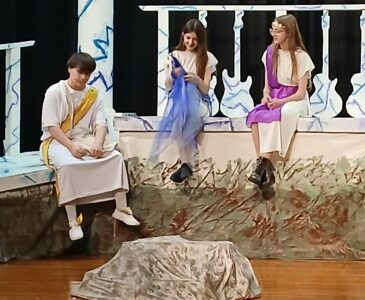
STEAM Studio Minot presents Greek mythology rock musical
Retirement’s Comic Relief: Kids do say darndest things
Art Linkletter hosted “House Party,” a program broadcast on CBS radio and television for 25 years, beginning in ...

Peace Garden offers free admission for seniors
Champagne and Ice Gala set for Feb. 14
Former National Football League player Gaelin Elmore will be guest speaker at the annual Champagne and Ice Gala of ...
Visit Minot announces community photo contest
Visit Minot has announced a photo contest to highlight everyday moments and places that shape the ...