
Opponents of housing project fail to sway council
Trending
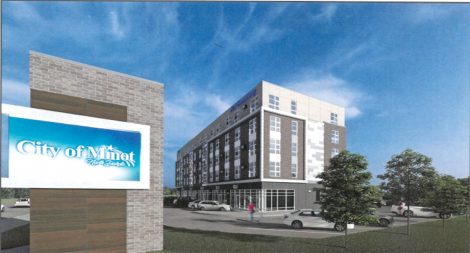
Over the objections of local property managers, the Minot City Council advanced a mixed-use project on South Broadway that proposes to provide low- to moderate-income housing with the help of city resilience dollars.
Known as Blu on Broadway, the 42-unit apartment project with main floor commercial space had gained the approval of the Minot Planning Commission for a Planned Unit Development. A PUD provides a regulatory process for a developer to meet certain land use goals without being strictly bound by existing zoning requirements.
What the city council described as flexibility, some in the community see as a relaxing of rules that others have had to meet.
Darwin Langseth, a property manager, opposed the project because of the density, which exceeds the density typically allowed in city ordinance. He reminded the council of a project he was involved in during 2011 that proposed 144 apartment units.
"We had to reduce it (by) three apartments because of density. That was all our own money, coming at a time when the vacancy rate was about zero. People were definitely looking for places to live. Yet it was OK to reduce our project," he said.
Doug Pfau, who has worked in property management, cautioned the council about approving a project with higher density and less parking than the usual requirements. According to the planning department, the 80 parking spaces are 15 fewer than would be allowed in a typical development.
"Why should this developer get a variance to these city ordinances?" he asked. "Just because these are federal dollars does not necessitate the spending of these unwisely."
Council member Josh Wolsky said no variances are involved, but rather the flexibility allowed under a PUD enables the public to get some things back in return.
"From a planning and development perspective, I think this is a good project," Wolsky said. "With regard to the concerns the public has brought forward in terms of density, in terms of the parking requirements, I view both of these particular issues as barriers in our current ordinance that increase the cost of development. They decrease the affordability of housing, and they reduce the returns to taxpayers on infrastructure investment. In other words, these current laws, these barriers, are reasons that our property taxes are higher than we want them to be."
Wolsky called for change to ordinances to reduce parking requirements and adjusting density requirements.
"I get that folks are unhappy that they have had to invest and spend more dollars on these types of developments in the past to provide parking or to meet certain density requirements, but from my perspective, I think I have identified that these are a part of our past that I would like to fix. So I don't want to let what is done in the past be a reason for not making a good step forward," Wolsky said.
Mayor Shaun Sipma said the goal should be developments that are mixed use and offer infill development and walkability.
"I look at this as a break from what I would like to call business as usual," he said. He indicated the project heads in the direction that industry leaders say is the path of the future.
Council member Paul Pitner, who cast the only vote against the proposed PUD, said he likes the proposal but has reservations related to traffic around the location, particularly with a proposed small, public park on the property.
The need for low- to moderate-income housing in Minot also came up for debate.
Pfau estimated about 1,000 vacant apartments exist in Minot, and of those, 85% to 90% qualify as affordable housing. The same percentage of occupied units also qualify as affordable, given the rapid decline in rents since October 2014, he said.
"The city is overbuilt on apartments, both low income and regular rent apartments," added Matt Watne, a property manager. "I would suggest that building additional apartments in Minot using taxpayers' money would just exasperate the problem of having too many apartments in Minot for the number of people to fill them."
John Zakian, the city's National Disaster Resilience Program manager, said about 260 people are on a waiting list for a federal housing voucher to get into existing apartments. They cannot get housing either because of the out-of-pocket cost not covered by the voucher or lack of voucher availability, he said. Only 19 additional vouchers were added last year, he said.
"That means we have a significant list of families that will be waiting a long time to be able to get this type of subsidy for their rent," Zakian said. Rents for projects such as Blu on Broadway are reduced and do not require vouchers.
Todd Berning, representing EPIC Companies, the developer of Blu on Broadway, argued the need for affordable housing is there. He noted another recent project aided by NDR funds, Park South Apartments, is 95% to 98% full with waiting lists for some units.
The city still needs to finalize a development agreement and approve any NDR funds for Blu on Broadway. The project could receive up to $4.75 million in resilience dollars.