Behavioral genetics research engages students at MSU
Trending
It is no secret that methamphetamine and other substance use is an epidemic that is sweeping the nation. Assistant professor Zeni Shabani of Minot State University and two of his students are looking at different genes that may cause certain individuals to become more susceptible to addiction.
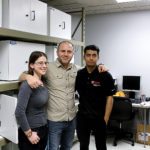
The students, Bikalpa Ghimire and Sydney Houlton, have been working with Shabani on studying the behavioral genetics of methamphetamine addiction. Their lab is working in conjunction with Tamara Phillip's lab in the Department of Behavioral Neuroscience and Methamphetamine Abuse Research Center at Oregon Health & Science University.
While the lab in Oregon has started looking at human genetics, the lab at MSU is working with mice to see how addiction affects them and how their genes play a role.
Shabani earned his doctorate from the Neurobiology and Behavior program at Georgia State University. His dissertation involved neuroethological questions about predator-prey interactions and chemical communication in spiny lobsters.
He then moved on to do post-doctoral research at Oregon Health & Science University, where they mainly focus on research related to addiction, which is what Shabani now focuses on. He shifted from the invertebrate (lobster) model to a mouse model. He kept his connections to Oregon when he brought the research to MSU.
Houlton, a graduate of MSU who was a psychology and biology double major, started working with Shabani in the fall of 2014, when the research started. In the fall, Houlton is moving on to the University of Iowa for its neuroscience program.
"We work with a very genetically specific set of mice," Houlton explained. "(They) have a predisposition to methamphetamine addiction."
At first, Houlton said they monitored the intake of the mice and set them up with a four bottle choice. In this, the mice were offered one bottle of water and three bottles of methamphetamine. This set up a binge intake behavior that was comparable to a human, she said.
"We've looked at withdrawal and depression," Houlton said.
Ghimire joined the team in the fall of 2015. Coming to Minot State from Nepal, he knew he wanted to be a biology and mathematics major and focus on neuroscience, which their research has allowed him to do.
"Learning in the classroom, someone else has already solved the problem," Ghimire said. "Here, we are trying to solve the problem."
The field of addiction studies is something Ghimire finds fascinating and hopes to continue to research post-grad.
"Normally when we see addiction we say, 'Hey, you are taking the drug. Why don't you stop taking the drug?'" Ghimire said. "Seeing that there might be genetic components affecting either you are getting rewarding effect or adverse effect to the drug is what we're trying to explore."
"The idea is to identify genes that make a person vulnerable to drug use; specifically we look for methamphetamine use," Shabani explained.
Shabani and his students are looking at different chromosomes, finding "druggable targets" to hopefully be able to develop a medication to help combat the rewarding effects of methamphetamine.
"The fact that it's a relapsing disorder ... that's the tragedy of this type of disease, and the goal is to find drugs that an individual can take and hopefully will abstain for good," he said.
Shabani said addiction research looks at the brain and the different circuits that control the want or the rewarding behavior for drugs.
"Drugs of abuse hijack our motivational circuits," Shabani explained. "Despite many, many, many negative consequences, a person is unable to control their want and they gear their want towards something completely artificial, like a drug of abuse."
The scientific process itself is what really keeps Shabani motivated in his research and helps keep his students involved. He enjoys designing experiments, testing hypotheses and generating knowledge that wasn't available before.
"This is our goal, that we can not only find what the genetic risk is in some individuals, but also develop a drug that can target it," Shabani said.
Shabani said the research they are conducting at Minot State will help Houlton and Ghimire understand that there is science behind the things they will go on to do and that there is always more to be developed and improved on. They are also understanding the logistics behind the research.
Currently, the team has isolated a gene found in mice that leads to a full-blown methamphetamine addiction. Oregon Health & Sciences University is currently using what was found at MSU to try and isolate a similar gene in humans.
"They are looking at the meth population, those that show up in rehabs and so on, and a control population to see whether there are some gene variances on this particular gene," Shabani said.
For the gene they are targeting, Shabani said, there are already drugs on the market to combat the addictiveness of the gene.
"In fact, we are doing a pharmacological manipulation with our mice and the drug works like a miracle," Shabani said. "It really curbs the drug use and that potentially could translate to humans. That's a very high possibility."