
Diversion plan seen as best option
Army Corps of Engineers identifies Maple Diversion plan as most cost effective for Minot flood protection

Jill Schramm/MDN Kevin Bluhm with the Corps of Engineers visits with Warren and Liz Hoppmann at a public meeting on flood protection Thursday.
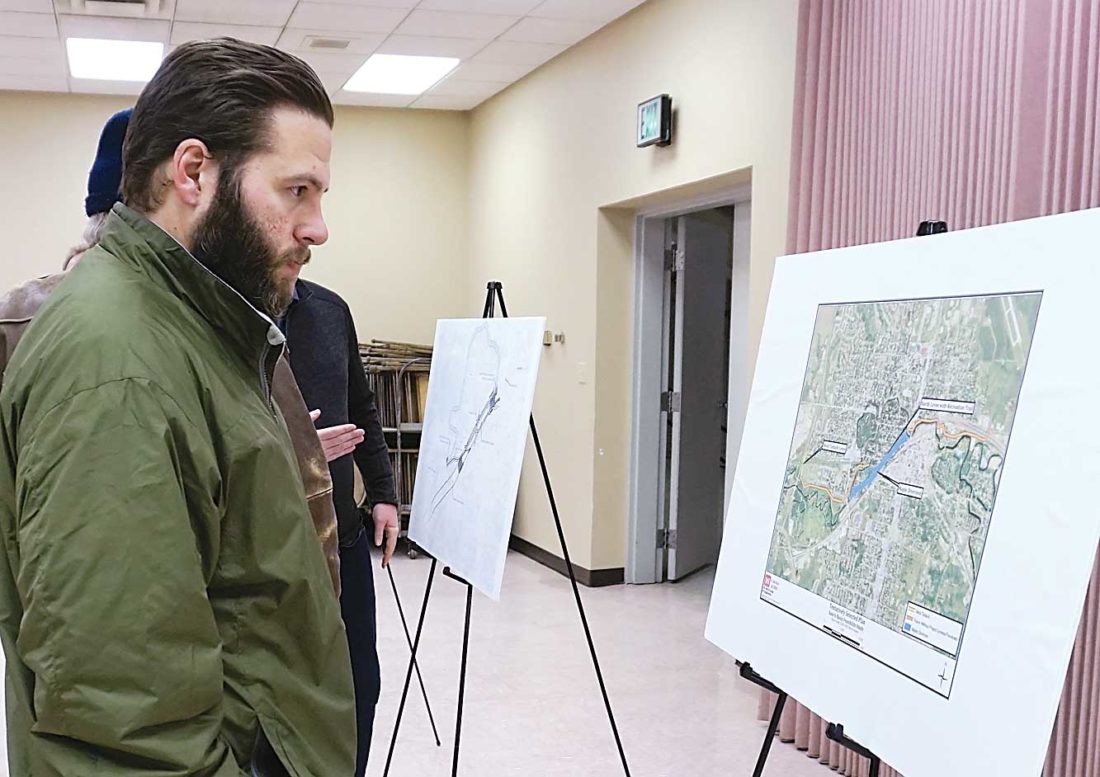
Submitted Photo Tom Filkins looks over a map on display at a public meeting Thursday held by the Corps of Engineers on the flood protection project.
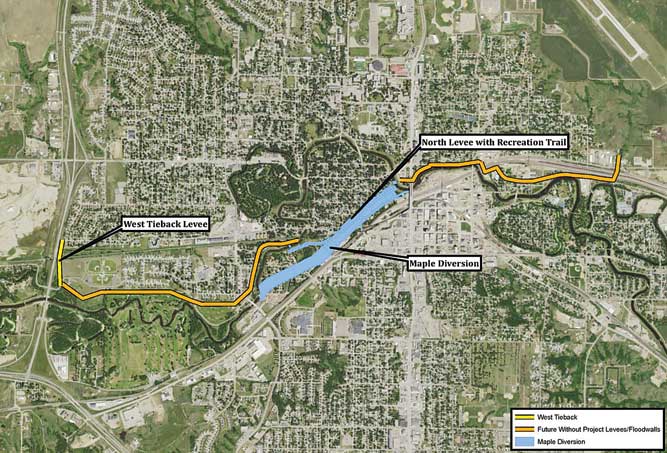
Submitted Photo A map shows the area of the Maple Diversion, north levee that begins just west of Broadway and west tieback near the U.S. Highway 83 Bypass.
Jill Schramm/MDN Kevin Bluhm with the Corps of Engineers visits with Warren and Liz Hoppmann at a public meeting on flood protection Thursday.
Submitted Photo Tom Filkins looks over a map on display at a public meeting Thursday held by the Corps of Engineers on the flood protection project.
Submitted Photo A map shows the area of the Maple Diversion, north levee that begins just west of Broadway and west tieback near the U.S. Highway 83 Bypass.
Trending
A diversion channel tying into a levee with a recreation trail appears to be the best plan for flood protection in west Minot, according to the U.S. Army Corps of Engineers.
The Corps held a public meeting in Minot Thursday to outline its rationale and take comments. The meeting is part of a $3 million feasibility study being conducted by the Corps on the Mouse River Enhanced Flood Protection Project to determine whether there is value in the federal government participating financially in the project.
The Corps' analysis for west Minot showed the best economic return for the federal government would be a plan that includes the proposed Maple Diversion. Federal interest also might exist in a north levee that runs east of the diversion, beginning just west of Broadway, and a west tieback levee near the U.S. Highway 83 Bypass. A recreation trail would exist on the north levee.
The Maple Diversion, a bypass structure to take water during times of high river flow, would be flanked by a levee on the north side. Two large gates would close when river flow exceeds 3,000 cfs, redirecting water into the diversion channel.
The economics of the approximate $71.5 million project came to around $1.46 of benefit for every $1 of cost.
"That's a pretty good investment," said Kevin Bluhm, chief of riverine economics at the Corps in St. Paul. "Is it the best investment in the world? Maybe not. There might be other needs in the nation that stack up higher and that's always the competing interest side of things."
Nathan Wallerstedt, Corps chief of project management, outlined the criteria looked at so far in determining the benefits of the project. Reduction of flood risk is an obvious benefit, but there also are benefits to the ecosystem, recreation, public safety and community resilience.
Wallerstedt said it is reasonable to assume flood control would exist if the Corps did nothing because Minot and the Souris River Joint Board were moving forward with construction. However, full funding is not guaranteed, so that played into assumptions, he said.
The Corps considered other alternatives for flood protection, ruling them out as not economically justified in most cases.
"We believe the Maple Diversion concept, or something like this, is going to be the most cost effective way to fill the gap or complete the system," Wallerstedt said.
The public review period on the "tentatively selected plan" will end Nov. 30. Comments concerning the proposed project can be submitted to David Potter, Corps biologist, by calling 651-290-5713, via email at david.f.potter@usace.army.mil, or by mail at U.S. Army Corps of Engineers, Attention: Regional Planning and Environment Division North, 180 Fifth St. E., Suite 700, St. Paul, MN 55101-1678.
Written comments will become part of the study's public record and be used in the study's environmental review document. Therefore commenters should exercise care before submitting personal information with their comments.
The Corps hopes to hold a public review of a completed feasibility report in the fall of 2018 and submit the report to Congress in the spring of 2019.