
Minot poised to re-examine economic development efforts
Minot to consider future of MAGIC Fund, direction of MADC in proposed review of economic development
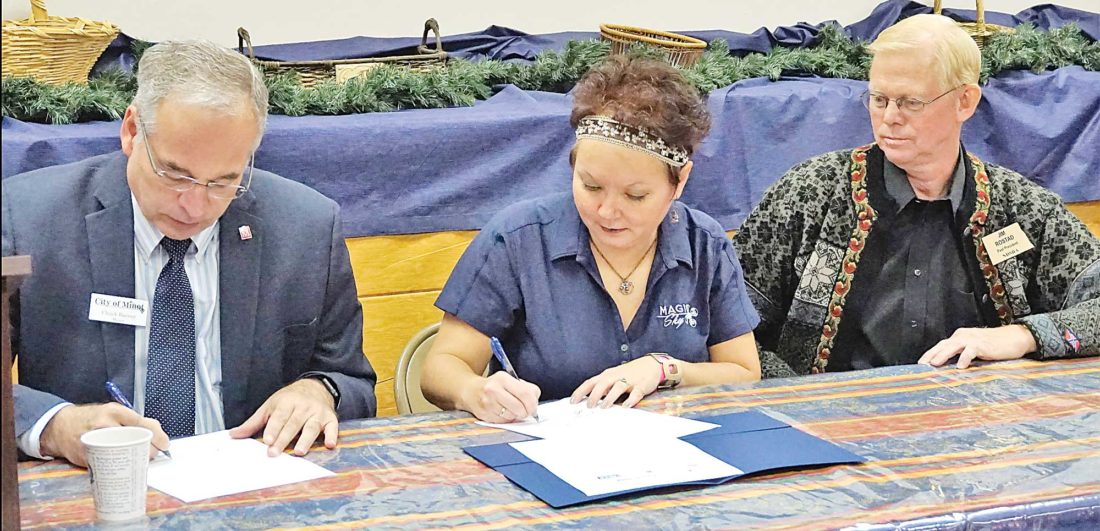
Jill Schramm/MDN Mayor Chuck Barney and MADC President Stephanie Hoffart sign Minot’s Sister City documents with Skien, Norway, during an event at Norsk Hostfest Sept. 26. Watching at right is Jim Rostad, MADC’s first vice chairman.

Jill Schramm/MDN Drones are on display as Matt Dunlevy, president and founder of SkySkopes, speaks at a news conference announcing the company will be opening an office in Minot in December 2016.

Jill Schramm/MDN AGT Foods anchors the value-added agricultural park, where MADC will soon be making more properties available with the completion of additional rail line.
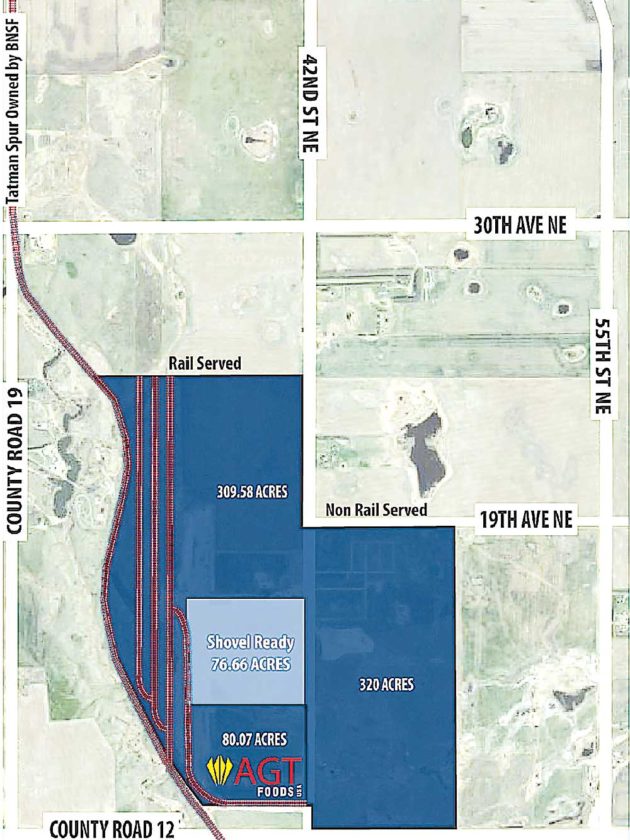
A map shows the location and features of the value-added agricultural park in east Minot.
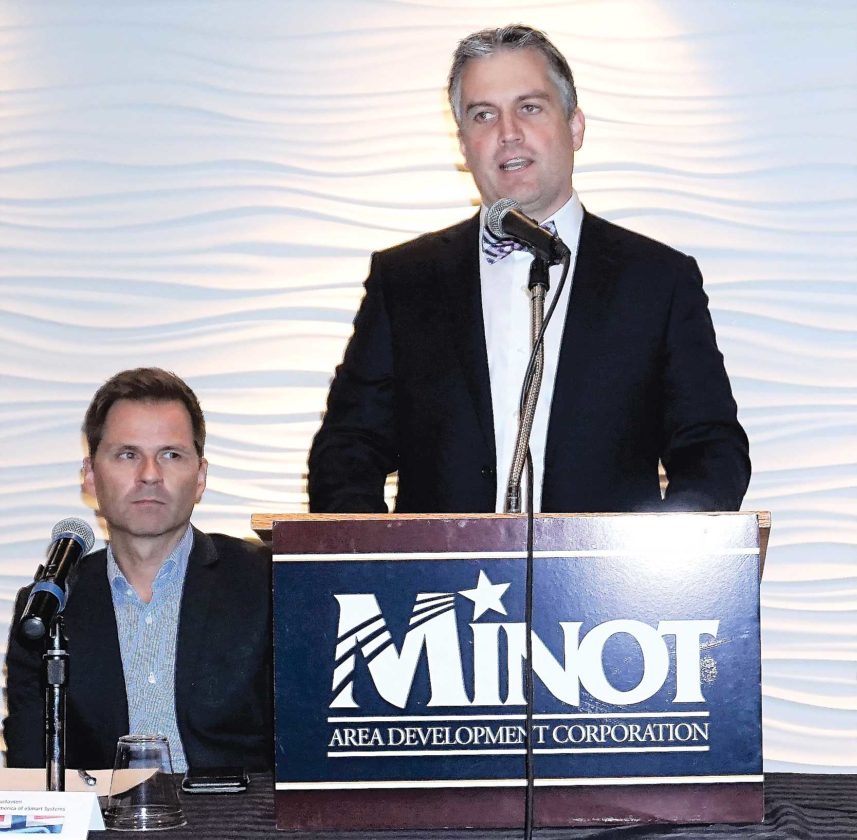
Bjorn Forsdal with Robot Aviation speaks at Minot Area Development Corp.’s Business to Business Seminar Sept. 26, as Knut Gustavsen with eSmart Systems listens at left. Drone systems has become a targeted industry for MADC.
Jill Schramm/MDN Mayor Chuck Barney and MADC President Stephanie Hoffart sign Minot’s Sister City documents with Skien, Norway, during an event at Norsk Hostfest Sept. 26. Watching at right is Jim Rostad, MADC’s first vice chairman.
Jill Schramm/MDN Drones are on display as Matt Dunlevy, president and founder of SkySkopes, speaks at a news conference announcing the company will be opening an office in Minot in December 2016.
Jill Schramm/MDN AGT Foods anchors the value-added agricultural park, where MADC will soon be making more properties available with the completion of additional rail line.
A map shows the location and features of the value-added agricultural park in east Minot.
Bjorn Forsdal with Robot Aviation speaks at Minot Area Development Corp.’s Business to Business Seminar Sept. 26, as Knut Gustavsen with eSmart Systems listens at left. Drone systems has become a targeted industry for MADC.
Trending
The ups and downs of Minot's commodity-driven economy can create challenges in economic development. With the latest fluctuations in the oil and agriculture industries, city leaders see merit in re-examining Minot's economic development strategies and use of a long-time incentive fund.
"I think it's about time to take a look at the way we have been conducting economic development to see if there's new methods that can be debated, if our old methods are as effective as we want them to be," said Josh Wolsky, Minot City Council member.
During budget meetings this fall, the council indicated an interest in taking another look at economic development. Wolsky said he expects the council to take up the subject in November and likely appoint a review committee. A primary topic of discussion would be the MAGIC Fund.
For 2018, the council agreed to divert to flood protection the estimated $822,968 in sales tax expected to be collected for the MAGIC Fund, which currently holds about $7.6 million.
Founded in 1990, the MAGIC Fund granted and loaned money to many businesses over the years. The fund more recently has lent money to the city's economic development arm, Minot Area Development Corp., to build infrastructure to attract industry.
Keeping the MAGIC Fund is important to remaining competitive in business recruitment, said MADC President Stephanie Hoffart. Even though a company might not need incentives to financially make a move to a community, those incentives can influence decisions, she said. The ability of the local community to provide matching funds also determines where state economic development dollars go, which impacts companies' location decisions.
However, Hoffart said economic development isn't just about incentives.
"It's one of the tools in the toolbox. It isn't the only thing," she said. Nor is MADC objecting to the one-year diversion of MAGIC Fund collections to flood protection.
"We know that there are a lot of priorities within our city, and flood protection is a big priority," Hoffart said. "I don't want to negate that. I understand that."
But she added Minot can't afford to shift its focus entirely away from economic development.
"The only way we are going to help this sales tax to go up is finding more businesses. I don't think we can expect people to just spend more," Hoffart said.
Mayor Chuck Barney said the city needs to look at how and where money is being spent on economic development. That look needs to be broader than the new strategic plan prepared by MADC last year, he said. He prefers a committee arrive at a plan following public input. Eliminating funding for economic development efforts isn't an option, though, he said.
"Whatever industries we get in Minot, we really have to fight hard to get. That's why I feel organizations like MADC are critical to the long-term health of the community from an economic point of view," Barney said.
Although sales tax won't be going into the MAGIC Fund next year, MADC is budgeted to receive $365,000 from the tax to support its efforts. Ward County also has budgeted $58,000 for MADC.
Between $150,000 and $180,000 of MADC's budget comes from private investors, Hoffart said. MADC has about 175 members. Businesses can invest at any of seven tiers, with annual membership fees beginning at $250 a year and increasing to $5,000 or more a year.
Hoffart said MADC adopted the new membership structure post-boom to give businesses more options for participating at whatever level is most affordable. Promotional benefits increase with the higher tiered memberships, but all investors have access to MADC's logo, are listed among MADC's recommended companies and receive recognition in newsletters and annual reports.
"We remind them you are not just investing in MADC. You are investing in our community. You are investing in Minot," Hoffart said. "By finding new primary sector businesses, that brings in new wealth. Everybody is going to see a benefit in it."
Minot's economic development efforts and use of the MAGIC Fund have changed since the 1990s. In earlier days, the economy was such that communities were open to any jobs that could fill a void, regardless of the staying power of those jobs, Hoffart said. Call center jobs were among those that fit that bill.
Minot's strengthened economy has enabled the community to be more selective and to target industries that offer the most promise, Hoffart said. Part of that effort has been to invest MAGIC Fund money in infrastructure, such as the value-added agricultural park and energy park.
"If that business moves on, that infrastructure can stay. It's not giving cash out the door," Hoffart said.
MADC recouped the investment into the energy park by selling developed lots to energy companies and returning the money to the MAGIC Fund. With the slowdown in the oil field, some of those companies have scaled back or ceased active operations, but they continue to hold on to the properties, Hoffart said.
The value-added agricultural park is anchored by AGT Food and Ingredients, which initiated a $30 million expansion last year.
Hoffart said MADC postponed recruitment to the ag park while completing rail infrastructure. With that work wrapping up this month, MADC expects to have shovel-ready property to market to companies.
Hoffart said MADC invested nearly $10 million in the park and is anxious to turn it into a benefit to the community. She said quite a few companies have shown interest.
"Everybody in this past six months has had a little bit more optimistic view about expanding their businesses, so they are asking lots of questions. I have had good conversations with developers who are looking at the future," she said.
Hoffart herself is optimistic there will be enough interest to eventually warrant more acreage and additional infrastructure construction in the ag park. Currently, MADC owns the rail lines, but its goal is to eventually sell to another operator. The original plan for the Port of North Dakota to own and operate the rail lines isn't a given because of financial issues facing operator ND Port Services. Hoffart said the intermodal facility is an asset, although not a deal-breaker in recruiting companies.
MADC also has turned its attention to the unmanned aviation industry, recruiting SkySkopes and launching its Magic Sky Initiative last year. The MAGIC Fund invested in SkySkopes via a $375,100 forgivable equipment loan.
Hoffart said MADC had visited with the state Commerce Department about the opportunities available in unmanned aerial systems to determine whether to pursue a piece of the action that Grand Forks was seeing.
"We will never be Grand Forks and that's OK. But why can't we be the number two city in North Dakota that does UAS operations?" Hoffart said.
MADC invited SkySkopes to Minot and successfully sold the Grand Forks company on a satellite office after company officials saw how much easier it would be to access oil field clients and additional utility customers.
MADC has courted Scandinavian UAS companies as well. Hoffart said the goal is to land a drone manufacturer looking to establish itself in the U.S. market.
Value-added ag, energy, unmanned aircraft systems and distribution - with two Class 1 railroads and three U.S. highways - are MADC's targeted industries.
In 2016, MADC implemented a new strategic plan with a revised mission and vision. MADC developed a new website and set a goal to touch 50 businesses a year for possible business expansion and pursue five qualified businesses a year. The Business Expansion and Retention program was rehabilitated and a "Team Minot" created to coordinate the efforts of tourism, business and government groups and fill gaps in the community.
Minot saw growth from the oil boom, but overall, MADC's ability to recruit in its targeted industries was hampered because of the low unemployment rate and high cost of living, said Jim Montgomery, MADC board chairman. With a return to a more normal economy, MADC will be able to resume recruitment and once again make use of the MAGIC Fund, he said.
"Our purpose is primary sector jobs," Montgomery said. "A lot of people get confused and think we should be looking at secondary jobs." He said a committee examination of MADC's efforts could be beneficial in clearing up that confusion.
"Part of what that will do is educate the general public on what our mission is and what economic development is all about," he said.