
Walking provides great start toward fitness
Trending
Seniors seeking an uncomplicated way to improve their fitness should slip on their sneakers and walk.
"The greatest advantage of walking over other types of exercise is the majority of people are able to do it, and it's a great way to get started, especially if you have not been exercising on a regular basis," said Russell Gust, Trinity Health exercise physiology manager at the Minot Family YMCA.
Gust said the word exercise might seem intimidating to beginners, but the emphasis really is on activity and simply moving.
"Walking is a good start because everyone knows how to walk. You don't have to be taught," he said. "You can adjust the intensity yourself. You can adjust your speed. You can adjust your incline. You can adjust your duration. You can do it anywhere."
Gust said walking doesn't necessarily require stretching before or after, but like any new exercise, people should work up to their goals, starting slowly and building up as their endurance increases. Follow your body's cues on what is appropriate.
Minot walkers can attest to the benefits of getting moving.
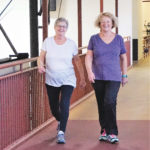
About three years ago, Sandy Drevecky began experiencing back problems that discouraged her from engaging in regular activity. To avoid surgery, and at the urging of her daughter, who is a physical therapist, she took up walking and saw her back problems reduced by 70 percent, she said.
She now engages in regular walking of two or more miles five days a week, using the Minot Family YMCA facilities for much of the year. She also participates in Pilates and has been a long-time user of the Curves program.
A former employee at Minot State University, Rosie Winczewski took advantage of the MSU Dome or walked outside regularly for many years. Now she often walks at the YMCA, aiming for three miles four days a week.
"It's really good mentally. It's relaxing for me," Winczewski said.
Walking also boosts her endurance and helps keep her limber. When people are inactive, especially seniors, they can lose mobility, she said.
For Winczewski, having a walking partner is important because it provides a social outlet.
"It's got to be fun," she said of exercise.
Gust said the social aspect of walking is especially good for seniors. Social contact can be an advantage to joining a fitness center, although the fresh air associated with walking outdoors is also encouraged at least part of the time. Even in the winter, people can walk outdoors if they remain aware of the conditions and dress appropriately. Cleats for shoes can be purchased inexpensively for winter use, Gust said.
Trinity Podiatrist Tyson Williams stresses the importance of sturdy, supportive shoes designed for walking or running. Toenail issues, corns and bunions often are the result of wearing the wrong shoes, he said.
The best time of day to go shoe shopping is whenever the feet naturally swell a bit, typically near the end of the day, he said. When sizing shoes, there should be a thumb's width between the end of the shoe and toes. Shoes don't need "breaking in," Williams added. The shoes should feel good in the store or it will be one's feet that end up being broken in, he said.
Shoes should be replaced as often as every six months, depending on use. Even if they appear to be in good shape, the cushioning becomes reduced and the shoe no longer provides the needed protection, Williams said. Shoes don't need to be the most expensive to provide the right support, and people should shop around for the best fit because everyone's feet are different, he said.
Whether orthodic arch support, heel or insole inserts that provide more cushion are necessary will vary by individual, Williams said. People tend to lose natural cushioning in their feet as they age, making cushioning products sometimes useful for seniors, he said.
"When they start to notice aches and pains, a lot of seniors will say that's just normal. We have to get in the mindset of saying, 'No, that's not normal.' That pain is probably telling us something is wrong," Williams said.
Arthritis can be a potential culprit.
"Arthritis is pretty common in the foot," Williams said. "It comes on slowly."
Arthritis can be detected with an X-ray, and often can be treated with topical medicines or prescription or nonprescription anti-inflammatories. In more severe cases, cortisone shots can be given. In other cases, surgery might be the best solution. Joint replacement in the ankle, big toe or smaller joints in the foot is one option. Fusing joints is another.
Another cause of pain in the feet is collapsed arches, Williams said. This places strain on the tendons and ligaments. Collapsed arches might require surgery.
Shoes with support soles can help prevent problems, but there also are over-the-counter arch supports that can be used, Williams said. If the over-the-counter products don't work as well as hoped, custom supports can be created.
Tendonitis, resulting from overuse, or plantar fasciitis, an inflammation of the ligaments of the arch or heel, are common ailments that require rest and often lead to a temporary suspension of walking programs. A regimen of anti-inflammatories and icing can help.
Walking on the wrong surface - such as certain grassy or hilly terrain - can contribute to tendonitis, Williams said.
"Try not to do hills," he said. "It really puts added strain on certain muscles. A regular predictable, flat surface is best."
People with diabetes may have special foot issues, requiring the use of extra cushioning, diabetic socks or even special shoes. Some people with diabetes have circulation or numbness issues that can lead to foot problems or affect the ability to detect warning signs, so they should visit with their doctors, Williams said.
If feet become sore after walking, they can be iced, but feet should never be iced before a walk, Williams said. Nor should foot soreness be ignored. Redness, swelling or bruising are warning signs that should be investigated and might warrant a trip to a medical provider, he said.
Podiatrists can work with a patient's primary provider and physical therapists to address pain that can derail a walking program.
"We enjoy helping people get back on their feet," Williams said. "We can usually help people understand and overcome whatever it is that's limiting their physical exercise."
When exercised wisely, walking can be a lifetime activity.
Fred Gruenberg of Minot, who turns 96 this month, has been a frequent walker at Dakota Square Mall, although he has had to shorten his route as he's aged. He suffers from leg problems going back to his time in the service during World War II.
"I am a little handicapped, but I still try to keep going," said Gruenberg, who credits walking for playing a role in his longevity. His advice to other seniors thinking about taking up walking: "Don't hesitate. Do it."