
Rain, snowfall make ‘a big difference’ for Pierce County farmers, ranchers
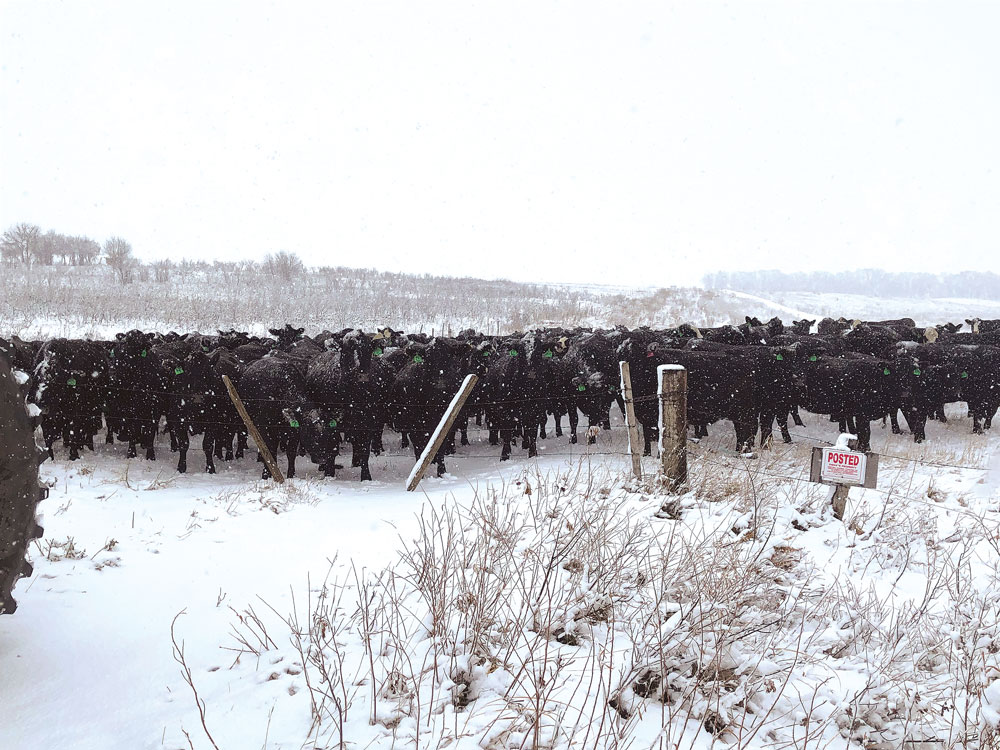
Submitted Photo Cattle move toward shelter in the snow on the Virgil Scherr Ranch near the Pierce County town of Orrin.
One year can make a big difference in the world of agriculture. Farmers and ranchers in Pierce County hope the 2022 growing season makes a very big difference for them by bringing relief from exceptional drought conditions they saw in 2021.
Heavier than normal snowfall in North Dakota reported by the National Weather Service has given Pierce County farmers and ranchers reason for optimism.
A Feb. 7 report from the NWS said, “Drought conditions have improved across much of the state. Drought has been completely removed in parts of the James River Valley and eastern North Dakota.” A precipitation graph in the report showed Pierce County received between 150% and 200% of normal rain and snowfall between Oct. 1, 2021, and Feb. 6.
Brenden Klebe of the North Dakota State University Extension Office for Pierce County said he’s been monitoring the weather developments closely.
“I’m not going to say that’s a total sigh of relief, but it’s a big difference,” Klebe said of the increase in precipitation for fall and winter over the previous year. “Last year, we were in the worst of the worst of the drought. And we’ve seen that with our crops. Even in springtime, farmers couldn’t get their crops growing at all. And the ones that did come up were all over the place.
“With this moisture we have now, we can at least start getting back to our even crop,” Klebe said. “That’s the biggest part when it comes to yield sometimes, just to have evenness out there. So, really, it’s going to be a huge boost this spring – a total 180 from last year, I’d say.”
The Feb. 7 NWS report bumped Pierce County and Central North Dakota up from its exceptional drought category to “abnormally dry.” The report added drought would persist in the western part of the state, especially in Divide and Williams counties. Climate prediction maps from the NWS forecasted wetter than normal conditions for the rest of February and an equal chance of precipitation or dry conditions in February, March, and April.
Klebe said the possible precipitation increase wouldn’t mean farmers and ranchers could expect flooding on their land; however, he advised growers to “be patient” as they managed the change.
“I know we’re going to be wetter this spring, but I don’t see it as problematic,” Klebe said. “I think it’s going to come down to being patient and letting the soils warm up. The last few years, we’ve had such an early start (to the growing season) because of the lack of moisture. Now, we’re going to be getting a later start to it. Let the soil warm up and get a good seed bed going and do the right preparation to let the moisture move where it needs to move.
“The biggest thing is not to be working soil bone dry,” Klebe added. “In Pierce County, a lot of people are on the no-till side of things. But the biggest thing is, if you need to be doing some culturing or some minimal till things, all of that helps getting your seed bed ready.
“I have no problem with minimal till, but you don’t want to go full-on till when the soil is wet,” Klebe said.
Some early snowmelt in February wouldn’t cause a problem either, according to Klebe.
“Not from what I’ve seen,” Klebe said. “I talked to quite a few guys who see that the snow is now in some of the tree rows and some of the lower areas. They’ve been worked up the last few years and haven’t been seeded in 20 years, darned near. If the moisture’s back there again, we’re going to be back to our normal planting acres instead of those sloughs we were able to go through last year. *
“I was just in Harvey this weekend and driving back up, you can already see some bald spots where the snow’s already gone again,” Klebe added. “If that’s any indication, I think the moisture’s going to be sucked up into the ground very fast.”
Klebe said ranchers would find relief in spring, too.
“Luckily, this fall, we got that moisture to give our grasses a little bit of a boost before our freeze-up,” Klebe said. “That’s the biggest thing, talking with our grazing experts. It’s knowing how much you graze that pasture. Now that we’ve had this moisture and if you were able to get your cattle off your pasture last fall, you’re going to have much better pastures coming into this spring.”
Klebe added, “With fall moisture combined with this snow, if you were conservative with your pastures, you’re going to reap the rewards this spring.
“I heard stories (in 2021) about people who had to go all over the place for hay,” Klebe added. “And now, it’s looking like a lot of these cool season grasses are going to get an opportunity to get growing. Last year, we pretty much didn’t get any of those grasses because we were so dried out come spring last year. I think the moisture this year is going to make a huge difference.
“At least for the beginning, I’m going to be a lot more optimistic for this year, with what I’ve seen with the moisture and our fall moisture,” Klebe said, looking ahead to spring 2022. “For the first quarter of the year, I’d say there’s a lot better outlook, at least at this time.”