
Elections top Ward County highlights
Trending
An out-of-the-ordinary election process and some significant ballot items spurred record voter turnouts in Ward County in 2020.
Ward County voters decided overwhelming to discontinue participation in a weather modification program that had existed for around 50 years. They voted to extend a 0.5% sales tax, and they also chose three county commissioners, replacing one incumbent with a newcomer.
Conducting elections that saw record turnouts and large numbers of absentee ballots put county election workers to the test.
The June primary consisted entirely of mail/absentee ballots. Although her office was hectic as staff sought to manage the election with new election equipment, Ward County Auditor Devra Smestad was satisfied with the way things went and said the casting of 12,919 ballots indicated that voting by mail was effective.
For the general election, the county opened five vote centers, allowing any county resident to vote at any center, while offering early voting and continuing the option for absentee voting.
Jill Schramm/MDN
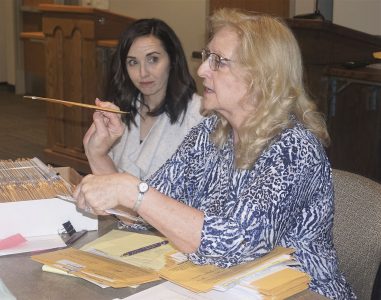
Devra Smestad, right, who retired as Ward County Auditor Aug. 31, picks up a ballot for examination at the election canvassing board meeting June 15 while looking on is Marisa Haman, left, Ward County's new county auditor.
Ward County saw 28,389 ballots cast in the general election, or 54% of eligible voters. The numbers included 13,406 absentee ballots and 8,318 early voters.
Ward County also saw a change in its county auditor and chief election official when Devra Smestad retired Aug. 31 after 16 years. Deputy auditor Marisa Haman began training in June to take over the position after selected by the commission to replace Smestad. Haman came to work in the Auditor/Treasurer's Office as a property tax clerk in September 2012. She became deputy auditor in October 2013.
Howard "Bucky" Anderson joined the county commission in December after voters selected him to replace Alan Walter, who had served since 2012. Walter and Anderson were among five candidates seeking three commission seats. Commissioners Jim Rostad and Shelly Weppler also were re-elected.
Anderson was an educator for 39 years, the last 24 years at Minot's Central Campus. He also has farmed and ranched in Ward and Burke counties since 1980 and has served on various local boards.
The decision by voters to direct the commission to discontinue county participation in weather modification came about in June on a vote of 1,891 in support of the program to 10,908 against. The county's contract with the Atmospheric Resource Board expired in March. The intensity and diversity of public opinion surrounding cloud seeding led the county commission to put the matter on the ballot rather than authorize another five-year contract.
Proponents and opponents had disagreed on the program's effectiveness and cost. Friends of Weather Modification sought to get voter support while North Dakotans Against Weather Modification encouraged voters to reject it.
The county commission had been restricting funding for cloud seeding in recent years, appropriating $112,360 in 2019. The Ward County Weather Modification Board had requested $225,000 for 2020.
County residents also agreed to extend the sales tax another 20 years, with 68% of voters supporting the June election measure. Ward County commissioners placed the proposed extension on the ballot because the existing sales tax would have fallen short in paying off bonds on the buildings for which the tax was originally imposed in 2012. The tax was to sunset at the end of 2022.
The county budgeted property tax revenue to augment sales taxes to pay the building bonds in 2020. Without a sales tax extension, Ward County would have needed to leverage more than $17 million from property taxes to pay off bonds, according to county figures. The pre-existing sales tax also has provided only $3 million of the $10 million promised for county road improvements and maintenance, and it would not have been able to provide the additional $7 million without an extension.
Once pre-existing obligations are paid, the county plans to use continued tax collections for roads and bridges to ensure the capacity to handle larger and heavier equipment used in agriculture and other industries.
A bargain on former oil company property also led the Ward County Highway Department to relocate to new headquarters in 2020. The Ward County Commission gave final approval in July to the $1.75 million purchase of former Halliburton property in east Minot. Highway staff began the move-in process in November.
In keeping with legislative action in 2019 to have the state absorb county social services, Ward County officially established a human service zone in 2020 to replace the former social service office. A number of counties combined their former social service offices to form zones, while the state's four largest counties established single-county zones. Ward County appointed a new human service board that consists of the five commissioners, a legislator and an at-large member.