
Improvement associations promote agriculture
County associations serve varied functions
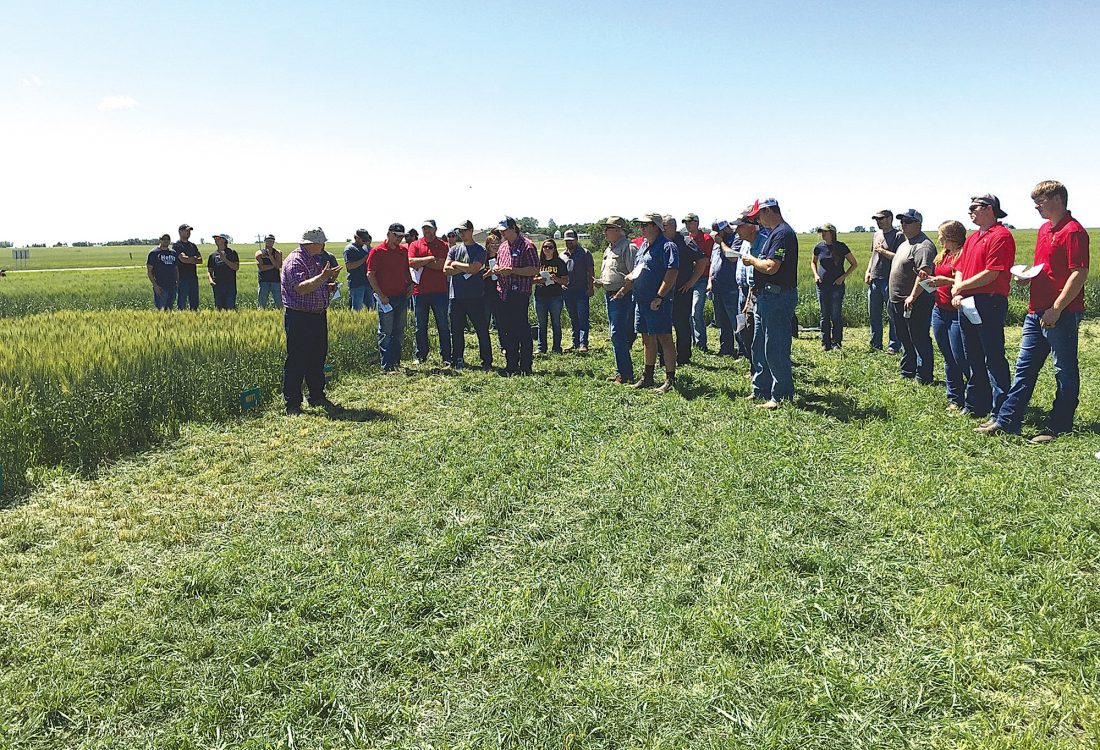
Submitted Photo A crop tour sponsored by the Renville County Agricultural Improvement Association drew farmers interested in production information.
Set up to create an avenue for increasing new seed varieties, agricultural improvement associations across North Dakota have looked beyond that mission to promote agriculture in various ways.
For instance, Divide County’s association has supported four new North Dakota Agricultural Weather Network (NDAWN) stations.
Scott Sova, Noonan, one of seven members of the Divide County board, said fundraising $25,000 from businesses and farms for NDAWN was a major project and an important one. The stations provide rainfall, temperature inversions and other weather data that NDSU uses in its disease forecasting models.
“Farmers can decide whether they need to make application and what to scout for,” Sova said. “Some of those applications can be pretty costly so this gives a guy information on whether he should be doing it and what the risk level is.”
In Renville County, the association sponsors an annual ag show that has seen an increasing number of vendor booths and attendees. About 100 people attended this past year’s event, which featured 43 booths and a program on crop insurance.
Matt Peterson, Antler, a past president of the Renville association, said the events have been both educational and enjoyable.
“There’s always something new out there, and it’s a good time to get together with friends you haven’t seen for a while,” he said. The shows have had a broad scope to capture the interest of the community, with home and energy programming as well as the agriculture programming, he said.
Peterson, who served more than 10 years on the county’s nine-person board, said he also found value in working with the other directors and learning from the knowledge they brought to the table.
Every county has an ag improvement association, although the governance and the activities might look somewhat different with each association. Annual dues to join the associations are minimal, typically from $3 to $15 a year. Income to support the groups’ activities largely comes from a checkoff from sales of new seed varieties in the seed increase program conducted through the associations by North Dakota State University.
The seed program is an enormous benefit to producers, said Josh Cook, a Renville County Ag Improvement board member from Kenmare.
“I do see the ag board as being a strong player in the seed game, to bring the right seed to market, bringing affordable seed to market,” he said. As a seed increase grower, he was able to obtain soybean seed for this year through participating in the program.
“For me personally, that’s going to cut my seed cost to a fifth of what it was before,” he said. “With the price of soybeans, I couldn’t do it buying new seed. Being able to put my own seed back in the ground, it makes it doable and it actually pencils out on the profitable side.”
The ag improvement associations are coordinated through county Extension Service offices. County agents serve as board secretaries.
Renville County Ag Agent LoAyne Voigt said the association board helps guide many of her decisions about what types of programs Extension should bring into the county.
“I rely a lot on my local ag improvement board,” she said. “They’re kind of my go-to when I have questions on ‘Is this something we should be addressing?'”
The Renville association meets several times a year and in addition to the ag show every winter, it often hosts a crop tour and a banquet. Over the years, it has hosted programs such as exotic animal tours, feeder calf show, shop tours and an appreciation breakfast. Board members serve three-year terms but the number of terms is limited to discourage burnout and encourage new blood.
“We try to keep it a very active board,” Voigt said. “They get to meet producers across the county, and they seem to really enjoy it socially.”
She added the association has earned a solid reputation with producers because of its accomplishments.
“Just simply because we’ve been so strong over the years, the producers will look to the improvement association for leadership at different times,” Voigt said. “We were struggling once with varieties and trying to get information out there. We noticed, even though we’re only 50 miles away from Minot, that some of our variety development seemed to be kind of different than what they were seeing at the experiment station just south of Minot. So our group worked together, and we developed local funding to support a variety (plot) here, just outside of Mohall, and that’s been going now for 18 years. But that was the grassroots through the ag improvement that saw the need for it.”
The Ward County Ag Improvement Association will be holding its second Dinner on the Prairie this year. The dinner enables members of the public who don’t have a connection to agriculture to meet farmers and ranchers and learn about their food supply, said Ward County Ag Agent Paige Brummund.
The association also holds an annual meeting that features a speaker. In the past, the association has sponsored bus tours and shop tours. Like many associations, it has supported programs of other groups that seek to promote farm improvement, particularly programs of the Extension Service.
The Ward County association gives a scholarship to a student pursuing a career in agriculture and provides grants to youth programs that teach about agriculture. The Ward County group also has donated toward development of the North Central Research Extension Center seed plant.
Membership in the association allows for participation at the annual meeting and information on the latest lists of seed varieties available for distribution. Ward County has a 15-member ag improvement board. Seven districts each select two members, with one member elected at large. All terms are two years, with a maximum of three terms.
Bottineau County’s association has sponsored farm-related or Extension programs and provides a $500 scholarship to a youth from a member family interested in a career in agriculture.
Bottineau Extension Agent Sara Clemens said the group is looking to get more active in hosting activities, such as farmer appreciation events being planned for this summer. The association also offers a program in conjunction with its annual meeting, which brings people together for issue-based discussions and for socialization.
The association board consists of 10 members elected to three-year terms. Members receive an Ag Alert newsletter about topics of agricultural interest once or twice a month.
McLean County has a nine-member improvement association board, of which one member is an agri-business industry representative, such as a grain elevator representative, who serves a one-year term. Other members serve four-year terms.
McLean County Agent Calla Edwards said the board meets about twice a year to consider sponsorship of events and activities. Many of those activities involve bringing Extension programs to the county.
Like other associations, seed distribution is the primary income source, but the McLean group also had received memorial money, which the board donated to construction of the seed cleaning plant at NCREC at Minot.
Pierce County Ag Improvement holds an annual meeting and an annual plot tour. One of its members hosts an off-station plot for NCREC.
The group also has supported a NDAWN station and expects to contribute to maintain a new station being constructed. It supports Extension programs and meetings as well as 4-H Achievement Days.
The board’s 10 members include herself as secretary, Pierce County Agent Yolanda Schmidt said. Other board members are elected to three-year terms.
McHenry County Ag Improvement Association is governed by a 10-member board, elected to three-year terms with a two-term limit. County members pay nominal dues for a lifetime membership.
McHenry County Ag Agent Rachel Wald said in addition to the seed increase program, the association conducts an educational program in connection with its annual meeting.
“We try to get as much education into that as we can,” she said. This past year, the focus was on marketing. The meetings also have addressed disease and weed issues and offered producer panels to discuss issues local producers have worked through. The goal is to get the community working together to make agriculture better in the county, Wald said.
Because of time constraints on producers, the association has only been moderately active, but it sponsors Extension events, has supported a soybean plot demonstration and gives two student scholarships.
Wells County Better Seed and Grain sponsors a 4-H contest each year, conducts a summer crop tour and holds a grain show at the annual meeting, known as the Winter Show. The December 2019 Winter Show was the 81st year for the show, which features various speakers on topics relevant to area agriculture.
The group sponsors a farm safety day for school children in grades three through six every other year. Funds also go each year to promote other local agriculture-related activities, said Wells County Ag Agent Lindsay Maddock. The group donated toward the new seed plant at the NDSU research center in Carrington.
There is no formal membership but any Wells County producer can participate in the annual meeting. Better Seed and Grain is governed by a nine-member board, elected to three-year terms.
Dan Folske, Burke County Extension agent, said his county’s association has been less active during the past several years but is looking to get more involved again. The association is reviewing its bylaws for changes that might encourage more involvement. For instance, the bylaws currently call for six members, elected from districts to two-year terms. Folske said consideration is being given to making all the positions at-large.
Currently, the association helps sponsor programs and promote activities in line with its mission.
“Soil health is one of the big topics right now,” Folske said.
In Divide County, a primary activity is hosting the annual ag show that features speakers on issues related to the past crop season and marketing for the future. The meetings draw 50 to 60 people, Sova said.
“It’s definitely important,” Sova said of the meetings. “It fosters a lot of discussion among producers about what someone might try or has tried and what has worked and maybe failed.”