
Extension offers opportunities for ag women
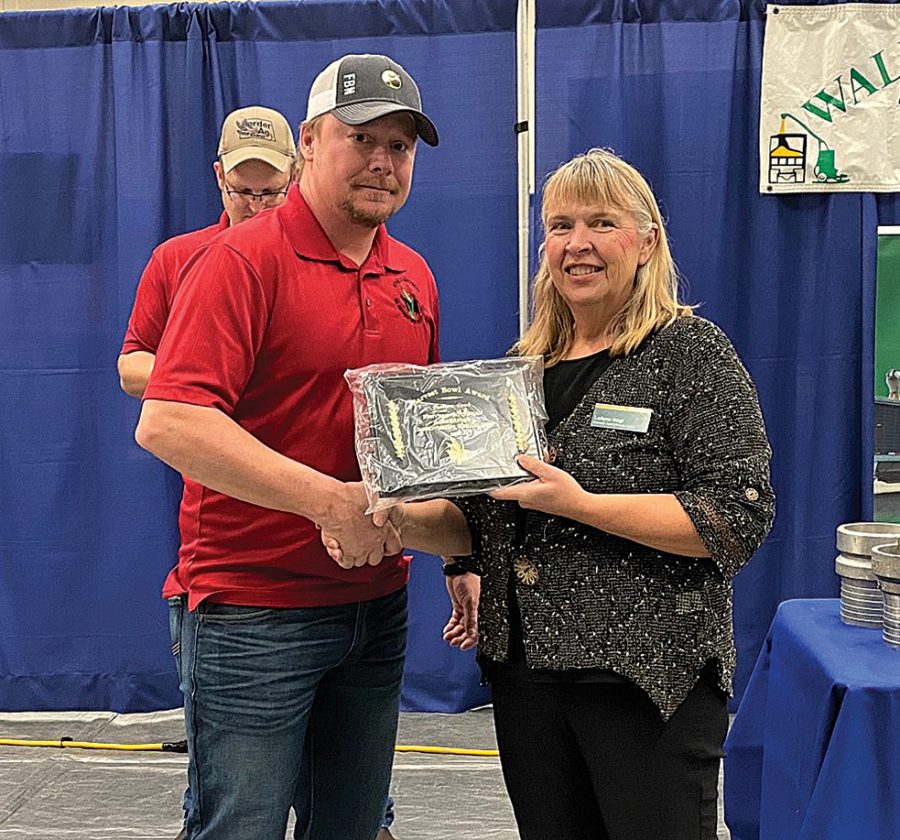
Submitted Photo Renville County Agent LoAyne Voigt presents an award plaque to the county’s NDSU Harvest Bowl winner, Josh Cook of Kenmare.
Women always have had a role in North Dakota agriculture, but there’s a new level of visibility and engagement as more women see the opportunities in the industry.
From production to agri-business and finance to education, women are finding there’s a place for them at the table. One area where they have increasingly shown a presence is through the research and educational arm of the North Dakota State University Extension Service.
In the Minot region, most county agricultural Extension agents are female, a major change from even 10 years ago.
Renville County Ag Agent LoAyne Voigt, Mohall, was one of only a few women serving as ag agents in North Dakota when she took the position in 1988.
Voigt holds a degree in Extension education from NDSU but worked a couple of years with a Fargo landscaping company after graduation and did temporary Extension assignments before coming to Renville County.
“I was just coming here for a short period of time to get some experience and go back to the eastern part of the state. I’m originally from Minnesota. But 30 some years later, I still haven’t made it,” she laughs. “It’s just an enjoyable career. For me, probably the best part of it is no two days are ever the same. I like the education. I like the teaching.”
She attributes the increase in women in agriculture to the increase in women in the workforce generally. For women who grew up around agriculture, a career in the field can be a natural fit and it has become widely accepted, she said.
Her interest in Extension started as a 4-H member. Her family farmed, although they lived in town.
As Renville County’s first female agent, Voigt said, she generated some curiosity. However, once farmers quickly discovered she could provide the information they needed, her gender didn’t matter. In the same way, the increased involvement by women in the Extension Service’s mission is only a surface change, she said.
“From the outside you notice it. But it really hasn’t changed much,” Voigt said.
Voigt said for any agent, there is a learning curve associated with becoming a trusted source of information on all the different aspects of farming. Additional questions continually arise as farming evolves. The move to reduced tillage, the introduction of new crops such as chickpeas and soybeans and the new insects and diseases that come with new crops have kept Voigt constantly learning.
“I find it very fascinating,” she said. “It’s always changing, always something new. That makes it fun.”
Now as one of the veteran agents, she has enjoyed mentoring new agents.
“As a mentor, it’s kept me abreast of a lot of new ideas, new technology, and I think it’s been a real win-win situation,” she said.
Voigt also enjoys working with youth as she manages Renville County’s 4-H program with the help of an office assistant. She has taken 4-H programs on science and technology into the schools.
The responsibilities of 4-H commonly fall to the ag agents in the smaller counties.
Bottineau County Ag Agent Sara Clemens is also 4-H coordinator. A South Dakota farm girl, she started her professional career as an agricultural education teacher in Rolette before becoming the Bottineau County agent.
“I’ve taken to the livestock side of things a little bit more so than crops, but I knew from a very early age that I wanted to do something in agriculture,” she said. Her experience in agriculture-based classes in high school heightened that pull toward that career field. The Extension Service has been a great way to fulfill that desire to be part of agriculture.
“I like getting to know the producers. You get some freedom to be able to go out to their operations, get one-on-one, hands-on experience with them,” Clemens said. “It’s definitely a network-building type of job. I get to see a lot of different people. You get some really off-the-wall questions. I like the variety it offers.”
She might be discussing vaccination schedules with a livestock producer one day and examining weeds or discussing chemicals in a crop rotation the next.
“Every day is different,” she said.
As the first female ag agent in Bottineau County, Clemens remembers the public’s surprise when they would call and ask for the ag agent. But having been the first female ag teacher in Rolette, she was familiar with breaking new ground.
Clemens said women are seeing opportunities in nearly every field, and agriculture is no exception.
“There’s definitely not the typical gender roles anymore,” she said. “It goes back to, if you can do the job, you’ve got the right skill set and the right knowledge base, the sky is kind of the limit.”
That’s the mindset shown by Shana Forster, the first female director at the North Central Research Extension Center in Minot. A native of Mandan, she spent many hours as a youth on her grandparents’ diversified farm. An internship through the U.S. Department of Agriculture and college courses opened the world of agricultural science to her.
“If you like science, there’s a lot of career opportunities, especially if you want to stay in North Dakota,” she said.
Forster was one of only a handful of young women in the crop and weed science program at NDSU when she was working toward her degree. She received her bachelor’s degree in 2000, master’s in 2002 and doctorate in 2016. She worked at the USDA-ARS Northern Crops Science Laboratory in Fargo and later as assistant pulse crops breeder and then cropping systems specialist at NCREC.
Although there weren’t always female role models to guide her way, she said, “It really wasn’t something I thought about. It didn’t seem like that was an obstacle, either.”
Forster said her path to her current position isn’t the only way but what is important is being a life-long learner because agriculture is a changing field.
“The technology component of agriculture is huge,” she said, “so if you have any interest in technology and agriculture, I see a lot of opportunity.”
Ward County Extension Ag Agent Paige Brummund remembers only a handful of female colleagues across the state when she took her current position in 2011. However, joining Extension wasn’t her first thought for a career.
“I knew I wanted to do something agriculture-related, and particularly on the livestock side. That was my passion area. But I didn’t think of Extension being one of those options really. My association with Extension was primarily through 4-H when I was growing up,” she said.
After college, she worked for ranches in Texas as a breeding manager for horses and cattle. When the opportunity to come back to North Dakota arose nine years ago through an opening in Extension, she applied.
Brummund said agriculture may be attracting more women because it is such a diverse field. Women particularly have been drawn to the livestock side, but there’s also opportunities in crop science or working in fields such as sales or finances, she said.
“I think it’s a good career, for sure. I think in some instances, it’s flexible,” Brummund said. In Extension, part of the attraction is it is a hands-on job that presents opportunity for continued learning and professional development. She also enjoys the 4-H involvement and the chance to make a positive impact on youth.
Brummund’s interest in agriculture extends to going home to a cow-calf operation and feedlot as well as horses.
McLean County Ag Agent Calla Edwards grew up around horticulture and horses. Her parents operated a nursery/garden center and she was active in 4-H and FFA. She intended to become an agriculture teacher but after deciding the classroom wasn’t for her, she began looking at Extension.
“It was somewhat similar to teaching. There’s still an educational aspect to it, but it wasn’t in a formal classroom setting. I think that’s what attracted me to it,” she said.
She worked about seven months as an agent in Oliver County before coming to McLean County, where she is in her fifth year.
“I have really enjoyed getting to know the people, working with the 4-H and working with the kids,” she said.
During the growing season, she has more opportunity to exercise her horticulture interest, working directly with farmers as a resource for them. While there’s still some formal classroom instruction involved in the job, such as the pesticide training that ag agents offer, she prefers the one-on-one interaction with county residents.
She said agriculture is definitely a good fit for women, including on the production side.
“Women are more and more taking over. It used to be the sons were the ones that were taking over the family farm and I see more women step into that role,” she said.
Rachel Wald has been McHenry County’s ag agent since November 2015. She is a graduate of the University of Minnesota-Crookston with an associate degree in equine management and of North Dakota State University with a bachelor’s degree in veterinary technology.
She had worked as a veterinary technician. While she has a strong livestock background, she’s had to learn more about the crop side of agriculture since joining the Extension Service.
“I still have a lot more to learn. But it’s definitely getting me to open my eyes to every aspect of agriculture, the grain side as well as the cattle side,” Wald said. “If you are in Extension, you have to be a forever learner.”
Wald grew up active in 4-H and FFA near Willow City. Her grandparents were farmers, and her husband now farms and ranches the family place.
Because fewer young people are looking to get into farming, Wald sees women being needed on the production side to fill those roles. In addition, there are jobs from marketing to agronomy that need to be filled, and women are stepping up, she said.
Wald credits exposure to agriculture careers to the growth in female interest. Even someone interested in computers can find a agriculture-related job because of the technology in the industry, she said. The key, she said, is “just getting it out, letting the kids know that you can do just about anything if you want to do it in agriculture.”
The role model for Lindsay Maddock, Wells County Extension agent, was her mother, who worked in animal health sales and later in beef nutrition. Her mother’s joke at that time was there’s never a line to the ladies’ room when you are a woman in agriculture, Maddock said.
“Because when she started, there just weren’t that many women doing jobs within the agricultural fields,” she said.
These days, Maddock sees a growing number of women in agriculture, particularly in the Extension Service, and she finds that encouraging. A bigger handicap than being a woman is being young and inexperienced, which is overcome only through building that knowledge base, she said.
Maddock grew up on a cattle ranch in southeastern Minnesota. She was involved in showing cattle in 4-H and Minnesota and National Junior Angus Association. She holds degrees in animal science and equine studies.
Her interest was in livestock nutrition, which she followed up on through selling feed for a year. Maddock said she relied on other more experienced agents when she started and she still taps into the knowledge at times.
“Going from a job that was kind of very specialized towards one area to something where you wear multiple hats every day and cover different sectors within agriculture is what’s different, and it’s an adjustment,” she said. “Just being able to lean on others with experience was probably the most helpful for me.”
Pierce County Ag Agent Yolanda Schmidt grew up on dairy farm turned beef operation in the Towner area.
“Ag has been a big part of my life from basically infancy,” she said. She studied animal science, which took her into the dairy industry as a dairy herdsman for about six years at a Parshall facility that doubled in size while she was there.
“I was originally supposed to be hired as someone’s assistant, but there wasn’t a head herdsman so I kind of got cast into that role right out of college. So that was a quick learning curve,” she said.
She later moved back to Fargo to work with the dairy unit at NDSU. While in South Dakota at a dairy conference, she encountered a former colleague who was herd manager at Midwest Dairy Institute, a teaching dairy, who offered her a position.
“That dairy was 1,200 cows, and by the time I left, we had expanded to just under 2,000,” she said.
She later took a job with a small community college in Watertown, S.D., that was looking for an instructor for its revamped dairy curriculum.
“I spent three years there and thoroughly enjoyed it. But my heart was still in North Dakota,” she said.
She watched for an opportunity to return to her home state and found it with Pierce County Extension.
“All of my experiences have helped me in my current role. I would say the backbone of my role here is animal science, and so all of my other jobs have prepared me for that. But where the learning curve has come in is more on the ag business side of things, maybe a little bit more on the cropping side of things, and then somewhat on the horticulture side of things as well,” Schmidt said.
In entering the ag industry as a woman more than 15 years ago, the biggest obstacles centered around being young and inexperienced and then dealing with cultural differences that were common with the diverse workforce in the dairy industry.
“For the most part, once they understood that I knew what I was doing, then I was accepted,” Schmidt said. “What I found is once you built the key trust level, there usually wasn’t the problem.”
Today, it is easier for women as more females have entered the field. Schmidt notes the veteran agents who paved the way. Jackie Buckley of Morton County, who retired at the end of 2016 after 37 years as an Extension agent, and Voigt are among them.