
Recipes have deep roots for deep traditions
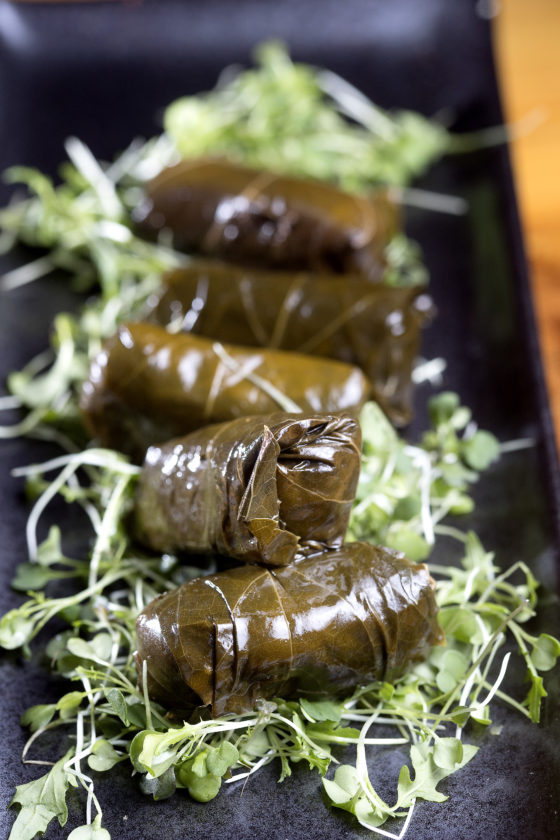
Forum News Service Dolmas, stuffed grape leaves, by Nyanyika Banda.
In preparation for the arrival of spring every year, I choose to observe the Baha’i 19-day fast. It is a welcomed time of reflection for me, a chance to be more intentional and conscious of all of the food I am eating.
I was raised a third-generation Baha’i — a religion with origins in Persia — and that believes that all of the world’s religions are one. Part of that upbringing meant that on Sundays I would go to the Baha’i Center with my family, and we could have classes where we learned about all of the world’s religions including Zoroastrianism, Christianity, Judaism, Islam, Hinduism and Buddhism, to name a few. We were taught the history of all of these religions, so we would have understanding of how they are all united and alike. Humans use religion to make sense of the world, and there are many beautiful and different ways to do that.
While I have practiced fasting since the age of 15, I had never adopted any food traditions to go along with it. During the month of March, for 19 days, Baha’is abstain from consuming food or drink from sun up to sundown. Many religions also have periods of fasting — Yom Kippur in the Jewish faith and Ramadan in Islam, and I’ve found that many of my Catholic friends choose to give up a specific food they particularly love for Lent. Because these religions share many commonalities, I decided I would try something new this year; I would break my fast each evening not with a huge meal but with small snacks of dates and olives and pistachios. It was something I had learned from Muslim boys I worked with during a summer camp session when they were observing Ramadan.
My first summer working at Steve’s Camp in the Catskill Mountains happened to fall over Ramadan. All of the campers came from New York City to spend two weeks in the fresh air, eating farm fresh food, swimming and biking and having many new experiences. Many of these campers were either immigrants themselves or children of immigrants. I had the pleasure of working with these teens to prepare our daily meals. I had been hired that year to be the camp chef and work four sessions, two boys and two girls, and over the course of that summer, I formed special relationships with the ones who were deciding to fast.
The first session, there was a group of four boys who had immigrated with their parents from Burkina Faso, an African country that suffers from high levels of food insecurity. Hamza and Allasan were always polite and volunteering to help around camp and in the kitchen, always referring to me as “miss.” During free time, they played soccer.
Nu was a little older and was not as good at speaking English, he had escaped being recruited as a young soldier in Africa, and the younger boys helped translate for him. He enjoyed chasing the chickens around and picking them up and turning them upside down. I could tell by watching them that camp reminded them of the good parts of where they came from.
We were one week into camp when they said Ramadan was coming up. Their parents wanted them home early so they could practice together. I did not want them to miss out on the rest of camp, and because of my background, I without hesitation volunteered to wake up early with them and make them breakfast. For dinner, I would set aside plates that they could eat once the sun had set. Their peers did not treat them differently because of this; in fact, they were constantly being told by the other campers how much respect they had for them. It was truly inspiring to watch teens from different backgrounds come together and share their stories in an effort to understand each other better.
On their last day, Hamza passed a message on from his father to me, that he was happy I had helped them observe the fast and that knowing that brought him comfort back home. It made me feel good.
The next session, there were two boys from Pakistan who arrived off of the bus carrying bags of Halal (permissible) foods, like hummus, chicken and dates. Like the first group of boys, they participated in the daily activities, always volunteering while also abstaining from food and drink. They would take breaks a few times a day to pray. These boys were older and insisted I did not need to wake up to help them with breakfast, but in the evening I would again set aside plates to be reheated.
Just as in the first session, there was a strong unity among all of the boys. Perhaps it was because they were living in close quarters but I think it also was because they came from varying backgrounds, Jamaican, African, South American, American. Each kid had their own story. They used their experiences to form a bond of understanding.
As I was preparing to fast recently, I thought back to that summer and decided to research traditional foods of Ramadan. I learned that often Muslims break the fasting day with yogurt and dates. The origins and cultivation of Medjool dates have archeological evidence going as far back as 7000 B.C. They are sweet and sticky and high potassium. Dates grow in the form of a palm tree and have three varieties: soft, semi-dry and dry. Dates are mentioned many times in the Bible and the Quran. In Hebrew, dates are called “tamar.”
The combination of sweet soft dates with salty pistachios helped my body during the 19 days to adjust to accepting food. I would follow that with a bowl of salad greens topped with hummus, tahini, olives and feta and some days a piece of chicken or fish. By the end, I would feel full and nourished.
Those who fast do so for various reasons. I do it because it makes me feel good. When I fast, I wake up and watch the sunrise every morning and take time to meditate and reflect. I think about how I want the races and religions to be united under one title — human.
When I’m hungry, I am reminded of all that I have in this world, my health, that I don’t have to worry about where my next meal will come from, or where I’m going to sleep that night. Through fasting, I’ve found a bond with those who share similar beliefs, even if they may be practiced differently. I talk to my Jewish and Muslim friends about why they choose to fast, or not to fast, and how it makes them feel. What I’ve found is that through asking questions on something that seems different, I find many things in common.
Tahini Dressing
3 garlic cloves, chopped
2 teaspoons salt
3 lemons, juiced
1/2 cup tahini paste
1 teaspoon ground cumin
1 tablespoon olive oil
1/4 cup soy sauce
1/4 cup warm water
In a mixing bowl, combine garlic, tahini, cumin, salt, lemon juice, olive oil and soy sauce, whisk into a thick paste. Slowly add the water until it’s a thin consistency. Garnish with paprika.
Stuffed Grape Leaves
With Rice Stuffing
Stuffed Grape Leaves:
1 16-ounce jar Grape Leaves, drained and rinsed
2 cups hot water
1/4 cup extra-virgin olive oil
2 tablespoons freshly squeezed lemon juice
Rice Stuffing:
3 tablespoons currants, soaked in warm water and drained
2 tablespoons extra-virgin olive oil
3 tablespoons raw pine nuts
1/2 cup onion, finely chopped
1 cup long-grain white rice
1 tablespoon granulated sugar
1 1/2 teaspoons ground cinnamon
2 cups hot water
Juice of 1 freshly squeezed lemon
2 tablespoons finely chopped fresh dill weed or fresh mint leaves
2 tablespoons finely chopped fresh parsley leaves
Salt and freshly ground pepper to taste
2 quarts vegetable broth
To make the stuffing, heat the olive oil in a medium saucepan over medium heat. Add pine nuts; stir until golden brown, add onion, white rice, sugar, cinnamon and hot water. Stir the mixture, cover the pot and cook for 15 minutes, until the water is hot.
Remove from heat and stir in the lemon juice, dill weed and parsley. Season to taste with salt and pepper. Let the stuffing cool for 30 to 40 minutes before stuffing the prepared grape leaves.
Take one leaf, shiny side down, and place 1 teaspoon of the rice mixture at the bottom (stem) end of the leaf.
Fold both sides of the leaf toward the center, roll up from the broad bottom to the top, and place into a 4-quart pot. Repeat with all leaves, leaving no gaps as leaves are placed in pot (to prevent from opening while cooking). Sprinkle with remaining lemon juice and with olive oil. Pour vegetable broth over all to cover grape leaves. Cover pot and simmer for about 1 hour. (Do not boil because this will make the stuffing burst out of the leaves). Remove from heat, remove cover and let cool for 1/2 hour. Transfer to serving dish and serve.