
Ledger ‘The Sledgehammer’ inspiring a community
8-year-old’s battle with epilepsy forms special bond with Surrey boys basketball program
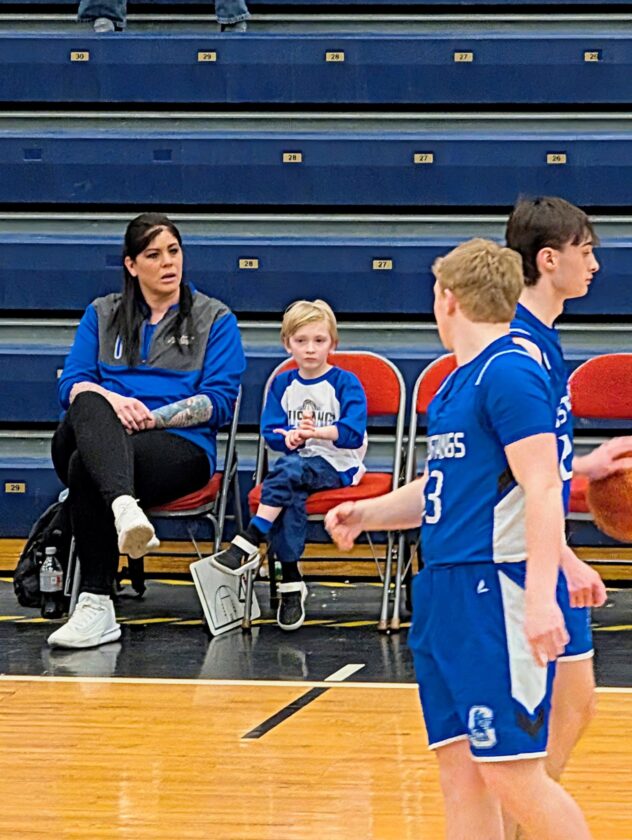
Ledger watches pregame warmups from the bench alongside Surrey boys basketball head coach Robyn Vollmer earlier this season at Surrey High School. Submitted Photo
Editor’s Note: Ledger’s mother requested that her name not be used in the story due to the nature of her job. Other names have also been omitted for consistency purposes.
If it’s game day at Surrey High School, you can bet Ledger will be there encouraging his beloved boys basketball team.
But the 8-year-old Mustangs fan won’t be found cheering from the stands alongside his family. No, you’ll find Ledger sitting on the bench alongside Surrey head coach Robyn Vollmer and the rest of the coaching staff coaching up the Mustangs as an honorary assistant coach.
In a season filled with ups and downs, the boys basketball team can always expect to see Ledger on their bench, serving admirably as an assistant coach for every Mustangs home basketball game for the past three seasons.
“He gets announced as our assistant coach and we call him Ledger “The Sledgehammer.” Every day when we have a game day he’ll walk around the school and be like ‘Big game today. Big game.’ He’ll prepare himself and have a speech for the night,” Vollmer said. “Every time when we do a pregame warmup or go into the locker room and have our pregame plan, at the end of the plan I’ll be like ‘Ledger, you got anything’ and he’ll say ‘Yep, box out.'”
Ledger has become the heart and soul of the team during his time on the bench, which is why the Mustangs felt incomplete near the end of January and through the first half of February when they would look over and see any empty chair where the 8 year old would normally sit. For the first time in years, Ledger was not in attendance to coach up the team. Instead, he was more than 1,650 miles away in Philadelphia, undergoing testing, imaging and surgery in an ongoing battle with epilepsy that Ledger has been dealing with since he was 18 months old.
Despite the regular season winding down and the Mustangs attempting to bolster their playoff seeding on the heels of the District 6 Tournament, all the team wanted to talk about was Ledger and when he would be back on the bench. Thankfully, for both the Mustangs and the Surrey community as a whole, Ledger would return with his signature positive attitude a few weeks later, but it’s been a long journey.
Testing, testing, testing
Ledger was born on March 11, 2017, in Minot. His mother grew up in the Magic City and she met her husband through her best friend, who was dating her husband’s brother at the time. They dated for five years and got married in 2015.
Two years after they married, Ledger was born and they moved to Surrey when he was just 1. He was promoted to the ranks of big brother a year later with the birth of his younger sister, Henley, in 2018.
When Ledger was born, he was given a clean bill of health. There was no indication that there were any complications with the birth and it appeared Ledger was perfectly healthy.
Eighteen months later, the seizures started. And they continued. And they continued. And they continued.
When Ledger’s mother first started taking Ledger to the pediatrician locally, they told her that Ledger was likely just experiencing febrile seizures, brought on by a fever that reaches 102 degrees, as they occur in children aged six months to five years. But Ledger’s mother was skeptical and wanted a second opinion, especially since the diagnoses didn’t match the symptoms.
Ledger experiences approximately two seizures a week, always occurring in his sleep when he is first waking up. During the seizure, which lasts roughly a minute or so, Ledger’s arms jerk up into the air and he isn’t able to talk or move.
One of his mother’s friends is a nurse, and she advised her to take Ledger to the emergency room after his next episode, which she did. While there, they ended up working with a different pediatrician, who didn’t believe the seizures were caused by fevers and therefore sent referrals to specialists elsewhere.
Ledger’s mother said that North Dakota doesn’t have anywhere that specializes in epileptic care outside of one neurologist in Grand Forks. Ledger visited the Grand Forks office in August 2018, where he had an EEG (electroencephalography) and an MRI done and was prescribed Keppra – an anticonvulsant medication used to manage epilepsy. The doctor wrote the family a referral for the Minnesota Epilepsy Group.
Two months later, the family started going to the Minnesota Epilepsy Group’s offices in Edina, Minn. Ledger twice had an MRI and video EEG, the first time in 2018 and again in 2020. A video EEG is a non-invasive process where electrodes are placed on the scalp to monitor brain waves while a camera records physical actions. The testing was done at the children’s hospital in St. Paul.
The Minnesota Epilepsy Group officially diagnosed Ledger with focal epilepsy in 2018. Focal epilepsy means seizures originate in one specific area of one hemisphere of the brain. Symptoms of focal seizures include jerking movements, sensory changes and fear or confusion.
In December 2020, the family switched over to the Mayo Clinic in Rochester, Minn. They continued visiting the Mayo Clinic for five years, with Ledger having a battery of tests performed on him, including a prolonged video EEG, MRI, MEG (magnetoencephalography) and CECT (Contrast-Enhanced Computed Tomography) scan. A prolonged video EEG is the same as a regular video EEG, except the test is conducted throughout several days. A MEG scan is non-invasive and involves a patient sitting in an open scanner for 30 minutes to an hour. The test measures brain activity to identify the source of the seizures.
The family experimented with Ledger’s diet, moving him to the ketogenic diet – a diet that is high in fat, low in carbohydrates and moderate in protein – in February 2021. Ledger stayed in the hospital for five days to get him started on the keto diet. It lasted six months before the family stopped the specialized diet, as it wasn’t reducing the number of seizures Ledger was experiencing. Ledger’s mother said it was also difficult to get a 4 year old to stick to a strict diet. Many doctors believe that children with epilepsy do better when they follow a ketogenic diet because it can reduce inflammation to the brain to prevent seizures from happening.
Ledger’s seizures are monitored via a vagus nerve stimulation device, which sends impulses to the vagus nerve – the main nerve of the system that controls digestion, heart rate and other vital functions. The electrical impulses are then sent to the brain. Ledger had the device implanted in his chest during a procedure at the Mayo Clinic in August 2022.
The procedure requires two incisions. One incision is made on the chest or in the armpit area and the other is on the left side of the neck. The stimulation device is implanted in the chest under the skin and a wire is threaded under the skin that connects the device to the left vagus nerve through the second incision. The device turns on and off in cycles, but Ledger’s mother also has a handheld magnet she can use to start the impulses, as the magnet is supposed to help shorten the length of the seizures. During a seizure, she will swipe the magnet over the device every minute to record the length of the seizure. If it lasts longer than five minutes, Ledger is given rescue medication. Ledger’s mother said that has been a rare occurrence.
While the stimulation device is not a cure for seizures and can take over a year to see results, it is intended to reduce the number of seizures as well as the recovery time after an episode.
A treatment method for focal epilepsy is taking antiseizure medication. However, Ledger also suffers from intractable epilepsy, also known as drug-resistant or refractory epilepsy, meaning that medication is ineffective in stopping or reducing seizures. The only way to determine whether someone suffering with seizures has intractable epilepsy is by giving them medication and seeing how they respond. It’s diagnosed as intractable once at least two appropriate antiseizure medications aren’t effective, as the third medication comes with a less than 5 percent chance of success. Ledger’s mother said they have tried at least 10 different medications, none of which worked. He was diagnosed at the Minnesota Epilepsy Group in 2020.
Intractable epilepsy affects roughly one-third of people with epilepsy and while there is no single cause, developing epilepsy before the age of two increases the risk factor.
With all the different trips to different doctors and different clinics resulting in a number of different tests and imaging, Ledger’s mother continued to search for more resources to give her son the best chance at a great life as possible. She may have found it in the unlikeliest of places: Facebook.
“I found a surgeon on Facebook,” Ledger’s mother said. “There was a Facebook fan page for this surgeon in Philadelphia. We were going to the Mayo Clinic. We met with the surgeon there and I just didn’t get a good vibe from him, so I just looked around and found Dr. (Benjamin) Kennedy on Facebook and there were a bunch of people who went to him and had really great experiences.”
The two connected and it wouldn’t be long before the next chapter in their journey took them to the East Coast and the City of Brotherly Love.
A bond bigger than basketball
Ledger loves sports. Whether it’s playing or watching, there isn’t a sport that Ledger won’t partake in. However, his doctors prohibit him from playing organized football or hockey due to the higher risk of concussions and trauma to the brain. But that doesn’t mean he can’t play as the Chicago Bears in Madden 2026 or the Notre Dame Fighting Irish in NCAA Football 2026 on his Xbox at home or cheer on the Minnesota Wild and Las Vegas Golden Knights on television.
Ledger has been at the Fargodome rooting on the North Dakota State Bison and attended Drake native and former NDSU and current Cincinnati Bengal offensive guard Cordell Volson’s football camp, “Small Towns, Big Dreams.”
When it’s not basketball season, you can still find Ledger at Surrey High School, as he attends most home games across all sports, especially baseball.
But the Surrey boys basketball team will always be No. 1 in his heart thanks to his first interaction with the team back when he was in kindergarten at the age of 5. Every year, the basketball team hosts its Mini Mustangs Basketball Camp and Ledger made his inaugural appearance four years ago
“I don’t know how to describe him,” Vollmer said. “He’s just an awesome kid. He’s a great environment to be around. He’s fun. He’s very straightforward and he’s just fun to be around. Our basketball team is a really good group of kids and they like to involve the younger kids, but something just gravitated them toward him and he’s just always been there.”
Ledger’s favorite part of basketball is when he gets to shoot.
Everyone on the team is a fan of his and Ledger is a fan of all of them, but he does have his favorites and sometimes it changes each year. This year, that designation belongs to Gavin Vollmer, with an honorable mention going to Bennett Nelson – both sophomores. Nelson has played varsity since seventh grade and Gavin Vollmer has been with the team since eighth grade. Both have been with Ledger since the beginning.
“He’s always positive,” Gavin Vollmer said. “Around us, he’s kind of shy, but we love him to death. He’s like a brother to us. It’s fun to have him on the bench with us.”
Said Nelson: “Ledger is one of the stronger kids I’ve ever met. There is nobody who is as strong as him mentally and physically. To be put in this position and what he’s going through and how he’s overcoming it is so impressive to me.”
The team was drawn to Ledger the moment they first saw him at camp four years ago, well before they had any idea what he had been going through. It wasn’t until later where they were filled in with the details. They took such a liking to him that they approached coach Vollmer about the idea of having Ledger sit on the bench with them during games and she loved the idea. She reached out to his teacher and she reached out to Ledger’s mother and she, too, loved the idea. Thus, at camp the following year, they informed him of his new role with the team and Ledger’s been on the bench the last three seasons.
“Sometimes after big shots, I’ll look over at him on the bench and he’s jumping up and down and that really makes me happy,” Nelson said.
Ledger loves to tell the team to box out during his pregame speeches and has even begun mimicking the actions of assistant coach Holden Hartley. The coaching staff will sometimes refer to him as “Mini Hartley” as a result.
Ledger’s favorite coaching moment came when he got to deliver his “Good, Better, Best” speech to the team during the pregame meeting.
“Good, better, best. Never let it rest. ‘Til your good is better and your better is best,” Ledger said.
It was all smiles on the team when Ledger was around. And when they learned that he would be leaving the team for a few weeks to have surgery in Philadelphia, they made sure to do something special before he departed. The team presented him with a jersey – Gavin Vollmer’s No. 32 – that everyone signed along with a card and a stuffed Mustang plush. The jersey is framed and hanging from the wall in Ledger’s room.
“It makes me emotional,” Ledger’s mother said. “Them taking him in has just meant everything. He’ll remember this forever.”
Nelson admires Ledger’s toughness and helps put life in perspective.
“When we found out what he has to go through, it makes us realize how easy we have it,” Nelson said. “Being strong and pushing through these games is nothing compared to what Ledger has to go through.”
Nelson’s toughness has also helped Ledger in moments where he had to be strong.
“Bennett kind of helped us out when Ledger had to get an IV and he does not like getting IVs, so we talked about how one time in a game when Bennett got hurt how tough he was because he went back in the game and started playing again,” Ledger’s mother said. “That helped Ledger get his IV and afterward he gave me a fist bump and said, ‘I was tough like Bennett.'”
Pancakes and fish sticks with a side of more testing
The family flew to Philadelphia on Jan. 21, roughly a week before the surgery, as Ledger was required to have a CT scan conducted prior to the appointment. It was the second time they had traveled to Philadelphia to visit the children’s hospital. The first time was in September after Ledger’s mother reached out to Dr. Kennedy. They spent 11 days there before returning home. Ledger made sure to take in a Philadelphia Phillies game while he was there.
Unlike the previous trip where it was just Ledger and his mom, this time the whole family went for the first week while Ledger wasn’t required to be in the hospital. During that week, the family visited the Liberty Bell, Ben Franklin’s house, the Museum of the American Revolution and – of course – got in a sporting event by seeing the Philadelphia Flyers play the New York Islanders at Xfinity Mobile Arena.
When it was time to go into the hospital, Ledger and his mother said goodbye to his father and Henley. Ledger was in Philadelphia for a Phase 2 diagnostic procedure called a stereo electroencephalography (SEEG). The Phase 1 version of the SEEG was done during their first visit in September. Phase 1 is non-invasive and requires 7-10 days of evaluation in an Epilepsy Monitoring Unit (EMU). Electrodes are placed on the scalp and seizures are recorded to pinpoint the origins of the episodes in the brain. Phase 1 determines whether more invasive monitoring like Phase 2 is required.
The results indicated Ledger was a candidate for Phase 2, which required surgery. The procedure lasted roughly five hours, with Ledger being under anesthesia the whole time. The process starts with 10-20 tiny holes being drilled into the scalp and electrodes being inserted through the holes into the area of the brain where the seizures originate.
After the surgery, Ledger was moved to the EMU for two weeks for data collection. Ledger was unable to leave his room, as he was hooked up to medical equipment that was also plugged into the wall. But he did have enough leeway to move around his room.
“He’s a trooper,” Ledger’s mother said. “He’s super tough. Being tied to his room with this big thing and it was heavy and he had to carry it around, but he never complained once.”
Ledger kept himself busy. He played games on his iPad and he and his mother read together and watched a lot of movies together. Child specialists would visit during the week and play games with Ledger. The hospital provided Bingo every day. They also had a mini hockey net and hockey stick that he played with along with plenty of sessions of Wii Tennis on the Nintendo Wii.
Ledger didn’t mind the hospital food. In fact, there were two specific foods he liked so much that he would order nearly every day: chocolate chip pancakes and fish sticks.
At the end of the monitoring period, the electrodes were removed and Ledger was in recovery for a day or two before he and his mother were on a flight back to North Dakota to reunite with the basketball team.
The family is in a holding pattern at the moment as now the medical team needs to review and present the findings in a surgical conference to determine the next plausible step. Ledger’s mother believes that next step will be Responsive Neurostimulation (RNS), a surgical procedure where a device is implanted just above the brain and in line with the skull and analyzes brain activity and sends electrical pulses via electrodes inserted through incisions into the skull.
According to a 9-year study, patients said they saw a 75 percent reduction in the number of seizures they experienced over the length of the study and 18 percent claimed to be seizure-free for more than a year. Doctors would only go so far as telling Ledger’s mother that there was a 50 percent chance the procedure would result in a 50 percent reduction in the number of seizures Ledger would experience. But they did stress that everyone that has had the RNS device has seen improvement.
A return to normalcy
Ledger returned to Surrey on Feb. 10 and took his rightful place on the Mustangs bench on Monday, Feb. 16, when the Mustangs hosted Mohall-Lansford-Sherwood in their final district contest of the regular season. On his first day back at school, he asked if he could wear a hat to hide the stitches from his surgery. When the basketball team caught wind of his request, they designated Ledger’s first day back – Feb. 12 – as Hat Day, encouraging everyone to come to school wearing a hat.
He was also in attendance at the Minot Municipal Auditorium on Saturday, Feb. 14, to watch the girls basketball team punch its ticket to the Region 3 Tournament..
Ledger has been through more than a lot of 8 year olds, but he is still your typical kid. He loves cartoons – Spongebob Squarepants being his favorite. He also enjoys pizza and isn’t afraid to get a bit adventurous by adding pineapple as a topping, though he prefers pepperoni, He enjoys fishing and has even reeled in a “big bass” according to Ledger himself. While he loved his fish sticks in the hospital, his favorite fish to eat is walleye.
As for a career? He’s already got that figured out. He wants to be a coach, and he’s setting the bar high. He wants to be patrolling the sideline as the head coach of the Chicago Bears. Ledger’s already building his coaching resume, compiling 21 regular season wins and two victories in the postseason.
It’s playoff time for Ledger and the Mustangs as they will play a District 6 play-in game against Lewis & Clark on Saturday, Feb. 21, at the Minot Municipal Auditorium at 2 p.m. for a chance to play Bishop Ryan in the quarterfinal round.
Win or lose, the Mustangs are just happy to have Ledger back on the bench with them, as he has taught all of them a valuable lesson.
“It makes us more aware that there are kids that look up to us and how we act and how we carry ourselves,” Robyn Vollmer said. “It matters because there are kids that look up to us and we want to be good role models for people like Ledger. We want him to feel included and he is included and we want to show that as young athletes, there are young kids that look up to you and want to be you.”
Ledger’s mother and the rest of the family could not be more thankful to friends, family and the entire Surrey community along with members from neighboring areas that have provided their support in one way or another. Family has chipped in with the cost of flights and lodging expenses, friends and neighbors have offered gift cards and neighborhood kids have made cards and wrote notes of encouragement. And everybody has been rooting them on, just like Ledger has been rooting on his Mustangs.
Ledger’s mother encouraged parents who have or may one day find themselves in a similar situation to continue to advocate for their child because no one knows a child better than their parents. There is always hope.
As for the Surrey boys basketball team, words can’t even begin to describe the admiration she has for the players and coaches.
“The power of kind gestures from the boys basketball team has been everything and something we will remember forever,” Ledger’s mother said. “We have a good spot in our heart for that team. We love them all.”
Local Sports

Locals defend titles in state wrestling
Ledger ‘The Sledgehammer’ inspiring a community
Majettes bounce back, top Patriots for WDA regular season title

Minot United advances to WDA Tournament semifinals in win over Williston
Women’s Basketball: Beavers snap 3-game skid with win over Jamestown
Tiyahna Trottier scored a game-high 26 points and Taryn Hamling added 22 as the Minot State women’s basketball ...
Boys Swimming & Diving: Magicians sweep dual meet with Sentinels, Coyotes
The Minot High boys swimming and diving team closed out the regular season with a pair of dual victories over Minot ...