
Sales tax review reflects well on flood project
Trending
The 1.08 cents currently allocated to water projects from Minot's 2-cent city sales tax should carry those projects to completion, according to an analysis from the Souris River Joint Board.
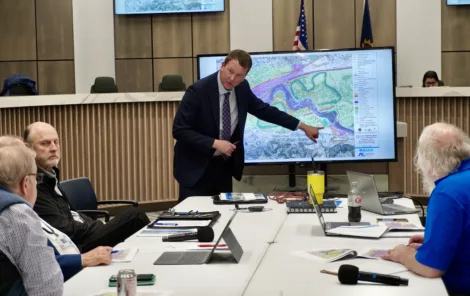
Ryan Ackerman, SRJB administrator, and David Ashley, board chairman, met with the Minot City Council Monday, Nov. 2, to provide an update on the flood protection project during a special meeting on water topics. The council expects to take up discussion on water projects for potential action at its Nov. 16 meeting.
Concerns about water projects soaking up a growing percentage of city sales tax may be unfounded based on the analysis.
"What we're finding is that the peak tax collected in terms of percent is actually today, and that we believe that we can dovetail the completion of NAWS with the ramp up of flood control and basically live within that 1.08 cents that's being collected. In fact, what we're projecting is the maximum necessary for flood control is 1 percent," Ackerman said.
The SRJB is asking the council to update their shared agreement to reflect current tax collections. The original agreement between the city and SRJB called for a 0.5-cent sales tax to be allocated to flood control, while the current tax allotment is 0.68 cents.
In analyzing sales tax collections and the pace of flood project development, the assumption is that 0.68 cents can be maintained through 2031 without negatively affecting the project, Ackerman said.
"Begining in 2032, we would start an annual ramp up, an annual increase of 0.05 percent per year from 2032-36, and then there would be a 0.07 percent bump from '36-'37. That would get us up to a peak sales tax collection for flood control of 1 percent," he said. "Then it tails off as debt is retired."
Ackerman said the intent is to again promote a plan to the Legislature to complete funding of the Mouse River Enhanced Flood Protection Project by the 2037-39 biennium. A plan to do so with an appropriation of $110 million in the 2025 session was shot down in the Senate, and the Legislature went with a more traditional appropriation of $81.1 million, he said.
Assuming 3% inflation, the request of the 2027 Legislature would be $115 million per biennium for five bienniums, with a final appropriation of $104 million in the 2037-39 biennium.
Ackerman said the goal is to maintain at least a reserve cushion of $30 million from sales tax to pay down local debt incurred to fund project construction.
"What our modeling suggests here is that we would have to collect sales tax through 2071. At that point, we project that we'd have roughly $40 million in the bank, and then we would essentially retire the debt - retire all the remaining debt," he said.
Access to low-interest loans through the state's infrastructure revolving loan fund is a key element that needs to remain in place for the analysis to play out, he added.
Along with seeking legislative support, the SRJB will be chasing federal dollars with the assistance of the state's congressional delegation, Ackerman said. However, at this point, no additional federal funds are anticipated in the assumptions of how much is needed from the state.
The local cost-share with the state on flood protection has been 35%, which has come from Minot's sales tax.
"We need to be able to provide what I would describe as a credible commitment locally," Ackerman said, explaining that they need to show local funds can keep up with state funds in advancing the project.
Ackerman also presented an updated map of the flood protection project area, which the council could act on at the upcoming November meeting. The new map reflects an updated footprint from the original 2012 map based on BNSF negotiations, property owner wishes and efforts to limit acquisitions and contain costs.