
MSU’s Focus on Healthcare: Social work makes impact
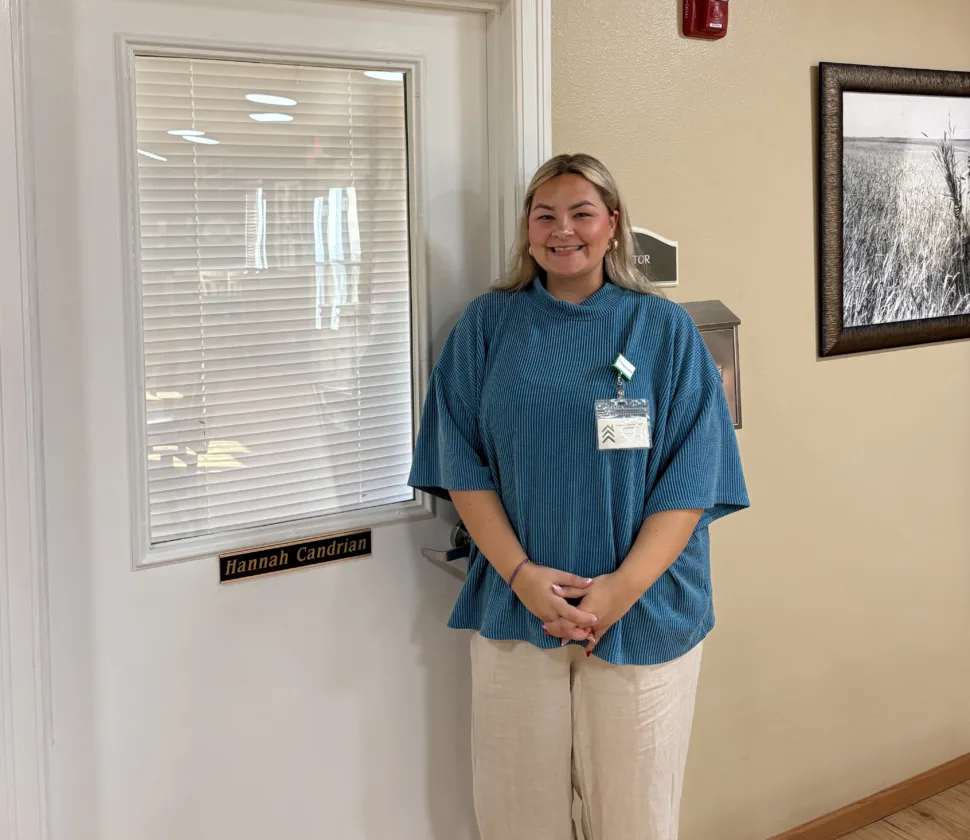
HANNAH VELASQUEZ/MDN Edgewood Memory Care Manager Hannah Candrian advocates for patients.
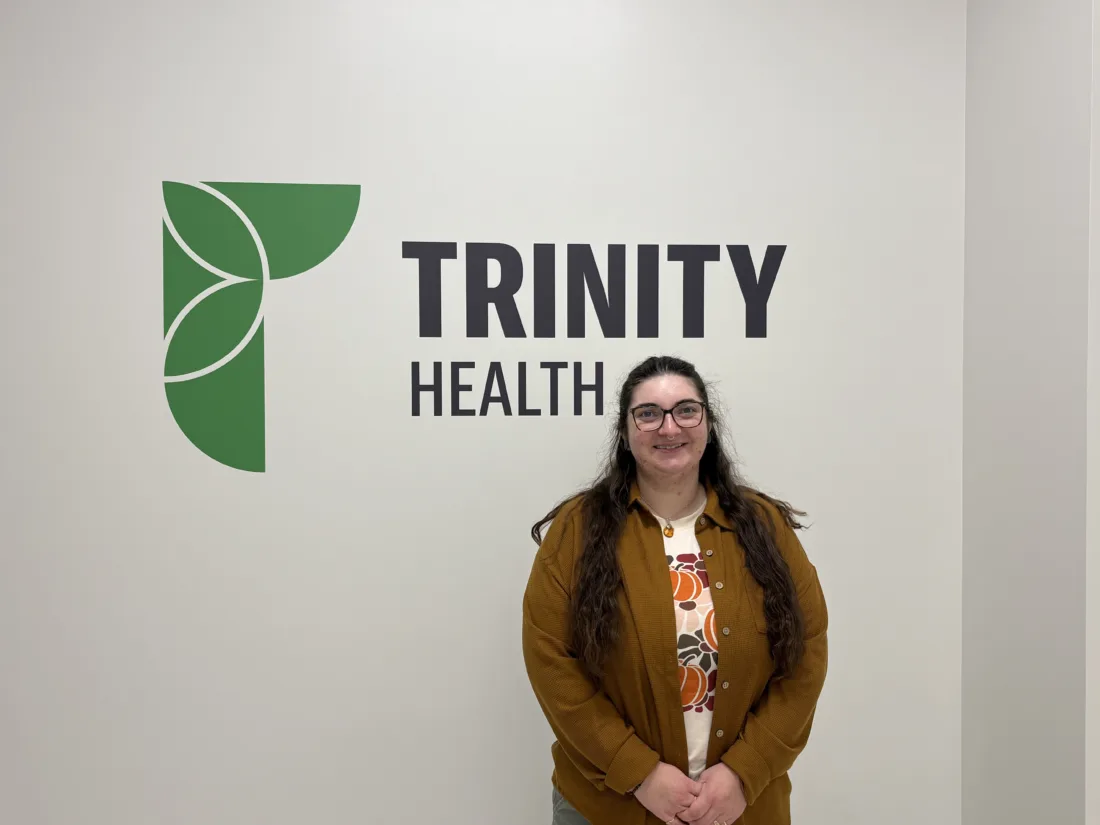
HANNAH VELASQUEZ/MDN Trinity Case Management Social Worker Shelby Stuckey interacts with all hospital patients before they leave.
HANNAH VELASQUEZ/MDN Edgewood Memory Care Manager Hannah Candrian advocates for patients.
HANNAH VELASQUEZ/MDN Trinity Case Management Social Worker Shelby Stuckey interacts with all hospital patients before they leave.
Trending
This is the fourth in a series about Minot State University’s focus on healthcare.
Social work often begins when someone finds themselves in a situation they cannot navigate alone. It can look like helping a hospital patient determine where to go after being discharged or supporting a family as a loved one experiences Alzheimer’s. The focus always remains the same, advocacy.
For two Minot State University graduates - Hannah Candrian, a memory care manager at Edgewood, and Shelby Stuckey, a case manager at Trinity Hospital - the work looks different everyday.
“Social work is work of the heart,” Stuckey said. “You’re serving your community in a professional manner. Keep boundaries, but being able to help when they’re feeling vulnerable. People need a social worker a lot of the time because something in their life is maybe a little more difficult right now. Being able to provide that for people has been an extraordinary experience.”
Stuckey became a case manager in 2024. She said a significant part of her job involves discharge planning and helping patients determine the support they will need once they leave the hospital.
“The doctors and nurses and specialists work on getting the patients stabilized, and then once they’re OK, we work with them on if they need support at home, if they need to go to a facility, and really help empower them to make decisions to try and get back to a normalcy after being in the hospital,” Stuckey said. “I like to empower people to tell them ‘your voice does matter.'”
Candrian’s work at Edgewood entails overseeing 28 beds while working alongside nurses, staff, residents and their families. She said her primary responsibility is advocating for a population that might not always be able to communicate their needs.
“Making sure they have quality of life in potentially their final stage of life, it’s really important, advocacy,” Candrain said.
When Candrian first joined the Edgewood team at 19, she had little experience working with older adults or people with dementia, but taking the role as the enrichment assistant changed her career path.
“I fell in love with bringing the residents joy and happiness in this stage of life,” Candrian said. “I was like, I want to help these people and I want to dedicate my life to serving these people.”
Originally, Candrian was studying education and communications. She came across the job listing while trying to find work over the summer. She eventually switched her major to social work and completed her internship at Edgewood before moving into her current position.
“I went into social work at Minot State and fell in love with that department,” Candrian said. “I’ve been in this position for almost two years. I’ve been at Edgewood for seven years and absolutely fell in love with geriatrics, but most importantly, people with dementia. They deserve the best quality of life.”
Candrian also helps facilitate a support group for Alzheimer’s caregivers, providing families an opportunity to connect with others experiencing similar challenges.
“You’re not alone,” Candrian said. “It can feel very isolating when you’re taking care of a loved one, because many families are that sole caregiver.”
Candrian said one of the biggest challenges in geriatric care is the limited availability of resources, including assisted living, memory care and geriatric psychiatric services.
Stuckey also said resource availability in the state is one of the challenges in hospital case management.
“The hardest part is keeping them close to home,” Candrian said. “There’s only so many places that offer assisted living to nursing homes and memory care in general. Geriatric psych is much needed but very limited. The biggest challenge in this field is not having adequate resources for this population.”
“Lack of resources,” Stuckey said of one of the biggest challenges. “We’re in a rural area. Rural areas are going to struggle with that. We’re not a big city. Finding resources, whether it’s something as simple as a home health agency that’s willing to go 100 miles out of town or finding a caregiver for somebody who lives in a small community, it’s challenging.
“We work with patients and their families and are transparent about saying, ‘Hey, this is what you want and I understand. This is the confines of what we can provide because these are the resources available.’ It’s hard to have those conversations. There can be a solution to every problem. Sometimes you have to get creative,” she said.
The responsibilities of a social worker go beyond coordinating services. They also navigate emotional and hard conversations with patients, residents and their families, while, in a short amount of time, letting them know they can trust the social worker.
Stuckey said she tries to make patients feel comfortable by introducing herself, listening to their concerns and bringing herself down to their level.
“If there’s a chair, sit by them and literally get on the same physical level as them,” Stuckey said. “I want them to know when I go into the room that there isn’t any hierarchy. We’re working together and equal parts of a team and being honest. If they want something and I can’t make it happen, I tell them, but then I give a solution.”
Candrian said her role also involves supporting employees who provide hands-on care to residents. She advocates for staff members while helping them navigate emotional challenges that can come with their roles.
“I am lucky to have a very understanding team,” Candrian said. “All of us here are truly here for the residents, but also the staff. It’s fighting for them if there’s something that is bothering them or something that they want or need. It’s having the confidence and courage to fight for them.”
The most rewarding moments for Stuckey are when patients or families begin to see a path forward after a difficult moment. She said any day that she can provide hope is a day in which she feels like she can and her patient can accomplish anything.
“It happens fairly frequently, when somebody is in a situation where they feel like there’s no way out, they use the word hopeless,” Stuckey said. “I get to tell them that not all hope is lost and there are other options. We can work together and you’re not alone. Seeing the relief on their face as they relax and realize they don’t have to figure it out on their own. Seeing the relief, that is the most rewarding part.”
“I was just here as a little stepping stone,” Candrian said. “I was just here to guide you and to support you, but ultimately, when they are making the choices and then using the resources that they get, it is really beautiful.”
Stuckey and Candrian both credit Minot State’s social work program with preparing them for the profession through hands-on experience and support from faculty members. Both said they still connect with former classmates and encourage any current students to explore different career paths.
Stuckey herself is a third-generation Minot State graduate and her mother is also a social worker. She said her mom and educational experience at MSU helped shape her approach to social work. Stuckey teaches interns at the hospital.
“I love being able to support students because I was there not too long ago and I know it can be scary,” Stuckey said. “But to show them ‘Hey, you’re going to stumble and fall, but that’s how you learn. You’re safe to do that here.’ It’s probably one of the most rewarding parts of my job, being able to help students go through the process.
Her advice for those entering the field after this fall is to remember who they are beyond their professional titles.
“We’re people that want to help,” Stuckey said. “The person sitting across from them or meeting them at their bedside, we’re on your side.”
Candrian also encouraged students to remain open to the opportunities and not to feel pressured to settle on a path too early. She said social work offers different ways to serve different populations.
“If you have a little inkling to work with the geriatrics, go job shadow. Shadow for anything,” Candrian said. “Don’t let fear hold you back.”