
Boarding school survivor shares her story
Trending
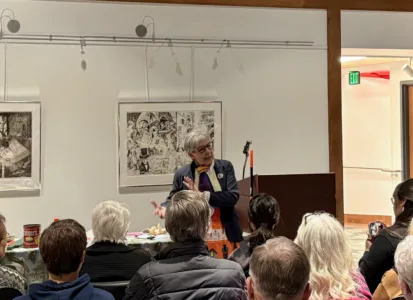
Minot State University’s Native American Club and Cultural Awareness Center hosted Dr. Ramona Klein on Thursday, Nov. 5, to share her experience at the Fort Totten Indian Boarding School and to discuss the lasting effects the system has had on Indigenous communities.
"We need generations to learn things and to remember things,” Klein said.
The speaker event was in recognition of Native American Heritage Month, according to the Native American Club. Klein spoke to students and faculty at 11 a.m. and the general public at 6 p.m.
Klein challenged the audience to reconsider what they knew about Native American boarding schools during her presentation.
"If you leave differently than when you came in, I am successful in sharing what I have to share," Klein said. "I'd like to express that if I can change the heart, I can change the mind."
Klein is a member of the Turtle Mountain Band of Chippewa and attended the Fort Totten Indian Boarding School from 1954 to 1958, beginning when she was seven years old. She asked the audience to envision their own children and grandchildren.
"Imagine that child is taken away from your family and you have nothing you can say about it," Klein said. "You have no control and you don't know what's going to happen to that child."
She shared the memory of leaving Belcourt on a large green bus and seeing her mother become emotional, standing outside the school, holding the hands of her younger siblings.
"That's burned in my memory," Klein said.
Klein described arriving at the school and the treatment the children were subjected to upon arrival. She said they had strict routines as if they were in the military.
"The atmosphere was cold and it was huge," Klein said. "We were taken into that building and to the right, there was an office. Behind the office was a linen room with tables, covered with white sheets. My hair was long and one of the first things that was done – I had a haircut. It was below the ear. I remember my hair falling to the floor. It was a gray tile floor. That's burned in my memory."
Hair holds cultural and spiritual significance in many Indigenous communities. Klein explained that cutting students’ hair was one of the ways boarding schools attempted to strip children of their culture.
"Following the haircut, the matrons, the women who were supposed to take care of us, they did not always take care of us," Klein said. "Our heads were bent over and a fine comb was dipped into the kerosene and we were fine combed."
She said students marched to meals, completed chores and followed a schedule that included going to bed at 6 p.m. Boys and girls ate separately and were divided into different dormitories. As a result, Klein said she rarely saw her siblings who were at the school with her.
She also recounted physical punishment by school staff and sexual abuse during her time there. Klein said the effects of those experiences have continued throughout her life, including difficulty expressing emotions and memories triggered by sights and smells.
"When there is that kind of abuse of that trauma, we try to make it a little bit lighter," Klein said. "Sometimes there might be alcohol, there might be drugs, food and work."
Klein also shared memories of a teacher who showed her kindness during her time at the school.
"Miss Thelma Daggs, she was my first grade teacher and she taught me how to do simple math," Klein said. "She may have taught me to write short words. She taught us about time and sitting for a minute. She taught me about life outside the classroom.
"She took me under her wing. She was my first employer and would check me out of the door and I worked for her. I swept the stairs. If anyone goes to the Fort Totten historical site, you see this beautiful staircase. I cleaned those steps many times."
Klein said she would earn money through the work and would purchase small gifts for her family. Daggs would also bring Klein gifts from her teacher trips. Those experiences helped her shape her understanding of generosity and influenced her future in education.
"Miss Daggs taught me errands. She sent me to a little store called Fort Johnson’s store. She gave me a list of what to get from the store and one of the times it was cookies. I didn't get the right one. What lesson did I learn? That it was okay. It was okay to make mistakes."
Spending 58 years in education, Klein has taught students from kindergarten through postdoctoral level. She earned a master’s degree and doctorate in education after returning to school to better understand how to reach students with different needs.
Klein currently serves as the vice president of the National Native American Boarding School Healing Coalition, which aims to increase awareness and education about the boarding school era while supporting legislation addressing the lasting effects.
The federal Indian boarding school system operated for more than 160 years, beginning in the early 19th century. The last federally operated boarding school closed in 1997.
Klein said the coalition has identified more than 500 boarding schools through its research. She said the generational trauma has caused a loss of language, cultural practice and family relationships.
"When you grow up in an institution, you don't learn to parent," Klein said. "If that love and caring is not there then it’s not shared."
She later said, "It changes our DNA. Trauma changes DNA. That's another way that the boarding school has impacted us."
Klein said the history of Native American boarding schools is slowly being introduced in education. She recalled a conversation with a friend who was her neighbor that hadn't known about the boarding schools prior to Klein speaking out.
"I used to get a little ticked. ‘Why didn't you know about it? We were right there, why didn't you know?’ Klein said. "We had a nice conversation and when she told me that, I had to change the language I was using because I would say I went to boarding school, but some people thought I was rich. Like the East Coast boarding schools.
“Now, I purposefully say, Native American boarding schools because there is a distinction. For me to be able to get my message across, I have to understand where you are. The people I'm talking to."
Klein said younger generations taking an interest in history, language and cultural preservation gives her hope for the future.
She said, "We are still here," and encouraged audience members who are not Indigenous to educate themselves by reading, listening and learning about Indigenous communities rather than making assumptions based on limited knowledge.
"People need to be able to listen and hear the message and it needs to be talked about," Klein said. "It needs to be taught in the K-12 schools, colleges and universities. We need support. We need to be able to educate people in mental health and behaviors. It's really important. People need to be open to that and withhold judgement because sometimes they see people and judge without even knowing."
Klein is preparing to release a book titled "Teaching Heart: My life from Native American Boarding School to Education Leader." The book explores her personal experiences, career in education and the seven grandfather teachings in depth.
Through her presentations and continued work in education, Klein said she hopes to encourage conversations that help people better understand boarding school history and its effects on Native American communities.
"I want people to go away differently," she said. "With a different understanding than when they came in. There were thousands of us, and there will be thousands of stories.”