
Regional meeting tackles housing, workforce
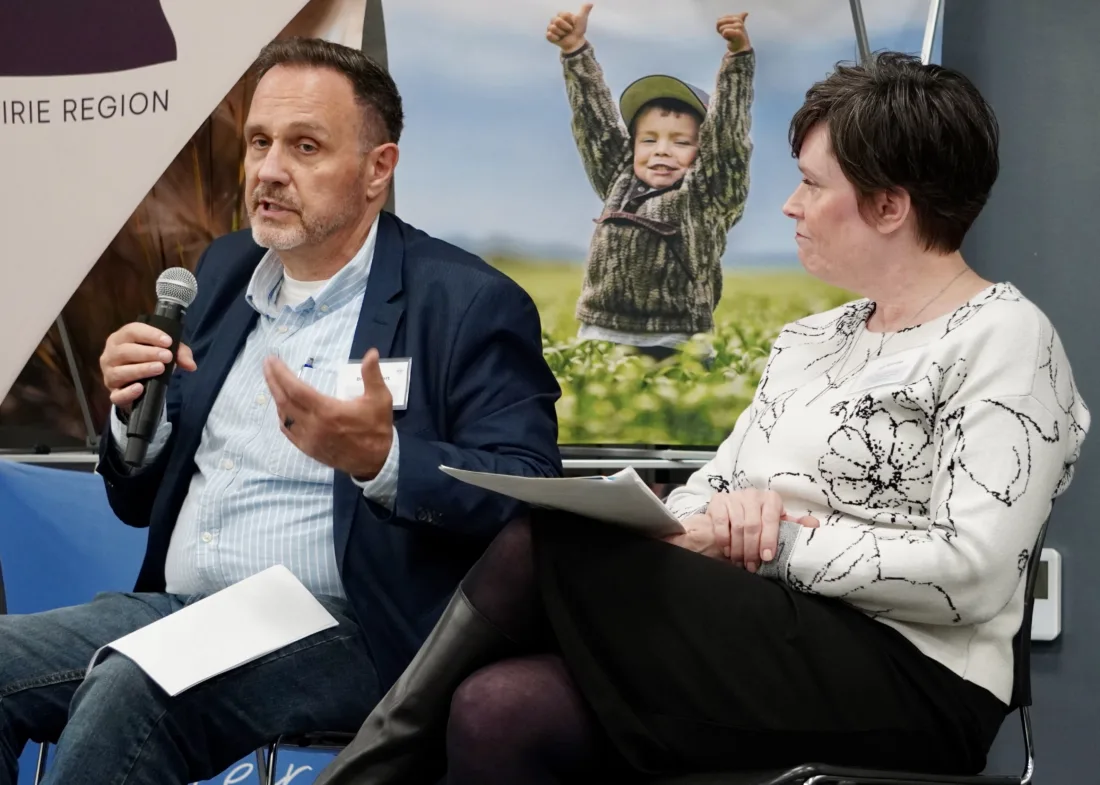
JILL SCHRAMM/MDN Brian Hoffart, executive director for the Rugby Job Development Authority, left, speaks during a panel discussion on rural housing as Lisa Rotvold, executive director for the Red River Community Housing Development Organization, listens at right. A large poster in the background captured aspects of the theme of Souris Basin Planning Council’s State of Region 2 event held in the Minot Area Workforce Academy Oct. 29.
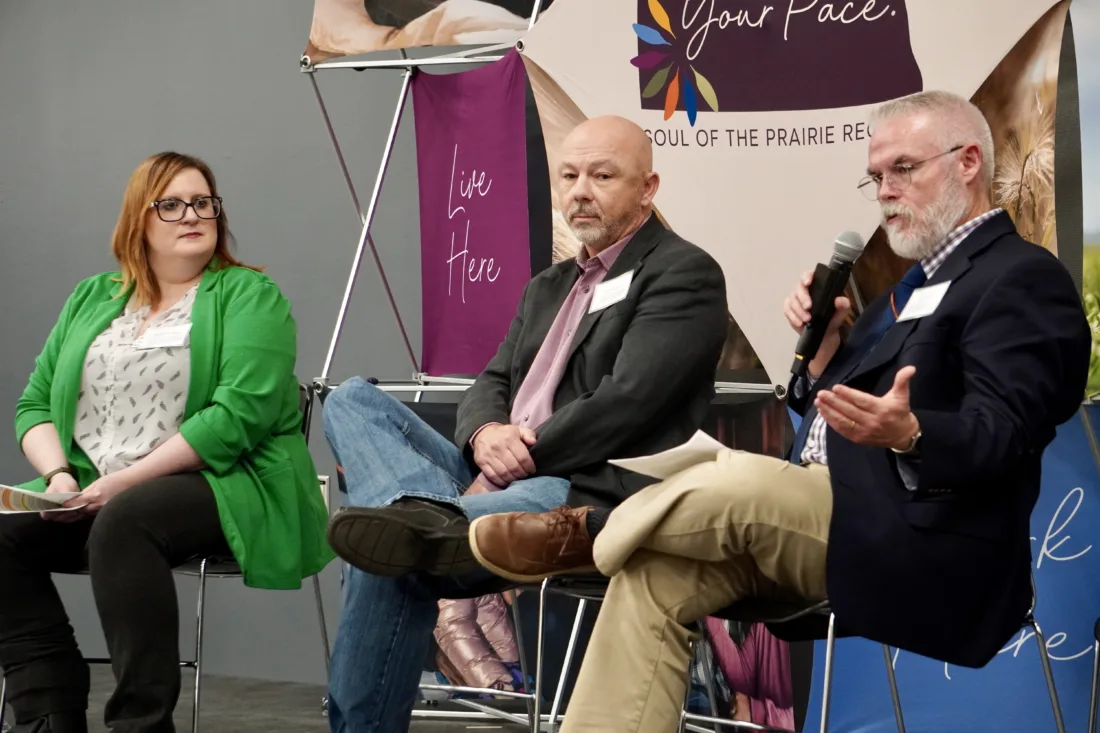
JILL SCHRAMM/MDN Dr. Steve Young, director of Career & Technical Education with Minot Public Schools, right, shares information as a member of a workforce panel during Souris Basin Planning Council’s State of Region 2 event in Minot Oct. 29. At left is Maggie Backen, Minot Programs director for Dakota College at Bottineau, and Lyle Krueger, assistant director for Central Regional Area Career and Technical Center.
JILL SCHRAMM/MDN Brian Hoffart, executive director for the Rugby Job Development Authority, left, speaks during a panel discussion on rural housing as Lisa Rotvold, executive director for the Red River Community Housing Development Organization, listens at right. A large poster in the background captured aspects of the theme of Souris Basin Planning Council’s State of Region 2 event held in the Minot Area Workforce Academy Oct. 29.
JILL SCHRAMM/MDN Dr. Steve Young, director of Career & Technical Education with Minot Public Schools, right, shares information as a member of a workforce panel during Souris Basin Planning Council’s State of Region 2 event in Minot Oct. 29. At left is Maggie Backen, Minot Programs director for Dakota College at Bottineau, and Lyle Krueger, assistant director for Central Regional Area Career and Technical Center.
Trending
The successful strategies of rural communities to generate new housing and the region's efforts to grow its workforce were the focus of Souris Basin Planning Council's 2026 State of Region 2 event in Minot Thursday, Oct. 29.
"We're not waiting for the solution to come to us. We're making it," said Maggie Backen, Minot Programs director for Dakota College at Bottineau, who participated in the "Growing Talent, Strengthening Communities" panel discussion.
Backen, who oversees DCB's downtown Minot campus, said 70% of applicants for the career and technical programs are from Region 2, which includes Bottineau, Burke, McHenry, Mountrail, Pierce, Renville and Ward counties. Some are older than average students, who may have jobs and families and need a place close to home to train for a job change, she said.
Among DCB offerings in Minot are nursing, dental hygiene, dental assisting and paramedic programs.
"A strong workforce equals strong communities," said panelist Dr. Steve Young, director of Career & Technical Education at Minot Public Schools' Minot Area Workforce Academy. "(When) people have good jobs, well-paying jobs, they can afford to invest in their communities, whether it's buying homes or opening businesses."
What excites young students today are the opportunities, added Lyle Krueger, assistant director at Central Regional Area Career and Technical Center, based in Bismarck.
"Who would have thought that aviation could have been provided in Mohall?" he said of the types of training available. "What excites me most about this current generation is they really do want to do things, and they want to do things hands on. They want to be involved, and the more opportunities it seems like they get, the more they want it."
Opportunities need to be provided in a meaningful and cost-effective way, Young said.
"That training can be expensive if you're paying for it yourself, or out of pocket. So, it's an incredible opportunity for high school students to explore some of those things and gain some training, kind of under the auspices of public education. Then I think, also, our partnerships with business and industry are important as well. So, students have the opportunity to sort of dip their toe into the workplace and see what it's like."
He also noted the more expensive training programs make multi-school programs attractive.
"The more partners we have and the more students we can serve, we gain sort of an economy of scale," he said. "Our goal is not to duplicate resources but to expand those opportunities for students and make sure that students have access to things that they might not otherwise."
Krueger spoke of the mobile meat lab that is a collaboration of agriculture programs at schools in Bottineau, Newburg, Westhope, Velva, Towner and Granville. He also mentioned a program in Bismarck that enables students to assist businesses with projects that meet core standards in English, math or other curriculum areas. The Central Regional Area CTC started a “Transition to Teaching" program that has heightened student interest by bringing in industry experts to teach career and technical classes.
Backen said dental students and the community have benefited from a clinical program that, since February, has provided 300 patients with care such as teeth cleaning and X-rays.
"Not only are these students seeing the impact they have in that community, they are now intertwined in that community," she said. "It's really nice to see students excited about giving back."
Closely tied to workforce concerns is the issue of housing. Lisa Rotvold of Hillsboro, executive director of Red River Community Housing Development Organization, said communities often have jobs but can't hire because there is no housing.
"That's a big economic development issue, and it ripples through the community in many ways," said Rotvold, who participated in the "Rural Housing: Turning Need into Action" panel discussion.
Brian Hoffart, executive director of the Rugby Job Development Authority, said a lack of new homes, coupled with an aging housing stock, has placed a cap on his city's growth.
"It affects all the different industries that we have," he said. "It'll affect healthcare with our hospital. It'll affect job recruitment. It'll affect our schools, and so it does have a ripple effect all the way through the community."
Rotvold said building housing is about more than just finding a developer.
"We need to create an environment in our rural communities where the private sector can make money. One of the things we have to do is ensure that they can sell houses, which means people have to be able to get financing for houses. One of the key barriers has been appraisal gaps, and we have those because there has been so little new construction in our small towns that there are no comparable sales," she said.
Appraisal gaps limit how much potential homebuyers can borrow, creating a situation in which only people with significant funds on hand can afford to build. That creates risk for speculative home builders and for banks, Rotvold said.
In Rugby, about 50 lots have been available since 2013, with some custom homes built. Building speculation homes has been difficult, though, Hoffart said.
"I don't have developers. I don't have somebody willing on the private side to take on that risk," he said.
"We, as a nonprofit organization, are taking the risk," Rotvold said.
Red River Community House Development Organization created the Spark Building Initiative, which seeks to entice builders by bundling a project of at least two homes. By building a small number of homes throughout the region every year, it creates comparables to address the appraisal gap.
"Then it becomes a healthy real estate market, and things can kind of take over from there," Rotvold said.
Partnering with communities such as Rugby, the organization asks for a donated lot and a two-year tax abatement for the buyer. The organization hires a contractor and markets the home. If there is an appraisal gap, the North Dakota Housing Incentive Fund assists in covering it. With that support, Rugby was able to bring a contractor on board to build houses to sell.
"Now we have that momentum that we're able to utilize," Hoffart said. "It allows us to now go from people wondering why aren't we selling lots out in Chalmers Addition to 'Oh look, we have four or five houses being built out there.' So, it changes the conversation. It changes the environment. It changes the whole atmosphere of what's going on out there, and all of a sudden now it also creates an urgency that if somebody else wants to do something, they need to purchase the lots and get things going because if I don't do it now, there might not be any lots available."
Panelists Kevin Carlson and Ossie Tande of Powers Lake spoke about their community's past effort to create more housing to accommodate oil field and Border Patrol workers. Tande said the Powers Lake Housing Corp. was created with investments from about 35 residents and other supporters, enabling the construction of seven houses.
"When we got done, we got most of our money back, if not more," Tande said. The corporation also removed several houses that needed to go, improving the town's aesthetics, he said.
"It brought in people and it brought in business," he said of the corporation's efforts, which closed out in about 2017 but could be revived.
"There's more need for it again," Tande said.
Following the panel discussions, North Dakota State University Extension facilitated an interactive session with attendees at the event to identify priorities related to housing and workforce and explore practical strategies for advancing solutions.