
ND Ethics Commission comes to Minot
Trending
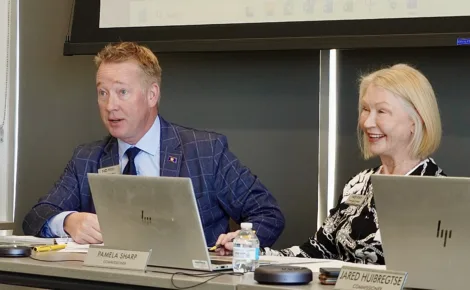
Several local citizens took the opportunity to learn about state government accountability when the North Dakota Ethics Commission brought its business to Minot on Wednesday, Sept. 30, with an invitation to the public to come and speak out.
"The work of the Ethics Commission belongs to all the people," said Commission Chair Pamela Sharp, former director of the state Office of Management and Budget. "At its core, the Ethics Commission is about public trust. People should be able to have confidence in their government decisions - that they're being made fairly, that public officials understand their ethical responsibilities and that there’s an independent place for questions and concerns."
Although the audience had few questions, there was interest in how the commission, created by voters in 2018, interacts with the Legislature.
"There is this tension that we are still working through - where the Ethics Commission's authority ends, where the Legislature’s authority begins and how the two entities, as well as the executive branch of government, all work together in harmony," said Commissioner Mark Western, a Stanley native and Williston attorney. "It's not perfect. It's not easy, but I think that it's safe to say that everybody wants transparent and accountable government in North Dakota, and there are reasonable minds who have different ideas about how to get there."
Western proposed the commission ask for policy legislation in the 2027 session to create penalties or sanctions for ethical violations or filing of a complaint in bad faith. He also suggested legislation to establish the commission's power to order documents or testimony in the course of an investigation.
Commissioner Jared Huibregtse of Mandan, who works for an engineering firm, said the commission already might have the authority to establish policy, but he prefers working with the Legislature.
"It's a show of good faith that we're not trying to expand our authority in some non-legal way. I think I prefer having them on board with our mission, even though it may not be legally necessary," he said.
Policy bills have had mixed results in past sessions, whether initiated by the commission or by legislators. The commission can introduce legislation as a state agency but debated Wednesday whether working with supportive legislators to introduce the bills might be wise.
Feeling time pressure with the Legislature convening in January and sensing the topic needs more discussion, the commission plans to meet again in about two weeks to determine a course of action.
The commission indicated its budget proposal is its top legislative concern.
"We are going to ask for two additional staff people, and it's a big request," Sharp said in response to a citizen's question about staffing. "But that is what we believe we need."
The commission's proposed 2027-29 budget of just over $2 million is up from about $1.36 million appropriated for the current biennium, according to Executive Director Rebecca Binstock with the Ethics Commission. The budget adds funding for more office space and for per-diem pay for commissioners, who are spending more time on the duties of the job. It also proposes more money to cover travel costs.
The meeting in Minot was the second time current commissioners have traveled to be more accessible to citizens. They had moved their May meeting to Fargo. A previous commission, with different commissioners, had held a meeting in Grand Forks. The commission indicated it hopes to hold more meetings across the state, including in communities other than the state's four largest cities.
"It's a good opportunity for us as a public to attend a meeting and see what they do and some of the issues they are having - and that we can have an opportunity to comment," said Cheri Bonebrake, president of the Plum Valley League of Women Voters, who attended with other league members.
Bonebrake said it was interesting at Wednesday's meeting to hear the advisory opinions given to the commission on ethics questions posed to it. She especially agreed with the advice that the State Auditor should decline outside funding assistance to attend a conference.
Along with responding to complaints, the Ethics Commission seeks to educate and serve as a resource on matters of ethics. In response to state audit concerns with the N.D. Development Fund, the commission took a proactive step Wednesday in directing its staff to connect with the fund's legal counsel about its conflict of interest policy as a first step toward potentially offering assistance to strengthen that policy.