
MSU observes Orange Shirt Day
Remembrance walk fosters solidarity
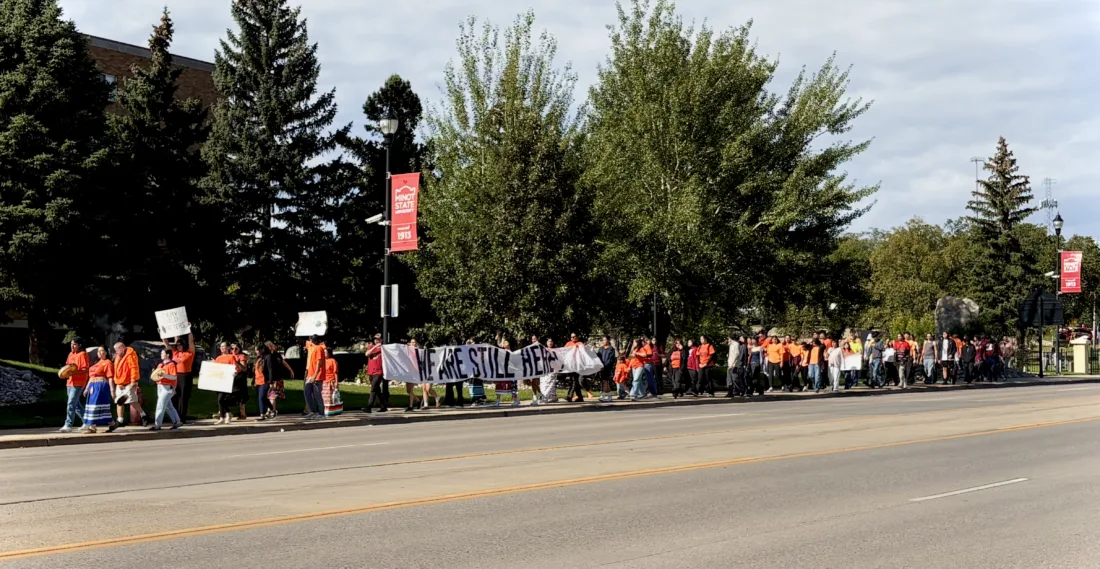
HANNAH VELASQUEZ/MDN The Minot State University Native American Club walks to remember and honor Indigenous children and families who were affected by residential schools for Orange Shirt Day on Sept. 30.
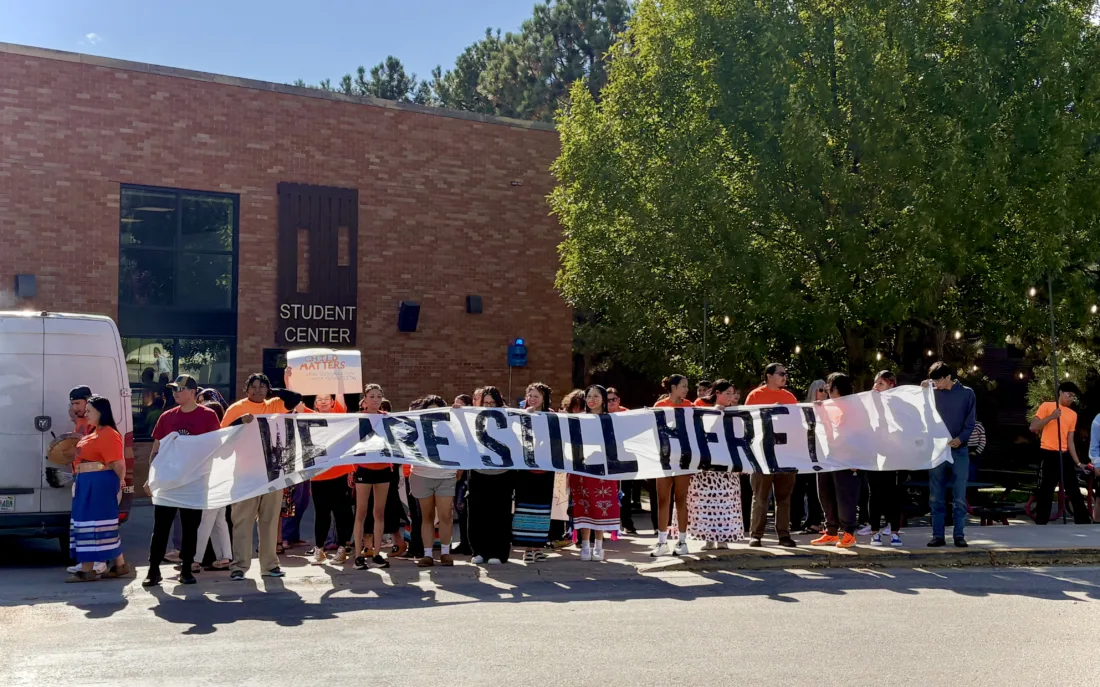
HANNAH VELASQUEZ/MDN The Minot State University Native American Club carries a "We Are Still Here" banner for Orange Shirt Day on Sept. 30.
HANNAH VELASQUEZ/MDN The Minot State University Native American Club walks to remember and honor Indigenous children and families who were affected by residential schools for Orange Shirt Day on Sept. 30.
HANNAH VELASQUEZ/MDN The Minot State University Native American Club carries a "We Are Still Here" banner for Orange Shirt Day on Sept. 30.
Trending
The Minot State University Native American Club held a community gathering at the Beaver Dam on Wednesday Sept. 30, for Orange Shirt Day. According to the club, the National Day for Truth and Reconciliation (NDTR) honors Indigenous children and families who were affected by residential schools.
The club presented speeches and personal stories before moving outside to conduct a prayer, smudge and a walk around campus.
To honor the children who suffered and died in the residential school system, indigenous groups and allies walk, fostering community solidarity and ongoing reconciliation, according to the club members. Participants held signs that said “Every Child Matters” and a banner with “We are Still Here,” displayed as they walked from the Beaver Dam, to 11th Avenue, to Broadway, to University Avenue and back to the Beaver Dam.
“People are encouraged to wear orange as a symbol of solidarity, remembrance and belief that every child matters,” Lisa Hale, Minot State University Native American Cultural Center coordinator said. “It is a call to remember that every child matters and to open conversations about the impacts of residential schools and the ongoing healing process.”
Minot State’s Orange Shirt Day is the city’s only remembrance event this year and happened because the club members wanted to hold the gathering, according to Hale. In her speech she said education, research, advocacy and community initiatives to address the history of residential schools are important.
“We can encourage education by using resources from websites such as the Orange Shirt Society, and teaching guides, survivor stories and interactive maps of boarding schools,” Hale said. “We also need to support healing. We need to contribute to research, advocacy and community initiatives that address the legacy of residential schools.”
Hale said the residential schools, also known as boarding schools in the United States, caused generational trauma to many Indigenous families throughout North America. Hale, along with members of the club said family members such as parents, grandparents and great-grandparents are still unable to discuss their own experiences in residential schools due to the abuse they faced.
The Canadian federal government recognized Sept. 30 as the NDTR in 2021.
“September 30 is the national day for Truth and Reconciliation. Also called Orange Shirt Day, an Indigenous-led grassroots movement inspired by Phyllis Webstad,” Hale said. “Phyllis Webstad attended her first day of boarding school at St. Joseph’s Mission in 1973. Her grandmother bought her a beautiful orange shirt to wear. That shirt was stripped away and replaced by a uniform. She never saw that shirt again.”
The residential school system lasted for more than 160 years. Beginning in the early 19th century and ending in 1997, with the last federally funded school residing in Canada, according to the Indian Residential Schools Settlement Agreement. Across Canada and the U.S., children were forcibly separated from their families as governments and churches culturally assimilated Indigenous children.
“According to the coalition of Natives and allies, more than 150,000 Native children in Canada and hundreds of thousands in the U.S. were taken from their families by law as young as age 4 to what are called boarding schools in the U.S., or residential schools in Canada, starting in 1879,” Hale said. “The Canadian Indian residential school system was a government-funded network of boarding schools, operated by Christian churches from the 19th to late 20th century. Its purpose was to remove Indigenous children from their families, cultures and languages in order to assimilate them into society.
“Attendance became mandatory for many Indigenous children, and approximately 150,000 children attended these schools over more than 160 years. Many children were sent far from their communities, limiting contact with their families and traditional ways of life. Children in residential schools were forced to give up their Indigenous identities by cutting their hair, wearing uniforms, speaking only English and using English names. The schools were harsh, especially for younger children who had forcibly been separated from their families and forced to abandon their Native American identities and culture. Children in residential schools sometimes died due to infectious diseases. Investigations later revealed cases of physical, emotional and sexual abuse.”
Crystal Alvarado from MHA Nation and a recent graduate from MSU detailed and discussed her and the university’s work toward researching and finding unmarked graves and partnering with Native American tribes. Her work focuses on the Fort Time Indian Industrial School. Alvarado’s hypothesis and scientific work is based in noninvasive Unmanned Aerial Systems LIDAR geopolitical data science.
“Our hope is that our work serves as a meaningful step towards bringing those truths to light, that every child matters and you will always honor and respect them,” Alvarado said.
Hale said the impacts of residential schools continue to affect the Indigenous communities today, contributing to generational trauma, substance abuse and mental health challenges. Despite 973 indigenous children dying in U.S. boarding schools, according to Hale, the U.S. still does not have a federally recognized day of remembrance.
“More than 130 residential schools operated across Canada. These atrocities also happened in the U.S.,” Hale said. “417 federal boarding schools, 973 children died at U.S. schools and there are 74 burial sites. Many of them are unmarked. The U.S. does not have a remembrance day. We need truth to acknowledge what happened, honor lived experiences and begin work of reconciliation.”