
Fossilized T. rex footprints airlifted from grasslands
Trending
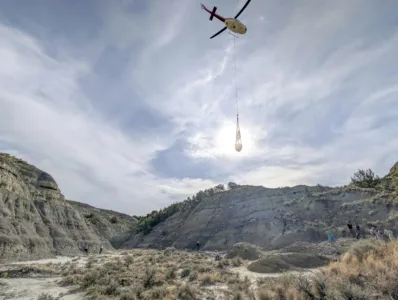
BISMARCK - A rare helicopter airlift in early October successfully removed three massive sandstone blocks containing fossilized Tyrannosaurus rex footprints from the Little Missouri National Grasslands in western North Dakota, marking a major step in preserving one of the most scientifically significant T. rex trackways documented in the region, according to the North Dakota Forest Service.
The footprints are part of a four-track sequence first documented in 2025 in the Hell Creek Formation near Marmarth. While the find built on decades of paleontological study in the Badlands, its scientific importance continues to grow as researchers investigate the ancient environment around the tracks and the behavior they capture.
Dating back roughly 66.5 million years, the impressions capture the deliberate steps of an estimated 7-ton adult T. rex. The 23-foot trackway, located on federal land managed by the Dakota Prairie Grasslands, includes four heavily weathered, three-toed tracks -- two left and two right -- each about 3 feet long. With a stride length of about 13 feet, scientists estimate the dinosaur was walking at 3.5 to 4.5 mph.
"Bones tell us an enormous amount about these animals, but footprints capture a moment of behavior," said Dr. Tyler Lyson, senior curator of vertebrate paleontology at the Denver Museum of Nature & Science. "With a trackway, we can actually follow an animal as it moved across the landscape. That is incredibly rare for T. rex."
To document the fragile impressions, researchers used high-resolution 3D scanning to capture detailed digital models of the trackway and individual footprints. Because the tracks are weathered, all measurements and speed estimates remain approximate.
To ensure long-term preservation, Lyson coordinated with U.S. Forest Service staff and interns to remove the most fragile sections. After each footprint block was carefully jacketed in plaster, a Helicopter Utility (HU-1) hovered roughly 40 feet over the site as Lyson attached the plaster-wrapped stones to a cargo net suspended beneath the aircraft. Each block was flown to a staging area, loaded onto a flatbed truck, and transported to the Denver Museum of Nature & Science for further study.
Although the trackway was discovered on public land, its precise location remains undisclosed to protect the resource. The U.S. Forest Service manages scientific fossil collection through Paleontological Research Permits issued under the Paleontological Resources Preservation Act.
The footprints will eventually go on display at the Denver Museum of Nature & Science.