
Family recalls heritage in Minot
Greek immigrants had vibrant presence
Trending
For several decades, the influence of an entrepreneurial enclave of Greek immigrants helped shape Minot's community life.
That influence has become less apparent with the passing of a generation. Yet for Minot resident Vivian Zimmerman, the daughter of Greek immigrants, some of those traditions and memories still are preserved, often through photos and family recipes.
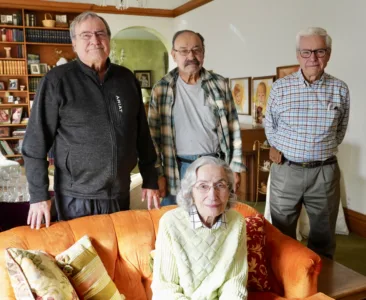
Zimmerman recently gathered with three of her brothers to reminisce about their parents and other Greek families who played a role in Minot's history. They recalled Greek language studies, religious rituals and strong community ties that kept the culture thriving despite the pull of assimilation into America's melting pot.
Zimmerman and Alex, Peter and Andrew Maragos, all of Minot, remain from the nine siblings born to George and Constance Maragos.
"My mother emigrated with my grandmother to St. Paul, Minnesota, in 1923. Dad came to Lowell, Massachusetts, with another young man from his village in 1912," Zimmerman recounted.
George Maragos, then 16, worked in a cotton mill in Lowell, where he had joined his godfather, also his immigration sponsor, who earlier had immigrated from their village in the mountains of north central Greece. Like many Greek immigrants from his village area, Maragos eventually found work with the Great Northern Railroad. The railroad brought Maragos to Minot in 1914 to work with a section gang between Minot and Churchs Ferry.
Maragos later served in France during World War I, driving a team of horses pulling wagons and artillery. He met and married Constance Angelopoulos, a native of southern Greece, in St. Paul in 1930.
While Minot's community of Jewish residents often ran clothing stores, Greek immigrants typically opened food-related establishments or taverns. Most of those businesses are gone or long ago changed ownership. Among the former Greek businesses were Tick Tock Tavern, replaced by the Blue Rider, and Charlie's Cafe, founded by Charlie DeMakis in the late 1950s and now known as Charlie's Main Street Cafe.
As an early venture, George Maragos and another Greek immigrant, Alex Pedas, opened New York Shoe Shine Parlor. Maragos went into the confectionery business and later joined Pedas to start Minot Food Store, which George Chumas purchased from Ted Pedas in 1964. Maragos opened his first Cut Rate Food Market in about 1929.
Maragos' grocery operation grew to four neighborhood stores, often with associated bars.
"In those days, they spent money on the basics, and every extra penny they reinvested," Andrew Maragos said of the Greek entrepreneurs.
The Cut Rate groceries sponsored several local baseball teams for the Minot Recreation Commission. Maragos also sponsored bowling teams, including a family team, Maragos and Sons. A bowling enthusiast, he had owned a four-lane bowling alley in downtown Minot at one time.
George Maragos had good relationships with area farmers from whom he would buy produce. He bought cattle and operated a butcher shop at the back of one of his stores. He made his own ice cream under the Cut Rate label, using cream from local farmers. When food regulations became more strict, the cream came from Williston Creamery, according to Peter Maragos, who recalls picking up the cream from the train depot.
Not all the business ventures that Maragos entered - often jointly with other Greek investors - worked out, although the details never passed down in the family history.
"He was not interested in talking about himself and so we did not pester him because he did not suffer us gladly," Andrew Maragos chuckled. "But he certainly had a lot of different ventures before he bought that land on the north side of the bridge, where Sammy's (Pizza) is now."
The land to the south of Sammy's, at Fourth Avenue Northwest and Broadway, was the site of his grocery, bakery and wholesale operation. Maragos delivered bread as far as New Town. He built a meat-packing plant in southeast Minot.
"Eventually the federal inspection came in and drove a lot of the small butcher shops, meat packers, out," Andrew Maragos said. The plant had been called the Minot Abattoir, the French word for slaughter.
The siblings also recalled how their father would allow railroad customers to charge at the grocery when they couldn't pay, even though some never did settle up at the end of the month. His stores never closed unless required by a Sunday closure law, and Zimmerman said if he received a call from someone needing groceries on a holiday after he'd closed the store, he would reopen for them.
"He cared enough to let things interrupt the little bit of time that was his because, I think, he had just an innate caring for people," Zimmerman said.
His family also recalled Maragos' efforts after World War II to hire veterans, giving them employment until other jobs opened up. George Maragos was active in the American Legion and the WWI Forty & Eight organization.
The Maragos siblings, including Steven, Ted, Sam, James and Angelo, now deceased, all learned a work ethic at a young age.
"The standing joke amongst my parents’ friends was that when the boys were old enough to see over the top of the counter, my dad would put an apron on them and they would go to work," Zimmerman said.
"Before we could even see over the top of the counter, we were sacking potatoes and sugar," Alex Maragos added.
Peter Maragos remembers using an electric grinding stone to pluck feathers from chickens being butchered, and Andrew Maragos recalls filling bags of potatoes as a youngster, gauging 10 pounds by the location of the needle because he couldn't read the scale.
As adults, most of the Maragos siblings were involved in the operation of the family-owned Holiday Inn Riverside while also engaging in other ventures. The operation started with the Riverside supper club and added the hotel and later a convention center. Jim Maragos ran the hotel for many years. Zimmerman was catering manager after it opened in 1983, and Alex Maragos was executive chef.
Ted Maragos, a Grand Forks attorney, served a term in the state Legislature in the early 1960s. Andrew Maragos later served 22 years in the Legislature.
George Maragos died in 1978 and Constance Maragos in 1986.
"The thing that I feel our parents were so focused on was, number one, that we were good citizens, that we obeyed the law, and Dad always said, 'You have to work for a living. Nobody owes you a living, and if you work an honest job and make an honest dollar, then you have fulfilled your responsibilities.' They were very, very adamant about how we conducted ourselves because, I think, they felt it reflected on them as foreigners," Zimmerman said. She said it also likely stemmed from a time when there was bias against Greek immigrants.
For herself and her siblings, it was less about proving themselves and more about being conscious of being American, Zimmerman said.
Alex Maragos noted it was exceptional that their mother raised nine children nearly single-handedly while their father managed up to about 10 different businesses and probably close to 80 employees after coming to a new country with minimal education.
Zimmerman said their mother played a major role in instilling heritage.
"She cultivated our ethnic culture," she said. "She insisted that we learn to read and write Greek, and we had Greek priests - priests that were born in Greece - and they would have what we called Greek school. After we would be finished with our regular school day, two or three times a week we would go to the church for Greek lessons."
Zimmerman said there had been almost 250 Greeks who used to meet in the basement of a downtown cafe. Eventually, they purchased a Pentecostal church building and consecrated it as the Greek Orthodox Church in 1934 after meeting there for a couple of years.
Andrew Maragos said when the Greek Orthodox diocese no longer could send a priest, it requested the American Orthodox Church come. In 1980, St. Mary's, the Greek Orthodox jurisdiction, became inactive, and the Greek families joined St. Peter's, the American Orthodox Church. Greek language services had been largely phased out by 1950.
The church was the center of social events, of which the main communitywide event was the annual Greek Picnic from 1945-1995 that would attract more than 1,000 people to the fairgrounds. Within the church, a dinner was held on All Saints Day, and Greek Independence Day was celebrated on March 25 with a dinner, patriotic drama and ethnic dancing.
"We used to do our own Mardi Gras, which was the beginning of our Lent season," Zimmerman said. "We always would have a costume."
Zimmerman also recalled the Names Day gatherings. Instead of celebrating birthdays, they would celebrate the day of the saints who shared their names.
Greek fraternal organizations that existed were the fraternal Hellenic Education Progressive Association for men and Daughters of Penelope for women. The youth group was Greek Orthodox Youth of America.
Alex Maragos said the Greek families had two Easter vacations because the Greek Easter was later on the Gregorian calendar than the American Easter was on the Julian calendar, and both were celebrated.
"The Greek community found things to celebrate and ways to celebrate," Zimmerman said. "Later generations fell away from all of that."
However, the one-day Greek festival that replaced the Greek Picnic was held annually for about 10 years at the Riverside, until the declining size of the Greek community made the festival no longer feasible.
Outside of the Maragos family, only a handful of descendants of Greek immigrants still call Minot home.