
AGRICULTURE NEWS
Trending
NRCS extends program application deadlines
The U.S. Department of Agriculture’s Natural Resources Conservation Service (NRCS) in North Dakota is extending the Fiscal Year 2027 application batching period for several conservation programs to provide producers additional opportunities to apply for funding and conservation assistance.
The extended batching period applies to the Environmental Quality Incentives Program (EQIP), Conservation Stewardship Program (CSP), and the Agricultural Conservation Easement Program (ACEP).
“North Dakota producers continue to show strong interest in voluntary conservation programs that improve the productivity and resilience of their operations,” said NRCS North Dakota Acting State Conservationist Jarvis Keney. “By extending the batching period, we are providing producers additional time to work with NRCS and submit applications that can help address resource concerns while strengthening their farming and ranching operations.”
EQIP provides financial and technical assistance to agricultural producers to address natural resource concerns and improve water quality, soil health, air quality, wildlife habitat, and overall land productivity.
CSP helps agricultural producers build upon existing conservation efforts while maintaining and improving the operation’s productivity and sustainability. Participants earn payments for implementing additional conservation activities and enhancing existing practices.
The Agricultural Land Easement component of ACEP enables producers to protect their agricultural land from development by enrolling it in a permanent Agricultural Land Easement. The Wetland Reserve Easement component of ACEP helps landowners protect, restore and enhance wetlands which have been previously degraded due to agricultural uses.
While NRCS accepts applications year-round, producers interested in being considered for Fiscal Year 2027 funding should submit applications by Nov. 13. Applications can be submitted through local USDA Service Centers.
USDA helps address salinity in prairie pothole region
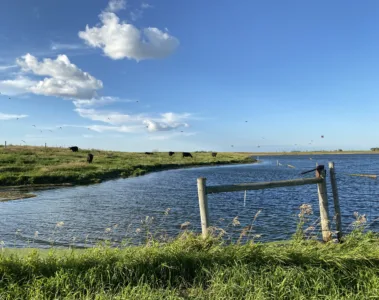
WASHINGTON - The U.S. Department of Agriculture is investing $30 million to help North Dakota producers address salinity challenges across the Prairie Pothole Region -- one of the largest wetland landscapes in the nation, containing 1.6 million wetland basins across 39 counties.
This targeted investment from USDA's Natural Resources Conservation Service (NRCS) will support conservation practices that improve soil health, protect water quality, strengthen agricultural resilience, and enhance long-term wildlife habitat through the new Prairie Revitalization and Agricultural Improvement for Resilient, Integrated Ecosystems (PRAIRIE) effort.
"Producers in North Dakota are facing real challenges from salinity, especially in areas shaped by prairie potholes and seasonal wetlands," said NRCS Chief Colton Buckley. "This investment gives us an opportunity to support local leadership and expand conservation practices that strengthen both agricultural production and the broader landscape."
Local working groups have all identified salinity and chemical concentrations as a top resource concern in the state for fiscal year 2027. Saline-related issues often develop in and around wetland basins, reducing crop performance, limiting soil function, and complicating field operations across the Prairie Pothole landscape.
Through the PRAIRIE effort, NRCS will work with producers to apply a suite of proven conservation practices by expanding the list of primary practices available under NRCS's Regenerative Pilot Program (RPP). This expanded list now includes vegetative buffers, filter strips, grassed waterways, salinity-management techniques, annual forages and wildlife-habitat improvements. It will allow producers to address salinity in both upland and wetland-influenced areas.
"Producers have been asking for more tools to deal with salinity, and this investment answers that call," said NRCS North Dakota State Conservationist Dan Hovland. "By supporting
practices that reduce salinity and improve soil function, we're helping producers maintain productive ground while protecting a landscape that is vital for agriculture, wildlife and water quality within the Prairie Pothole Region of North Dakota."
The PRAIRIE effort began this fall. Producers interested in voluntary, conservation-driven approaches to managing salinity are encouraged to contact their local NRCS office.
Senators hear from ND producers
FARGO - Sen. John Hoeven held a roundtable Oct. 6 with Senate Agriculture Committee Chairman John Boozman (R-Ark.) at North Dakota State University with producers, commodity groups and agriculture researchers. Hoeven invited Boozman to the state to hear directly from North Dakota farmers, ranchers, researchers and agri-businesses as the senators continue their efforts to:
- Advance the implementation of the farm safety net enhancements passed as part of the Working Families Tax Cut Act (WFTCA), also known as the One Big Beautiful Bill (OB3), which go into full effect this month.
Under this legislation, reference prices for the Agriculture Risk Coverage (ARC) and Price Loss Coverage (PLC) programs were increased by 10% to 20%. As a result, North Dakota will receive an estimated $721 million this month in payments for the 2025 crop year under ARC and PLC, according to the Senate Agriculture Committee. The updated reference prices resulted in an estimated increase of $456 million for North Dakota producers in the 2025 crop year, up from the $265 million producers would have received without the WFTCA's passage.
This comes in addition to the improvements to crop insurance affordability from Hoeven's FARMER Act provisions, which were included in WFTCA. This will provide more than $91 million in additional premium support for North Dakota producers in 2026, according to projections from the NDSU Agricultural Risk Policy Center.
- Pass the Farm Bill into law and ensure the final legislation includes key wins for agriculture producers from the Senate's version of the bill. The bill builds on and further strengthens the WFTCA farm safety net improvements, supports the development of greater market opportunities for agriculture producers and authorizes the year-round sale of E15.
- Work with U.S. Trade Representative Ambassador Jamieson Greer to protect domestic sugar producers and push back on foreign nations dumping into the U.S. sugar market.
"We made significant enhancements to the farm safety net in the Working Families Tax Cut Act, improving the affordability of crop insurance, strengthening livestock disaster programs and updating the counter-cyclical safety net so it reflects the actual cost of production. This month, those policies come into full effect and deliver meaningful assistance to North Dakota producers, who are set to receive an estimated $721 million from ARC and PLC for the 2025 crop year. In times of market uncertainty and increased input costs, those funds will make a real difference for our farmers," Hoeven said. "The Senate's Farm Bill 2.0 builds on that good work and includes more than 100 bipartisan bills to support the long-term success of our farmers and ranchers. We will continue working to move this critical legislation forward and get it passed into law."
Additionally, the Senate farm bill includes the following Hoeven-authored provisions:
- Increases Farm Service Agency direct and guaranteed loan limits.
- Adds fertilizer storage and handling infrastructure as eligible facilities under the Farm Storage Facility Loan Program.
- Provides matching grants to support state-led soil health and wildlife habitat programs, such as Gov. Kelly Armstrong's Legacy Soil Health and Habitat Program.
- Provides greater certainty for grazing permittees by preventing prairie dog colonies from expanding beyond reasonable levels.
- Includes an amendment based on legislation co-sponsored by Hoeven that requires mandatory country-of-origin labeling for beef.
- Reauthorizes the Joint Chiefs Program, which has provided more than $3.2 million for partnerships with private landowners to help improve and restore grasslands in North Dakota.
- Establishes a pilot program for pre-approval and pre-qualification of FSA Direct Farm Ownership loans.
- Authorizes USDA to study the potential inclusion of dry edible beans as a Title I commodity.
- Clarifies non-adult cattle weight categories in the Livestock Indemnity Program by establishing in statute, payment categories for calves weighing less than 400 pounds and 400 pounds or more.