
Minot doctor recalls Arctic adventure
Documentary coming to Minot Sunday
Trending
Traveling 1,400 miles across an uninhabited Arctic ice field tests one's mental fortitude, according to Dr. Jon Solberg, who made that trek eight years ago.
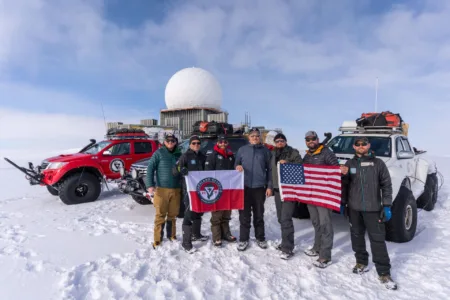
Solberg, a Minot emergency room physician, and six other team members made a south-to-north and back crossing of Greenland in three specialized Arctic-equipped Toyota trucks in the spring of 2018. Both the environmental dangers and human side of the expedition are documented in the film "Expedition: Greenland," to be shown at Minot State University on Sunday, Sept. 13.
"We had a plan, and things changed along the way. It's how you react to those changes and difficulties that determines the success of the trip, not whether you took a straight line there and back," Solberg said in recalling the adventure.
Solberg's training and background weighed into his selection for the expedition.
A Stanley native, Solberg moved to Minot and graduated from Minot High School. During his third year at the University of North Dakota School of Medicine in Grand Forks, he began a six-year stint in the Army, receiving training in emergency medicine and serving six months in a small field hospital in Afghanistan.
He was introduced to wilderness medicine through a course during residency. He later brought the course to the UND medical school, where he also chaired the Department of Emergency Medicine from 2019-2025.
Solberg also became a fellow in the Wilderness Medical Society and earned a diploma in mountain medicine from the University of Utah. He worked at a jungle hospital in Cameroon, Africa, for a couple of months.
His background and long-time connection with Overland Journal as medical editor opened the door for his participation in the Greenland expedition. When Greg Miller, a Land Cruiser collector and overland traveler from Utah, approached the Overland Journal regarding a possible medical team member for the expedition, he was led to Solberg.
"There are some opportunities that when they present themselves, you just can’t say no," Solberg said. "There may never be a chance to do this ever again. And it seemed like he had a solid plan and was very much interested in safety, and so I felt like we would be in good hands with Greg.'"
The seven individuals selected for the expedition included a mechanic, two navigators and filmmaker Clay Croft of Billings, Montana. Two were from Iceland and others from the United States.
The trip started on Greenland's southern coast.
"They had to figure out how we were going to get up on top of the glacier,' Solberg said. "It's like a wall of ice. They had hired these reindeer farmers and their snowmobiles to cruise along the coast and find a place where the slant was shallow enough that they thought the trucks could drive up.
"It was challenging because there really are no maps of Greenland. The glaciers are moving all the time," he added. "They had hired a company from Germany to survey those areas with a satellite, so we had some kind of an idea of where the crevasse fields were. But the rest of it is just unknown because it’s constantly moving and shifting."
In one incident, expedition support had been given the wrong coordinates for the ski plane to drop fuel needed by the team.
"We rolled up to where this fuel was supposed to be, and it wasn't there, and that was pretty nerve-wracking because your lives depended on this fuel to move the trucks and stay warm. It turns out it had been dropped about 50 miles away. Looking across that area, you could see there were all these crevasses along the coast. We had no imagery of that area, and so we had to take quite a detour just to go around this area and be safe," Solberg said.
The snow itself came in different varieties.
"It would be hard packed, and sometimes you could drive 50 miles an hour. Other times, you would be sinking in up to the axles and stuck, and we’d have to pull out winches and pull each other out. And other times it was like a corrugated road that was just shaking everything apart and breaking things," Solberg said.
"It was 40 below for much of the time," he added, "and no way to escape it except going inside of a vehicle. Every time you needed to fuel or fix something or stretch your legs, you had to get out into the 40 below."
The plan to camp every night was abandoned because of the time it took to fight the wind to set up tents. Instead, they drove around the clock. However, the trip also brought time to listen to audio books and music and enjoy great conversation with teammates, Solberg said.
"In spite of us having religious and political and even socio-economic differences, nobody ever argued. We were respectful of each other’s opinion and probably learned something from the other person," he said. "When you depend on somebody else for survival, you’re more tolerant of their differences, which is one of the reasons that travel and adventure is so great."
There were times he wondered what he had signed up for, though.
"There was a point, getting close to the northern end of the island, where we just had some really difficult things happen," he said. "There was some struggle amongst the group members about 'Should we keep going or not?' We had a mechanical failure, and the weather was terrible, and our safety was in question, and so there was talk about turning around."
The team stayed the course, ending the expedition at a shipping port on the southwest corner of Greenland.
As a physician, Solberg said, the expedition increased his awareness for not only the importance of healthcare but people’s access to it.
"There weren’t a lot of medical problems that happened on the trip, but the team members were able to do the dangerous things they did because they knew there was healthcare available for them," he said. "Knowing that you have access to healthcare, it allows you to function and feel safe."
Although the trip brought exhaustion, motion sickness and a case of frostbite, Solberg said his physician duties on the expedition were secondary to pulling his weight in all the other jobs that were necessary for survival. In working together, attachments formed that still exist among the team members.
"It's important for our mental health to not only help others but to be needed," Solberg said. "Getting out and having an adventure with somebody else helps to fulfill that hole that’s left by all the things that society has done for us, like instant coffee and drive-thrus."
Solberg’s continued quest for adventure led him after the Greenland expedition to later spend time in southern Africa twice and travel across Alaska.
The Study, formerly HumanitiesND, is hosting free, family-friendly screenings of "Expedition: Greenland" in Bismarck, Grand Forks, Fargo and Minot. The Minot event on Sunday is from 1-3:30 p.m. in Ann Nicole Nelson Hall.
Following the screening, Solberg will join adventure podcaster Brian Jackson of Bismarck and the audience for a conversation on risk, leadership and what extreme environments reveal about the human spirit.
Registration is requested on thestudynd.org website but is not required to attend.