
Forum focuses on housing challenges
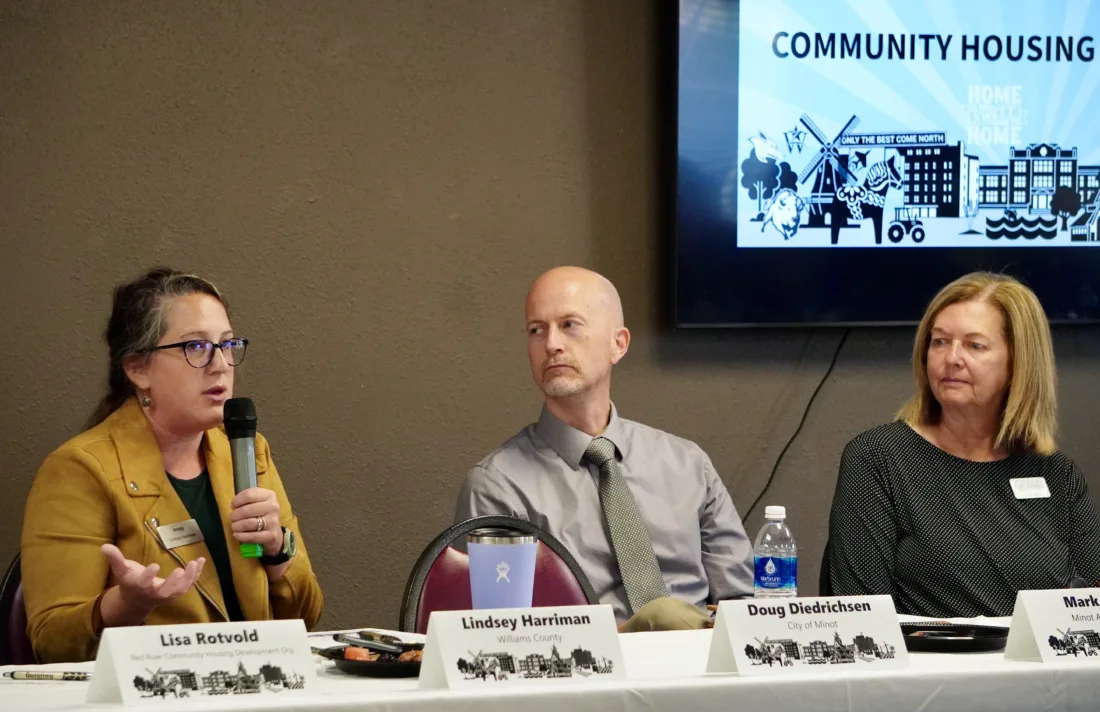
JILL SCHRAMM/MDN Lindsey Harriman, community engagement officer with Williams County, talks about housing in the Williston area as Mark Lyman with Minot Area Chamber EDC and Cheryl Merck with the North Dakota Center for Persons with Disabilities listen at right during the Community Housing Needs Forum in Minot Wednesday, Sept. 9.
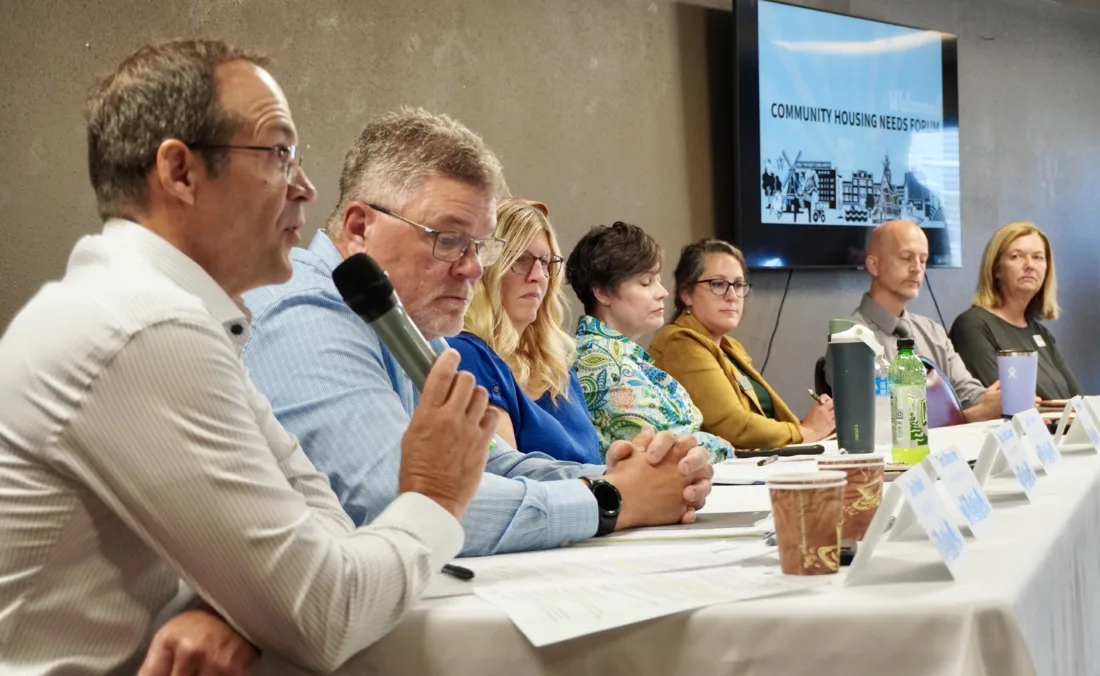
JILL SCHRAMM/MDN Dan Madler with Beyond Shelter, left, speaks during a panel discussion at the Community Housing Needs Assessment Forum on Wednesday, Sept. 9, in the Sleep Inn & Suites in Minot. Shown from left are Madler, Tom Alexander of Minot Housing Authority, Lisa Thuner with Town & Country Credit Union, Lisa Rotvold with Red River Community Housing Development Organization, Lindsey Harriman of Williams County, Mark Lyman of Minot Area Chamber EDC and Cheryl Merck with the N.D. Center for Persons with Disabilities.
JILL SCHRAMM/MDN Lindsey Harriman, community engagement officer with Williams County, talks about housing in the Williston area as Mark Lyman with Minot Area Chamber EDC and Cheryl Merck with the North Dakota Center for Persons with Disabilities listen at right during the Community Housing Needs Forum in Minot Wednesday, Sept. 9.
JILL SCHRAMM/MDN Dan Madler with Beyond Shelter, left, speaks during a panel discussion at the Community Housing Needs Assessment Forum on Wednesday, Sept. 9, in the Sleep Inn & Suites in Minot. Shown from left are Madler, Tom Alexander of Minot Housing Authority, Lisa Thuner with Town & Country Credit Union, Lisa Rotvold with Red River Community Housing Development Organization, Lindsey Harriman of Williams County, Mark Lyman of Minot Area Chamber EDC and Cheryl Merck with the N.D. Center for Persons with Disabilities.
Trending
North Dakota's anticipated housing growth of 7% through 2034 won't keep pace with the need, according to results of a study cited at a Community Housing Needs Forum in Minot on Wednesday, Sept. 9.
Brandon Dettlaff, executive director of the North Dakota Housing Finance Agency, said the study shows the state's housing supply is projected to fall more than 22,000 units short of demand by 2034.
Wednesday's forum spurred discussion on the status of housing in the Minot region and what needs to happen to increase supply, particularly the supply of affordable housing.
In Minot's region, the statewide study conducted through North Dakota State University identified a need for about 1,800 additional housing units by 2034. Not considering new enterprises coming to town, the study shows that will be enough.
"We know that's not correct. We know what's coming," Dettlaff said.
Mark Lyman, economic developer with Minot Area Chamber EDC, said if a proposed pig iron plant continues to move toward a 2027 groundbreaking, it would bring 1,500-2,500 construction workers and 650 permanent positions. The U.S. Air Force Sentinel missile upgrade could be several years out but would bring from 1,500-3,000 construction workers, he said.
Lyman said the City of Minot has permitted 230 single-family homes in the past four and a half years, along with 138 townhouse, duplex and twin homes and five apartment buildings.
"We are not in a panic mode on housing right now. We just need a little bit more," he said. "Let's increase it by 5 or 10 or 15 percent a year and I think we could get there."
"The other thing we're noting, too, is homeownership rates are actually falling," Dettlaff said. "It's just people getting priced out of the market."
In 2015, home prices of $250,000 or less made up 64% of sales. In 2025, they made up fewer than 34% of sales, according to the study.
Lyman also said there needs to be a mindset shift regarding what constitutes a starter home. He recently spoke with a developer who reported he is building $275,000 starter homes. Even getting to that price was only possible because the City of Minot adjusted setbacks to enable homes to be built closer together, he said.
To encourage construction, the City of Williston rebates some permit fees to those who build within a year, said Lindsey Harriman, community engagement coordinator for Williams County. The county has a housing incentive program that uses bed fees from man camps to invest in single-family housing, she said.
"So far, we've done over 100 homes through the program, primarily helping pay for infrastructure," she said. "On the buyer side, we help with closing costs and interest buydown."
The county helped the City of Ray obtain lots that it now can sell affordably for homes, Harriman said.
The statewide study showed Williston will need another 3,700 housing units by 2034. The forecast is for 969 units to be built.
Harriman said Williston hasn't had an apartment building constructed since 2016 despite significant construction jobs and a growing retail workforce that needs affordable housing.
"We're never going to be able to solve the multi-family problem and actually get our retail workers, our construction workers adequate housing until we can figure out the best lending strategy," Harriman said of the borrowing constraints developers find themselves in.
Beyond Shelter, a Fargo-based affordable housing developer, has six developments in Minot and one in Burlington for a total of 275 units. Partnering with the Minot Housing Authority, Beyond Shelter is building another 36 units of multi-family housing, CEO Dan Madler said.
Among the challenges is the extremely complex financing, he said.
"You have to bring in several layers of different financing and private investment. You also have to utilize the programs that are available that the state offers," he said. "It becomes a complex financing equation of how you make it affordable, and basically, it takes many stakeholders working together, utilizing many programs and getting them aligned."
Tom Alexander, executive director at Minot Housing Authority, said the authority is shifting to partnerships like that with Beyond Shelter. The authority plans to sell its 40 single-family and small-complex homes in Minot in two phases and use those proceeds to partner in creating new affordable housing units. Minot manages 128 public housing units in Williston and will be visiting with the housing board there on repositioning as well, he said.
"Hopefully, as things go down the road, we will be able to continue to provide affordable housing and get out of that old public housing mentality that we so desperately need to get out of because maintenance is expensive and we're underfunded in those areas," Alexander said.
Participants at the forum heard from state and federal program officials about the programs available to reduce blight that holds communities back and build more homes.
Chris Schilken, North Dakota Commerce commissioner, said legislators rejected a bill last session aimed at reducing investment costs by providing public funding for infrastructure. A new bill is being drafted for the 2027 session that would share the infrastructure cost equally among the state, local political subdivision and developer, he said.
Lisa Rotvold of Hillsboro, executive director of Red River Community Housing Development Organization, spoke about the organization's Spark Build Initiative to bring new housing to small towns. The organization has facilitated new homes in Lakota, Larimore, Park River and Grafton. Seven additional homes under construction in small towns and six more breaking ground this fall, she said.
"As we have built, more is happening in the private sector, which was our goal," Rotvold said. "We want to jumpstart. We want to create some comparable sales and make it less risky for the private sector to come in and do the work themselves."