
Farmers, officials call for wetland easement changes
Trending
VALLEY CITY - North Dakota's congressional delegation, state agriculture commissioner and Interior Secretary Doug Burgum were joined by North Dakota landowners and farmers in Valley City Friday, Sept. 25, to call for greater accountability and improvements related to wetland easements.
Landowners and farmers in North Dakota have faced longstanding frustrations with perpetual U.S. Fish and Wildlife Service (FWS) wetland easements, many of which were acquired without maps delineating covered wetlands, according to U.S. Sen. Kevin Cramer, R-ND. Subsequent regulatory creep has expanded control of their farmland without any additional financial compensation, all while degrading soil quality and diminishing agricultural productivity, he added.
Cramer and Burgum held a closed-media roundtable discussion focused on gathering information from local landowners and discussing potential solutions to landowners' concerns. The roundtable provided Burgum and Trump administration officials an opportunity to hear directly from North Dakota landowners about the challenges facing the Prairie Pothole Region.
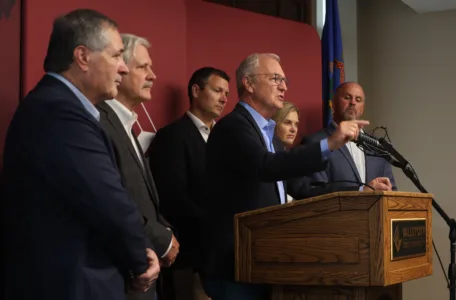
Following the event, Cramer, Agriculture Commissioner Doug Goehring, U.S. Sen. John Hoeven and U.S. Congresswoman Julie Fedorchak, both R-ND, hosted a news conference with local farmers. Participants called for greater accountability and improvements from the Department of the Interior and FWS, while seeking legal clarity and regulatory certainty for landowners with FWS easements.
"The wrap-up is simply that progress is being made," Cramer said. "But I'm very interested in an outcome -- not just the plan and promises -- but so far, Secretary Burgum and the Interior Department, Fish and Wildlife Service, have fulfilled what they've said they would do in terms of the remapping and the pilot program."
"We recognize that there's been some egregious behavior and that when you consider and look at the pre-'76 easements, it lacks clarity, it lacks intent and it lacks substance, and then the arbitrary actions taken by the government really have not been fair to those people that signed those contracts," Goehring said.
North Dakota farmers shared personal experiences. Fields that were once highly productive now suffer from stunted yields because water management systems cannot be installed to manage excess water. Salinity has further hindered production, LaMoure County farmer Cody Peterson said, but installing the needed drainage could have put him in conflict with FWS.
Steve Hansen, a farmer in Oakes, said conservation easements have made it harder for him and other farmers to produce food and argued the restrictions ultimately hurt wildlife populations. Drew Courtney, another Oakes farmer, said the policy disregards private property rights and leaves farmers forced to "watch (their) land go backward."
"We aren't allowed to maintain these wetlands that were purchased 50, 60 years ago," Hansen said. "That's all we're asking. Let us manage them. We can help the hunters. We can help the farmland. We can help soil health. We can accomplish it all. We are providing solutions to that, and we will get it done. And I think the best part about all that is we can quantify it. We can back it up with data. And it's not just me saying it. I'll take you right to my farm. We're doing it right now. That's the message we need to get across, and I want to see that happen, and I'll do whatever it takes because it is that important to our duck hunters, to all of our hunters, and to our farmers around the state, to help them stay in North Dakota, even more than we have been already."
"Private property rights are a huge deal, especially in the state of North Dakota," said Kyle Courtney of Oakes. "There are anywhere between four and six million acres that are under these units in the state of North Dakota."
The issue has spanned multiple administrations. In 2020, the first Trump administration sought to address concerns over older wetland easements through an administrative mapping process and new guidance on drain-tile setbacks. The effort was intended to give landowners greater clarity over easement boundaries and the circumstances under which water management improvements could be made.
The Biden administration later finalized a 2024 rule establishing a process for determining drain-tile setbacks on a case-by-case basis. Cramer and other critics argued the rule did not provide landowners with sufficient certainty and instead deferred to the bureaucracy to calculate arbitrary setback distances.
Prior to Friday's roundtable, the Department of the Interior announced FWS would incorporate feedback from North Dakota farmers, ranchers and conservation partners as it updates and expands an innovative Prairie Pothole Wetland pilot project addressing landowner concerns, particularly with wetland easements purchased prior to 1976.