
Ordinance would regulate data centers
Trending
An ordinance regulating data centers cleared the Minot Planning Commission last week after a hearing drew a few residents urging caution regarding the centers.
The ordinance approved by the commission limits data centers to the large industrial area east of the Minot airport, where a pig iron plant also is proposed to go.
Applicants would need to obtain a conditional use permit to locate in the industrial park, which would give the city the ability to put controls on how the center operates, including noise and water use. The planning commission has the authority to approve or deny a conditional use permit for a data center, but its decision can be appealed to the city council.
No data company has proposed or visited with city staff regarding a center in Minot. The ordinance is an effort to have rules in place should a request ever be made in the future.
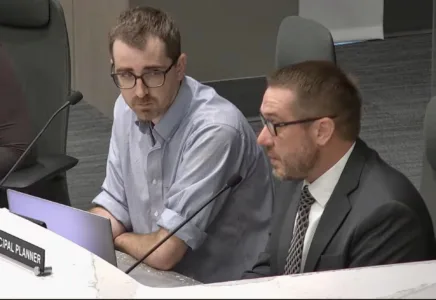
Principal Planner Doug Diedrichsen said the city currently has no rules that could keep a data center out. A data center could go into any area zoned for manufacturing or industrial because the closest category of zoning for a data center is a warehouse.
"If someone were to come into my office tomorrow with the building permit application and submit it to the building safety department for a warehouse that stores servers, I would have to click approve in our permit tracking system," he said. "There would be no conditional use permit. There would be no public hearing."
The new ordinance would give the community some control, Diedrichsen said.
"What we've brought you is what we think is a good ordinance, a good place to start, one that allows you some oversight of this use," he said.
"We want regulation in place, but not to overregulate. I know data centers have gotten kind of a bad rap nationwide, but it's important to understand we have louder, smellier, more energy intensive and more water intensive uses that are currently permitted by right in all of our industrial zones."
During the public hearing, Billi Gunderson said there is a difference between manufacturing plants, where noise is inside and workers wear ear protection, and a data center, where noise is outside and impacts the community. She asked staff to visit a data center to understand the impacts.
"The documentation that you've given is all on paper," she said.
Minot resident Sherry Heilmann also had concerns about noise levels and the impact on property values.
"First of all, I'll say that I do not want a data center in my community," she said. "I would question how much electricity will be used and how much it'll increase my rate and, most importantly, how much water will be used. Because water is a precious commodity, especially in Minot."
Terry Effertz, executive director with Tech ND, appeared remotely to offer recommendations for an ordinance.
Some of the concerns raised about data centers is misinformation or information that doesn't apply to North Dakota, she said. Lower electricity rates have been the case in Ellendale, which hosts a large data center.
Effertz acknowledged the issue that existed in Williston, where noise from a data center and higher electricity rates became a problem for homeowners. She said the state learned from that experience about the importance of siting centers away from homes, verifying the power plan is self generation or a stranded electrical asset that doesn't raise costs for existing users, verifying a closed loop water system and ensuring the developer has engaged with the community.
"Guiding your ordinance based on that, that's how you end up with a responsible player," she said.
Shay Todd, assistant executive director for the North Dakota Human Rights Coalition, cited several of what she called "myths" about data centers.
"It is a myth that hyperscale data centers will be good for local economies and provide tax revenue needed to support towns. Data center developments are receiving hefty tax breaks that are resulting in loss in revenue. Georgia is projecting $2.5 billion in losses per year due to data center tax breaks and incentives. Tax incentives in Virginia are costing the state $1.6 billion a year," she said. "It is a myth that data centers can use recycled water and are water efficient. Nearly all data centers require huge amounts of drinking water to function and cool their machines. In some cases, this water can never be reused or returned to the water cycle because of contamination."
Hyperscale data centers also have caused energy prices to increase up to 267% in 2024, Todd said. She added data centers release dangerous fumes that include fine particulate matter and nitrogen oxides.
The commission updated the originally introduced ordinance to ensure data center regulations are equitable with rules for other industrial park users. The ordinance cannot prohibit data centers.
"You have to always have a path. It can be a hard path, like it is for adult entertainment," said Dan Falconer, associate planner with the city. "But it still is a path, and someone could still do it."
The ordinance was drafted based on guidance from the American Planning Association, North Dakota League of Cities, North Dakota communities with data center projects and Loudoun County, Virginia, a major site for data centers, Falconer said.
"It's not perfect by any means," he said of the ordinance. "It's just a starting spot. It was basically the floor that I felt like we needed to build on. These were the important things that I saw in all those other ordinances.”
In addition to the industrial park restriction, the ordinance recommendation going to the city council includes provisions on electrical utility agreements, lighting plans, noise studies and water and sewer utility agreements. The planning commission approved it on a 9-0 vote.
Applications now will come before the planning commission where they will be reviewed case by case, Commissioner Tim Baumann said.
"As a community, we're going to have the opportunity to discuss every single application and determine whether this is an industry or a business that we want to have here," he said.
"No one wants a data center, especially the large-scale data centers or the hyperscale data centers, in our backyard," Commissioner Serena Pontenila said. "I think this is a good safeguard to help prevent it from being in places where we are going to have those negative impacts."