
Council adopts plan for mosquito control
Trending
Surveillance and ground fogging will be the focus of the City of Minot's mosquito control program going forward.
The Minot City Council on Monday, Aug. 17, contemplated costs, flexibility, effectiveness and chemical toxicity before settling on a plan that carries an estimated cost of about $100,000 annually for mosquito surveillance and a single round of fogging. A second round of citywide ground fogging would add another $30,000.
That compares with $108,000 to $115,000 the city has been spending the past couple of years. The city has utilized up to two aerial chemical applications each year, but with the lack of access to a second aerial spraying this year, the city has been conducting ground fogging to reduce the mosquito population.
The staff's recommendation was to stick with a similar plan that includes a single aerial spray followed by ground fogging and minimal larvicide for an estimated $150,000 a year. Staff also presented options for two aerial missions for $180,000 a year or a single ground spray and comprehensive larvicide for $280,000. Included in the cost of each of the options was contracted mosquito surveillance.
The council voted 4-2 for surveillance and ground fogging with an Environmental Protection Agency "caution" level chemical, dropping the larvicide piece that was estimated at $180,000 of the $280,000 cost. Voting for the option were Stephan Podrygula, John MacMartin, Eric Locken and Mark Jantzer.
Although the selected option called for less toxic chemical exposure than an EPA "danger" or "warning" label chemical, council members Mike Blessum and Scott Samuelson, who voted against, voiced concern about the extent residents are being exposed to chemical hazards.
"I truly believe that we're going at this the wrong way, just spraying a bunch of chemicals on our citizens in this city. It just seems absolutely ridiculous to me, and I know other cities do it, but it’s time to stop it," Samuelson said. "According to the Centers for Disease Control and Prevention, the most effective personal protection is preventing individual mosquito bites by eliminating breeding sites around your home rather than relying on chemical sprays."
Blessum's motion to eliminate a mosquito control program failed 2-4, with support from Samuelson.
Podrygula also aired concerns about chemicals but noted a chance to minimize the exposure to citizens by targeting ground fogging to specific quadrants of the city that surveillance identifies as a problem.
The council also rejected the staff recommendation for combination aerial and ground spraying on a 2-4 vote. Voting for that option were MacMartin and Locken. Locken then proposed the ground fogging and larvicide, which was amended on a 4-2 vote to remove the larvicide, with Blessum and Samuelson opposed.
Lisa Westman, director of Environmental Health at First District Health Unit, told the council that ground spraying is just a piece of the puzzle when it comes to mosquito control, but she has no worries about the city's decision to limit its mosquito measures to reduce chemical exposure and control cost.
"Weighing that cost and risk, I think, is valuable. And I think this would satisfy that lower risk," she said.
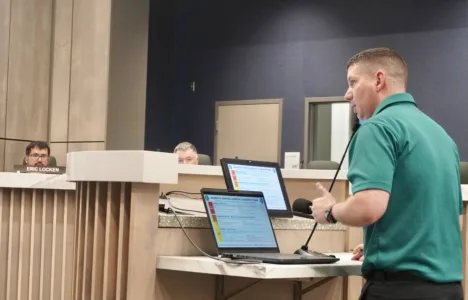
In addition to Westman, the council took input from Public Works Operations Director Bryan Banfill and Steve Settersten, CEO of Fog'Em Mosquito Control, which has been conducting the current ground fogging.