
Council adopts mosquito control plan
Trending
Surveillance and ground fogging will be the focus of the City of Minot's mosquito control program going forward.
The Minot City Council on Monday, Aug. 17, contemplated costs, flexibility, effectiveness and chemical toxicity before settling on a plan that carries an estimated cost of about $100,000 annually for mosquito surveillance and a single round of fogging. A second round of citywide ground fogging would add another $30,000.
That compares with $108,000 to $115,000 the city has been spending the past couple of years. The city has utilized up to two aerial chemical applications through an Air Force Reserves contract each year, but with the lack of access to a second aerial spraying this year, the city has been conducting ground fogging in response to rising numbers of Culex mosquitoes that can carry West Nile virus.
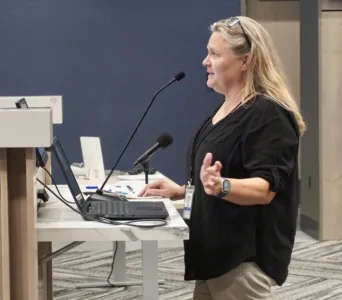
Lisa Westman, Environmental Health director with First District Health Unit, told the council mosquito control matters because West Nile virus is a public health concern.
"North Dakota consistently ranks among the highest states with per capita rates of West Nile virus," she said.
Weekly mosquito trap counts in Minot showed numbers rising peaking at 13,846 in the week preceding aerial spraying prior to the North Dakota State Fair that began July 17. Numbers dropped to 4,216 the next week, but Culex mosquitoes that can carry West Nile virus are a late season mosquito. Their numbers have been rising, according to Public Works Operations Director Bryan Banfill.
The city initiated a ground fogging operation Aug. 7, following the discovery of the virus in a mosquito pool in a northwest Minot trap. Ward County has had three mosquito pools with positive tests for the virus, Westman said.
Steve Settersten, CEO of Fog'Em Mosquito Control, said his company sends only about 27% of trapped Culex mosquitoes to the state laboratory to stay within the lab's testing capacity.
Council member Mike Blessum questioned the amount of spending on mosquito control given the low rate of illness overall, suggesting personal preventive efforts might be better.
Statistics from the Centers for Disease Control and Prevention list Ward County, from 1999-2025, as having had 124 cases, of which 32 involved neuroinvasive disease. The North Dakota Department of Health and Human Services listed four cases in Ward County in 2025.
Westman said mosquito control efforts do impact the rate of illness.
"A preventive approach has been proven to work, proven to decrease those numbers," she said. "Most entities nationwide have some sort of vector control program."
Blessum's motion to eliminate a mosquito control program failed 2-4, with support from council member Scott Samuelson.
"I truly believe that we're going at this the wrong way, just spraying a bunch of chemicals on our citizens in this city. It just seems absolutely ridiculous to me, and I know other cities do it, but it’s time to stop it," Samuelson said. "According to the Centers for Disease Control and Prevention, the most effective personal protection is preventing individual mosquito bites by eliminating breeding sites around your home rather than relying on chemical sprays."
The city staff's recommendation was to stick with a plan that includes a single aerial spray followed by ground fogging and minimal larvicide for an estimated $150,000 a year. Staff also presented options for two aerial missions for $180,000 a year or a single ground spray and comprehensive larvicide for $280,000. Included in the cost of each of the options was contracted mosquito surveillance.
The council voted 4-2 for surveillance and ground fogging with an Environmental Protection Agency "caution" level chemical, dropping the larvicide piece that was estimated at $180,000 of the $280,000 cost. Voting for the option were Stephan Podrygula, John MacMartin, Eric Locken and Mark Jantzer.
Podrygula also aired concerns about chemicals but noted a chance to minimize the exposure to citizens by targeting ground fogging to specific quadrants of the city that surveillance identifies as a problem.
Banfill said chemical dilution also needs to be taken into account. The use of the ground fogging chemical in Minot is about one ounce of product per acre of land. He added the chemical is at a rate that kills mosquitoes but not larger insects, such as dragonflies that eat mosquitoes.
Mayor Mark Jantzer asked about the use of natural controls such as bats and dragonflies. Banfill mentioned the feasibility of natural controls is being looked into, but Locken said he considered dragonflies for his backyard and found them surprisingly expensive with no guarantee of success.
The council rejected the staff recommendation for combination aerial and ground spraying on a 2-4 vote. Voting for that option were MacMartin and Locken. Locken then moved the option for ground fogging and larvicide, which was amended to remove the larvicide.
Westman said ground spraying is just a piece of the puzzle when it comes to mosquito control, but she has no worries about the city's decision to limit its mosquito measures to reduce chemical exposure and control cost.
"Weighing that cost and risk, I think, is valuable. And I think this would satisfy that lower risk," she said.
Blessum compared the health hazards of mosquito spraying to adding fluoride in water.
"I just draw some parallels with the things that government tries to control sometimes, rather than asking the public to take responsibility for the things that we do," he said. On the other hand, he said, it gives him pause to give up the aerial spraying by the Air Force Reserves because that option will no longer be available in an urgent situation. The Air Force Reserves requires scheduling two years in advance.
Banfill said staff would have been remiss to offer a mosquito program recommendation that excluded the Air Force Reserves.
"I think they're a viable resource for us that have proven themselves year after year," he said.