
Aviation boosts ND economy by $3.6B

JILL SCHRAMM/MDN Kyle Wanner, executive director of the North Dakota Aeronautics Commission, left, speaks at a public meeting in Minot City Hall on Tuesday, Aug. 25, about the release of a new State Aviation System Plan and Economic Impact Study. Georgia Twyerould, project manager, center, and Adam Elsell, lead analyst, right, both with Kimley-Horn, presented the findings during the meeting.
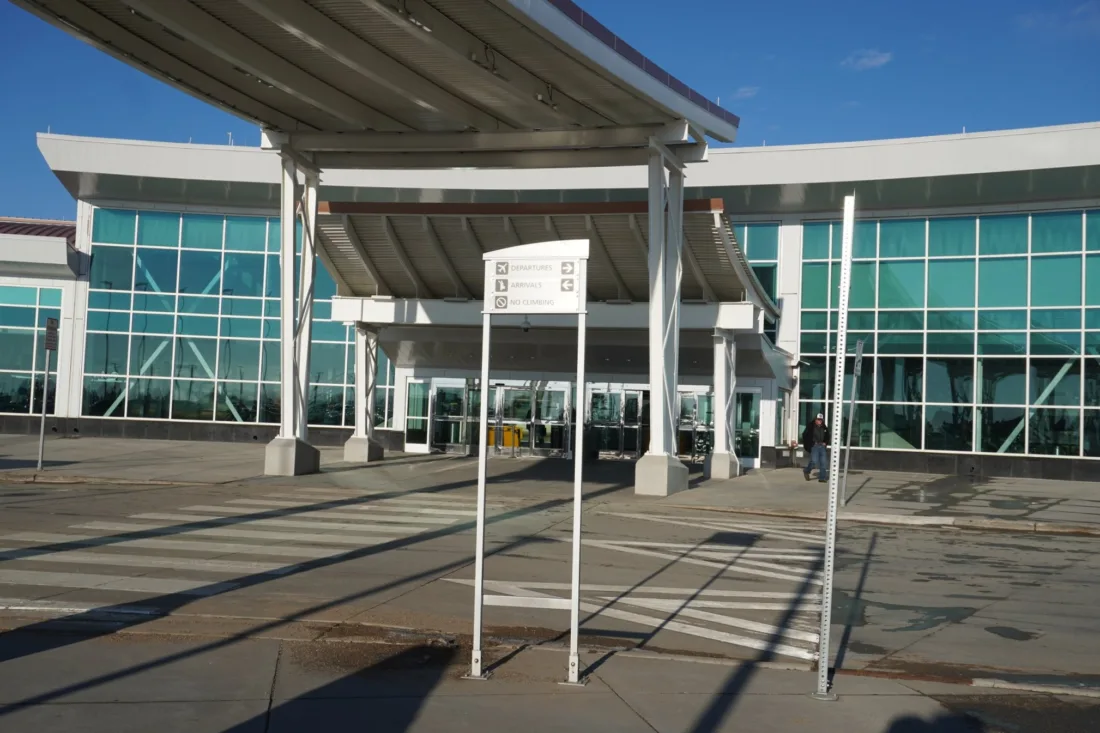
The Minot International Airport is estimated to have an economic impact of $171 million.
JILL SCHRAMM/MDN Kyle Wanner, executive director of the North Dakota Aeronautics Commission, left, speaks at a public meeting in Minot City Hall on Tuesday, Aug. 25, about the release of a new State Aviation System Plan and Economic Impact Study. Georgia Twyerould, project manager, center, and Adam Elsell, lead analyst, right, both with Kimley-Horn, presented the findings during the meeting.
The Minot International Airport is estimated to have an economic impact of $171 million.
Trending
The aviation industry generates a nearly $3.6 billion economic impact in North Dakota, of which Minot Air Force Base accounts for $651 million. Minot International Airport contributes $171 million.
The findings come from a recently released Economic Impact Study commissioned by the North Dakota Aeronautics Commission. Georgia Twyerould, project manager, and Adam Elsell, lead analyst, both with Kimley-Horn, presented the results of two years of research at a public meeting in Minot on Tuesday, Aug. 25. Kimley-Horn prepared the report in association with Marr Arnold Planning, using 2024 data in 2025 dollars.
Aviation's economic impact was calculated based on core airport-related impacts from both on-airport activities and off-airport visitor spending. It also measured broader off-airport industry effects, including activity at the air bases, manufacturing, unmanned aviation and the University of North Dakota School of Aerospace Sciences.
In total, there were 28,734 jobs credited to the aviation industry and an economic impact of $3.59 billion.
The overall economic impact might have been higher but for the inability to fill some jobs, Twyerould said. That lost activity was estimated at about $8.5 million.
"We did collect information on workforce challenges," Twyerould said. "We did see some sort of trends emerge in where those workforce challenges were being felt, typically in mechanics, customer service, avionic technicians, sales and ground support needs."
The study showed the state's 89 public use airports generate about $1.8 billion in total economic output, of which commercial airports accounted for $1.65 billion. Business tenants contributed nearly $834.8 million of that amount and visitor spending is listed at more than $694 million.
"Business tenants are a significant piece of this pie," Twyerould said. "That really demonstrates that there are a number of businesses across North Dakota located on airports. Often they exist because of the airport, and that plays a major role in the economic activity that we see across the state."
Among supplemental aerospace industry impacts, the biggest driver is Minot AFB.
"There's close to 8,500 total jobs supported by that Air Force base and about $651 million in total output," Twyerould said.
Aircraft/aerospace manufacturing accounts for 2,623 jobs and an economic output of $731.6 million; UAS businesses, 612 jobs and 114.3 million; and UND, 756 jobs and $103 million.
Looking by region, the seven-county region around Minot, with 13 airports, contributed about 1,400 jobs, generating about $186 million in total impact. The Minot airport alone supported 1,288 direct and multiplier jobs and had an economic impact of $170.97 million.
Other Minot International Airport findings were:
- An estimated 123,907 out-of-state visitors traveled through the Minot airport in 2024 using commercial and general aviation services. Visitors spent about $9 million on lodging, $15.3 million on food and beverage, $9.5 million on local transportation, $10.5 million on retail and $8.4 million on entertainment.
- The airport is home to 18 aviation-related or aviation-reliant businesses.
- Over the past four years, more than $16 million has been invested in capital improvements from federal, state, local, and private funding sources.
- The airport and the activities it supports generate more than $34 million annually in federal, state, and local tax revenues, with about $676,000 benefiting local governments.
Statewide, core airport activities generated about $276 million in tax revenues for federal, state and local agencies. Aviation fuel and airline property and aircraft excise taxes account for about $5.4 million in state revenue in a given year.
The study also included a passenger survey that found 90% of all passengers noted a positive experience traveling through the state's airports.
"We heard that airports are absolutely crucial. A viable airport is important to a community's growth," Twyerould said. "So, a lot of what we understand in the aviation industry about the value of airports was mirrored back to us in the survey results."
Tuesday's presentation also included information on the 2025 North Dakota State Aviation System Plan (NDSASP), which is an update to a 2014 NDSASP. The plan is used by the North Dakota Aeronautics Commission as a guide for future decision making.
According to the NDSASP, in 2024, North Dakota's commercial airports recorded about 1.2 million enplanements, which is expected to grow to about 2 million by 2044. North Dakota's airports are home to about 1,850 aircraft, which is projected to increase to 2,175 by 2044.
The capital improvement program estimates a need for $1.13 billion statewide aviation investments over the next 10 years. All but $5.5 million of that amount already is part of the capital improvement program for the state's airports.
"About 62% of total investment needs are associated with commercial service airports, just because they have bigger infrastructures and they have bigger needs. About 38% are associated with general aviation airports," Elsell said.
The system plan identifies a funding shortfall of roughly $350 million, or $35 million a year on average, to meet the investment need, he said.
"While federal, state and local funding sources will support a significant portion of those needs, they are not expected to fully close that gap," he added. "Funding challenges are not just unique to North Dakota. This is a problem that every state has."