
Veterinarian makes barn calls
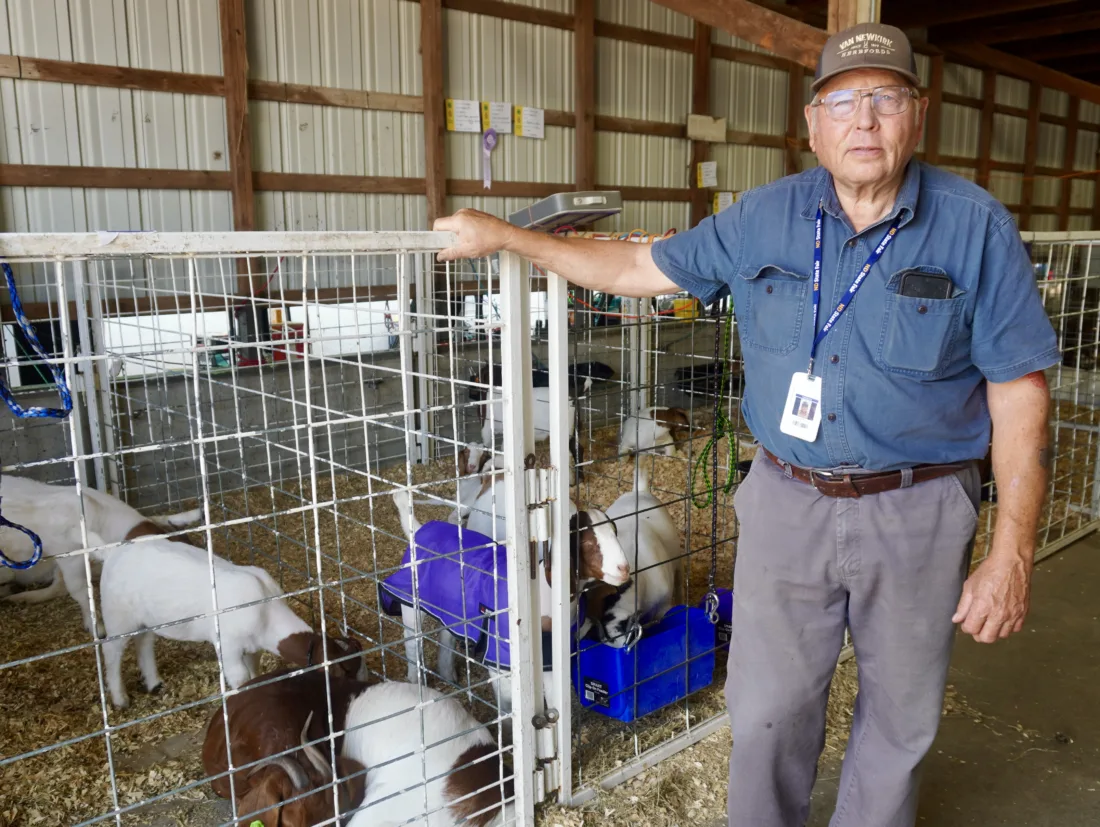
JILL SCHRAMM/MDN Minot veterinarian Russell Behm stops by the goat barn at the North Dakota State Fair on Thursday, July 23. He has served as the fair’s veterinarian for 40 years.
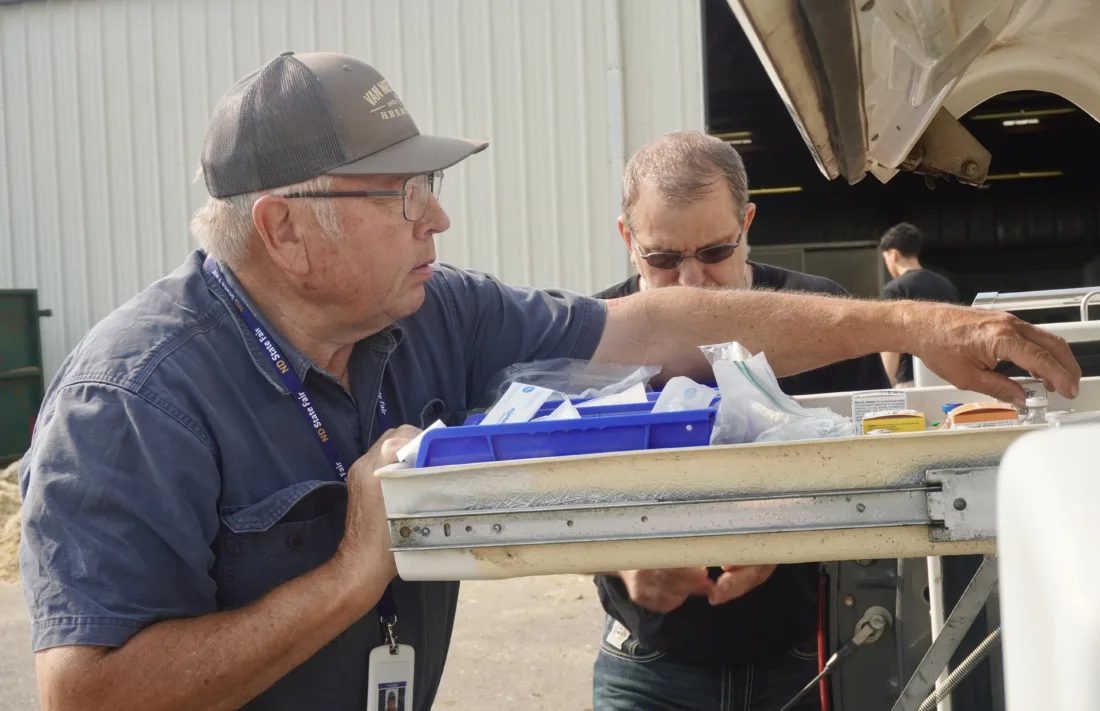
JILL SCHRAMM/MDN Dr. Russell Behm selects a bottle from his mobile pharmacy to dispense medication to an animal owner at the North Dakota State Fair on Thursday, July 23.
JILL SCHRAMM/MDN Minot veterinarian Russell Behm stops by the goat barn at the North Dakota State Fair on Thursday, July 23. He has served as the fair’s veterinarian for 40 years.
JILL SCHRAMM/MDN Dr. Russell Behm selects a bottle from his mobile pharmacy to dispense medication to an animal owner at the North Dakota State Fair on Thursday, July 23.
Trending
Whether it's a case of indigestion or something a little more serious, the livestock shown at the North Dakota State Fair might need a little doctoring now and then.
Dr. Russell Behm with Minot Veterinary Clinic is marking 40 years as State Fair veterinarian. Exhibitors with questions or concerns know to watch for him each morning and afternoon when he makes his rounds of the animal barns.
Behm said years ago he would fill in for former fair veterinarian George Christensen, also with Minot Veterinary Clinic, if Christensen wasn't able to make his rounds. When Christensen retired in 1984, Behm assumed the position. However, following the 2011 flood and during the COVID-19 pandemic in 2020, there were no fairs. There also was a year in which fair management wanted a veterinary booth, with the veterinarian to barter the service fee for the booth.
"I said I wasn't interested, so they had another veterinarian do it that year," Behm said. "He said he was uninterested in doing that ever again." The fair returned to its former practice, and Behm has been providing services ever since.
"There's some enjoyment in that I see all of the youngsters that are here showing their animals, their enthusiasm, their desire to be involved in agriculture. I enjoy being around animals," he said. "But there's a need to help sustain the fair as well. It's providing a service that needs to be done."
Primarily, he said, he makes himself available if needed, but there have been times when he has spotted animals with health concerns the owners weren't aware of.
At this year's fair, he noticed a sheep with excessive salivation, an indication its saliva failed to fully mix with the food due to eating too fast, resulting in a temporary esophageal obstruction.
"In most cases, you leave that alone. It'll self correct, but they were unaware of it," Behm said of the owners. "I brought that to their attention, and I instructed them what to do, not to have it happen in the future."
The most common incidents he sees among food-producing animals at the fair are digestive upsets.
"You can imagine living a solitary life on a farm and then being brought to a place where there's so much commotion. That does affect how much stress they feel, and sometimes they have digestive upsets," he said.
Cattle can experience bloating or stress-related pneumonia. Behm explained cattle and sheep cool themselves by respiration rather than sweating, so a hot, dusty, noisy environment can inhibit sleep and contribute to the development of pneumonia.
"There's usually a few pneumonia cases every year," he said.
Behm encountered his most unusual situation about 20 years ago, involving a horse at the State Fair.
"I was called to look at the horse because the people taking care of the horse said it had colic. Colic is a problem with the digestive tract," he said. "I did not believe that the horse was having a problem with colic."
The caretakers wanted the horse treated for colic, though, and the animal continued to be sick the next day. Taking some diagnostic samples didn't produce an answer, so Behm consulted with staff at Colorado State University. The horse was having difficulty using its hind legs and had no good control of its tail muscles, raising suspicions of an equine herpes myelitis infection of the spinal cord. The North Dakota Civil Air Patrol flew diagnostic samples to the university, which found them negative for herpes myelitis.
It was eventually discovered the owners had used a nerve block to counter a characteristic of the horse that caused it to carry its tail high instead of hanging between its legs as is desirable for a show horse.
"It's considered to be unethical and illegal," Behm said, noting veterinary and equine associations frown on it. "The horse had an infection involving its spinal cord and, ultimately, the horse died."
The individual involved was barred from ever bringing horses back to the State Fair, Behm said.
Instances of owners who don't properly care for their animals are unusual, though, he said.
"Most of the people that are here are local people - people with children. They're here to have their child have an experience. They're here to be with their children when their children are doing that. They want to have memories of a family growing up close together," he said. "Most people that are here are honest, reliable, are here for the experience. They help each other, and there's a lot of camaraderie between the people that show animals here."
More exhibitors than in the past are rural, nonfarm residents.
"That explains to some extent over the past 40 years the increase in the number of pigs, sheep and goats, because they are easier animals to house, take fewer acres to take care of," Behm said.
With more exhibiting families not having livestock backgrounds, there's more questions of the veterinarian as well as more sharing of information among the people who exhibit.
For Behm, one of the best parts of working at the fair are the relationships formed with families who come year after year to show animals. It can become a rotation of families as 4-Hers and FFA members grow up and move on and new families appear.
It isn't unusual for those young exhibitors to be back eventually with their own children, though. After 40 years, Behm said, he's watching the fourth generation of some families continue the State Fair tradition.