
MSU seeks program seed money from MAGIC Fund
Trending
A $500,000 MAGIC Fund investment to help launch a new innovation engineering program at Minot State University received the support of the fund's screening committee Thursday, June 18.
The committee voted to recommend the Minot City Council approve a forgivable loan for equipment and scholarships. The funds also would serve as a match to help MSU obtain another $250,000 from a North Dakota Higher Education Challenge Grant.
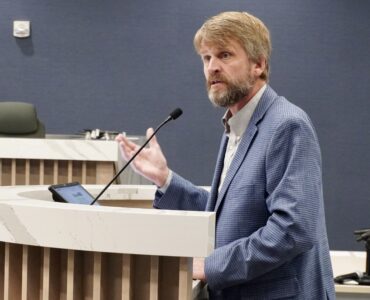
After working on the innovation engineering program for nearly two years, MSU is in position to launch it as an academic offering this fall, Dr. Steve Shirley, MSU president, told the committee.
"We’ve never offered a bachelor’s degree in engineering, so this is a major academic shift and a major academic expansion for Minot State University," Shirley said. "We had to go through some very robust reviews by the Higher Learning Commission, which is our national accrediting body. We went through all of that over the last year. We got a full green light on that through a very robust review, telling us that the program is ready to go. We’ve got the curriculum built. We've got a lot of faculty that have been working on this."
Shirley explained the impetus behind the program came from the energy and engineering industries, which are looking for individuals with general engineering mindsets and technical skills.
"We don’t specifically need civil engineers or mechanical engineers or electrical engineers, but we need general thinkers who can think in this area - students who are really good at math, really good at spatial concepts. So, as they think about dynamics and statics and thermodynamics and all these sorts of things, they’ve got that kind of mindset and they’re ready to go. Then we, as an industry, can train them the way we need to train them in our systems, but we just need that kind of thinking and that kind of pipeline of talent," Shirley said.
He added other universities in the state teach specific engineering programs but this will be the first of its kind. It will help address workforce challenges while also keeping talented young people in western North Dakota, he said.
The program already has about a dozen students enrolled for this fall. Most are from Minot, with others from Watford City or out of state, Shirley said.
"That’s a dozen engineering students that would not have been here a year ago, or five years ago, or two years ago. They would have been probably in Fargo or Grand Forks," Shirley said.
In addition to the bachelor's degree, the program offers a track for students who want to take their first two years at MSU and then move on to a specific engineering program at another school. If during those first two years, they can intern and build connections in Minot, they are more likely to return after gaining their degrees elsewhere, Shirley said.
Shirley said MSU has only begun to recruit students. A major renovation underway to establish the new engineering labs will be finished by fall, giving students a better look at the program when they tour. The goal is 15-20 students in the program once ramped up.
If approved by the council, $350,000 of the MAGIC Fund dollars would be used over the next two years for equipment, which Shirley described as more extensive than some other academic programs. The remaining $150,000 would go to scholarships to attract and retain students over the program's first five years.
For the MAGIC Fund loan to be forgivable, MSU would need to show receipts and scholarship awards indicating money was spent in accordance with the agreement.
About a year ago, MSU received seed money through the state's new Workforce Education Innovation Fund, designed to provide money for innovative education programs. Shirley said it allowed the hiring of the first program faculty member.
Over the longer term, MSU looks to establish an endowment to help sustain the program.
Rick Hedberg, MSU vice president for Advancement, said the university has been working with industry on funding and recently received a grant. However, MSU's position is dollars from the MAGIC Fund and the state are needed to launch the program successfully and show industry that contributing to an endowment is worth their investment, he said.
"We want impact right away. We want to see the results," Hedberg said.
"I think it’s a great program, and I like seeing the response to the needs of the area," Screening Committee Chairman Jordan Nelson said. "I give Minot State a lot of credit for that."
The committee also voted to recommend the additional investment of $250,000 into Souris Basin Planning Council's Business Accelerator Fund (BAF), a revolving loan fund established in 2018 with $1 million from the MAGIC Fund. Boosted by additional MAGIC Fund investments over the years, the fund has provided 81 businesses with matching interest buydown money for the Bank of North Dakota's PACE and Flex PACE loan programs. Of those, 74 were Minot businesses, according to SBPC information.
From 2015-2025, the Flex PACE program provided more than $44.91 million in the region, of which about $44.18 million was invested after the launch of the BAF.
SBPC reported it had an estimated $158,000 in potential funding requests as of April, with no funds available to lend from the BAF. SBPC used $148,167 from another fund meant for down payment assistance to help support interest buydown projects last year.
SBPC estimates the fund will need an additional $750,000 to cover projects over a two-year period. The $250,000 request of the MAGIC Fund is the limit allowed for the program under fund guidelines but the fund also is replenished as loans are repaid.
Erin Charley, SBPC's director of Organization Development and Program Management, said the fund has not seen shortfalls from inability of borrowers to pay. She noted the maximum allowable loan is about $107,000. The BAF's current term for loans is three years.
The City of Minot also provided a financial report showing the MAGIC Fund's balance at about $11 million, with nearly $10 million uncommitted.
City Finance Director David Lakefield said future requests are unknown, but based on projects in development, there could be potential demand for MAGIC Fund dollars going forward. While projects in recent years have been fewer, the MAGIC Fund also is serving more as a source for matching state money, he added.
"We're leveraging millions of dollars of capital, so the need for that money up front is a lot less. We’re able to leverage other dollars to do that and accomplish more for the community, and it's a lot less risk for us as a city as well," he said.
Low interest rates are another factor impacting MAGIC Fund requests, Lakefield noted.
"It seems there's a lot less demand when the capital markets are freely available at lower cost," he said.