
Data center expert urges caution
Republicans host Minot discussion
Trending
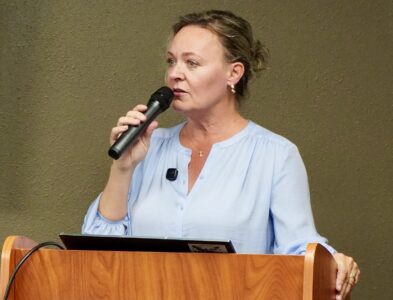
An environmental health specialist who has been issuing warnings about data centers around the country brought her message to Minot Friday, June 5.
Tammy Clark said some Americans already are living with environmental hazards because hyperscale data centers have been built without the public becoming adequately informed.
"I'm not against technology," she said. "We need to manage it. We need global safeguards in place. There has to be regulations with it and we're not doing that."
Clark came to Minot at the invitation of District 3 Rep. Jeff Hoverson, R-Minot, who reported significant interest in data centers from constituents as he has campaigned for reelection.
"We were getting a lot of feedback on that one issue," Hoverson said. "It's easy to hear from the data centers and we need to. We need to hear both sides."
And unlike industry officials, Clark is not speaking for her own monetary gain, Hoverson added.
District 3 Republican House candidate Crystal Hendrickson also sees proliferation of data centers as a concern for the state, calling it a bubble that eventually will burst in an article in the May 18 issue of The Minot Daily News.
"I feel like it's going to ruin our quality of life here in North Dakota. The noise that's generated by them is disruptive to animals and wildlife and anybody that would live close by," she said.
Tim Mihalick and Blaine DesLauriers also are running for the two District 3 House seats in the Republican primary.
"As bankers, our backgrounds are rooted in supporting responsible economic growth and helping communities thrive," they said in a statement. "Data centers could represent an opportunity for continued growth in North Dakota’s economy, particularly given our strong energy resources and business-friendly environment. However, any project should have the support of the local community where it is located and be developed in a way that benefits residents, businesses, and taxpayers. We believe economic development is most successful when it grows alongside the communities it serves."
Clark said she brings her background as an industrial hygienist and occupational and environmental health and safety professional to the data center discussion.
"It's our job to anticipate, recognize, evaluate and control hazards," she said. "I love my country, and I love my freedoms more than anything. That's why I felt I needed to stand up, and I needed to use my knowledge, my expertise, my credentials and my experience in my career field to speak to this in a manner that most people can't.
"My colleagues and I have blown the whistle and said what they're proposing is going to create sickness and harm in both human and animal populations and it is going to completely destroy our agricultural farmlands in this country, and it is going to suck the wells and the aquifers dry," she said.
Clark said the growth in data centers is driven by contracts rather than the need for more computational power.
"They have contracts that they need to satisfy within a certain amount of time, and if they don't, the fines and the fees are in the billions, and right now, if they get the permits approved by a certain date," she said, "then they can take advantage of that tax incentive upfront. They're investing billions, convincing their investors, because they're going to make their money up front. They know this is all a game. They know that they're not going to be using these hyperscale data centers for much longer because we already have newer technology out there. We have fractal with edge computing, quantum computing, and it's much smaller."
She voiced concern about building strings of new transmission lines and gas plants along which data centers can be placed.
"It's not one standalone. It is the cumulative exposure from multiple sites all around your communities that create the synergistic toxicity," she said. The toxicity includes electromagnetic frequency emissions that cause pollinators to leave, which will impact agriculture in North Dakota, she said.
She also emphasized the danger of noise, particularly tonal noise, or low-frequency waves known as infrasound, and the negative effects it can have on people physically.
"That has been our biggest concern from a health perspective," Clark said.
Williston residents living near a data center reached a settlement earlier this year after suing over noise. Residents in Dowagiac, Michigan, more recently filed a class action lawsuit against a data center company over the impact of noise on health and property values.
Clark urged local residents to ensure their communities have noise ordinances that include infrasound and that require mitigation when levels go above thresholds. She recommended they not support any facility that uses water because alternative cooling systems that don't require water are available. She advised that decommissioning plans be in place, with escrow money from the companies to cover those future costs.
However, she said, there is no one size fits all to regulating any particular data center because design and materials differ and environmental factors such as weather, wind and topography also matter.
"Siting is the number one most important thing, and we do have areas where we can place them, but for starters, we've got to just all understand hyperscale data centers are completely unnecessary," she said.
Clark said she and others she is working with are preparing a resource guide with a checklist of items that should be required of data centers.
"Or what I like even better - you just say, 'No data centers allowed in this county because we don't have an appropriate location where you can build that's not going to cause harm to the community or the environment,'" she said. "More and more communities are starting to do that."