
City leaders review flood history, future
Trending
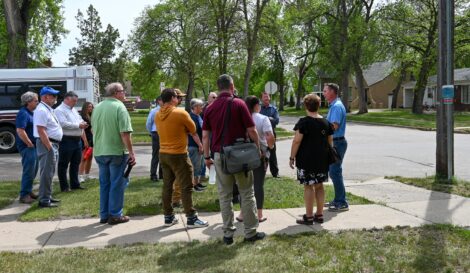
A group of Minot City Council members and candidates toured the flood protection project in Minot Wednesday, May 27, after gathering for a review of the city's history of flooding and protection efforts.
Ryan Ackerman, administrator for the Souris River Joint Board, which oversees the Mouse River Enhanced Flood Protection Project, recounted the history behind the U.S. arrangement with Canada to utilize two water supply dams, Rafferty and Alameda (now Grant Devine), to accommodate downstream flood protection. A 1989 agreement between the countries defines how the dams will be operated.
The dams were operated as prescribed in 2011, when record flooding occurred, Ackerman said. According to a post-flood study, if the dams had been operated as dry dams to only hold flood water, Minot still would have seen 15,000 cubic feet a second of river flow, or well above the 5,000 cfs capacity of the existing flood protection system and above emergency efforts to raise dikes, he said. Had the river been unregulated, Minot would have seen 30,000 cfs instead of the 27,000 cfs peak flow that occurred at the end of June 2011, he added.
The Canadian dams released water in the spring of 2011 as the agreement intended, and as flows became too high for Minot's capacity to fight flooding, the dams held that water back, Ackerman said.
"The system behaved as it was designed to," Ackerman said. "But there were complicating factors in April, May and June that ultimately led to the system becoming overwhelmed.
"The flood fight had gone on from February to really through June, and at that point we could probably pass 8,000, maybe 10,0000 cubic feet a second, so there was zero appetite to ask Saskatchewan to send us more water, because we were not prepared for it, and we were not in a position to be able to handle it," he said.
When a 7-inch rainfall occurred in the dam's runoff area, the dams were full and were forced to release water, he said.
"The reservoirs were operated in accordance with that agreement, and they did their intended job. They were just basically overtaxed," Ackerman said.
The flood protection now under construction is designed to protect against another 27,000 cfs flood. Ackerman said none of the project pieces that have been completed are tied together, which leaves the city without any additional flood protection. Once the Maple Diversion segment is complete, it will help pull existing pieces together to remove 60% of valley residents from the flood plain, he said.
Council member Mike Blessum asked about any operational changes to the dams that might be coming.
"It would seem that collaborative effort around managing the water upstream is what gives us a chance," he said.
Ackerman responded that following an intensive study effort by the international Joint Commission after 2011, no operational changes occurred. However, the commission created an Adaptive Management Committee, which is looking at ways to optimize flood control and water flow.
"The pace at which these committees do their work is kind of slow," Ackerman said, noting the committee that formed in 2025 isn't scheduled to report back on findings until 2037. "So, I believe they have 12 years to look at different operational scenarios and see if there's a way this might be further optimized. But again, keep in mind, that push-pull between water supply and flood control is still going to be present, and I wouldn't expect there would be massive changes that would affect our decision-making process here."
Ackerman said he suspects the Adaptive Management Committee will propose recommendations catered to mid-range floods, in which optimizing reservoir operations is in conjunction with the flood control that is in place.
Blessum suggested the ongoing flood protection project could be seen by the committee as a chance to lean more toward Canada's water supply uses. Ackerman disagreed, saying the United States is represented on the committee and would resist recommendations that add flood risk in North Dakota. Additionally, he said, despite all the planning and dam operation scenarios, if rain occurs below the reservoirs, any excess moisture becomes uncontrolled.
Mayoral candidate Josiah Roise took issue with laying responsibility for flood control on local entities when decision making lies with the two federal governments.
"If the state doesn't really have a say, and the city doesn't have a say, then why should it fall on Minot taxpayers to build it?" Roise asked. "It sounds like there's federal level interest in having this done, but it's being put on the Minot people to stick the bill."
Ackerman agreed there should be a federal interest and more federal dollars. The issue, he said, is the federal government justifies its involvement based on a cost-benefit analysis built on the value of property that would be damaged in a flood.
"It places a priority on high value property, versus people. So, for example, if we had a valley that was full of million dollar homes, the federal government would certainly have an interest in building flood protection," Ackerman said. "I wish there was a strong federal interest, and we certainly try to advocate for that any chance we get to our congressional delegation."