
Minot principals say test scores tell ‘rest of the story’
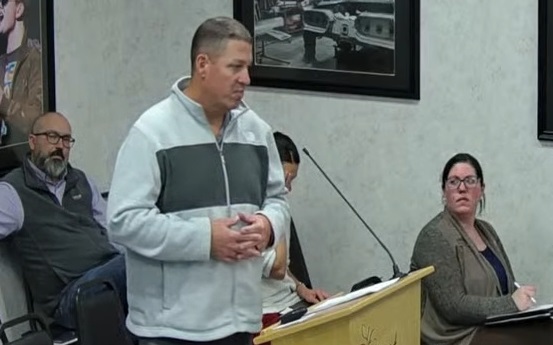
Screen Image Jill Hill Principal Mike Arlien presents a special report to the Minot Public Schools Board at its regular meeting on April 9.
Minot middle schools test scores were in the spotlight at the Minot Public School Board’s regular meeting on Thursday, April 10, for showing significant gains and progress on state and national tests.
Jim Hill Principal Mike Arlien presented the report to the board, expounding on data he and his fellow middle school administrators felt showed the great strides being made at those grade levels in the district.
Arlien highlighted the latest results from the ND A+ tests, which showed marked year over year improvements in rankings in reading scores for Erik Ramstad and Jim Hill Middle Schools, which leapt into the top 10, joining Memorial Middle School which claimed the top rank in the state.
“We don’t often hear that narrative in the media. We don’t hear that narrative in Bismarck at the Legislature. We don’t hear that narrative at the national level. We keep hearing about public education is failing our students, we’re underperforming, and I’m here to paint a little bit different picture with facts and numbers,” Arlien said.
Memorial and Erik Ramstad cracked the top 10 in math proficiency exceeding 50%, while Jim Hill came in at 11 in the state with a 10 point improvement to 47%. Central Middle School ranked 20th in the state in its first year after opening. Arlien said the statewide data was showing drops in proficiency in other districts, while Minot middle schools either maintained or improved.
“It’s showing what Minot middle schools are doing with the dollars and resources we’re allocated, and I think we’re really making a difference,” Arlien said.
Arlien then shifted to the 8th grade scores from the National Assessment of Educational Progress testing, of which North Dakota schools ranked third in the nation in math. Arlien drew attention to the seeming disparity between the in-state proficiency testing results from North Dakota at 41% and Iowa’s 77%. Iowa schools were ranked 15th on the NAEP for 2024-2025.
“When left up to the individual states to set the bar, we have chosen to set that bar high. To use a sports analogy, we have placed our field goal try at the 35 yard line kicking into the wind. Iowa seems to have placed the bar and moved that football to the 15 yard line, and that’s why they’re seeing such a high percentage,” Arlien said. “Then we get this false narrative with public education. I just wanted to celebrate that we are really doing a lot with our resources and really performing well.”
School board member Scott Louser, who is also a state legislator, acknowledged Arlien’s point, saying legislators in Bismarck were more aware of the NAEP results, which he said was shifting the narrative. Louser asked Arlien what he thought made the difference in the classroom to explain the gains, to which he replied, “I don’t think I’ve ever seen better education in the classroom.”
“Time on task. Bell to bell teaching. Minot Public Schools has delivered outstanding professional development for our teachers. I would say the teaching has never been better than what we have right now. And this might be a shocker, but we’ve never had better students. We have good, kind humans. That’s a narrative we hear too often. I’ve never been more proud of the kind of character of students in our building. So many of them influence the culture of your school. They push each other and work hard,” Arlien said.
Arlien also championed Minot Public Schools for being ahead of the curve on the bell-to-bell cell phone ban policy, saying it helps students focus.
Central Middle School Principal Nathan Freeman said another aspect is using data to better identify students in need of help or assistance so interventions can be applied sooner. Louser said this data will prove to be instrumental for the board as they develop the district’s long term strategic planning.
“All of those things are metrics that we’re going to be able to measure with this group of kids who are going to graduate in a few years. So, you are crucial for implementing what I think we’re going to bring forward shortly. That’s why I’m asking what’s working. We need to know we can measure our success in two, three, four years from now,” Louser said.
Local News
Minot principals say test scores tell ‘rest of the story’

Local students advance to state Civics Bee

Ward County archers compete at McKenzie County match
Ward County archers succeed at Morton County match
Park district announces 2026 Movies in the Park
The Minot Park District has announced the return of its popular Movies in the Park series for summer 2026. Movies ...
County faces digital accessibility deadline
Ward County is working under a time crunch to comply with new federal rule regarding access to a government’s ...