State updates county on feedlot noncompliance
Operation needs county, state approvals
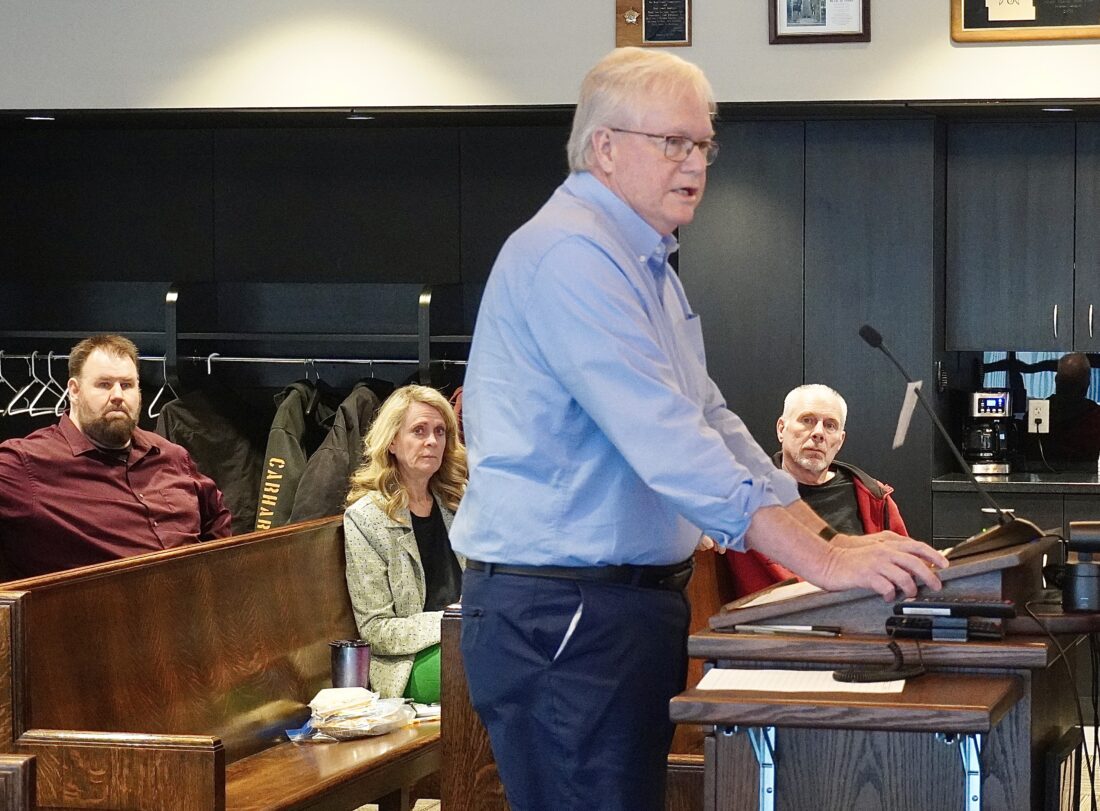
JILL SCHRAMM/MDN Dave Glatt, director of the North Dakota Department of Environmental Quality, speaks from the podium about issues with a Surrey-area feedlot at a Ward County Commission meeting Tuesday, March 17. Also shown from left are County Engineer Dana Larsen, State’s Attorney Roza Larson and feedlot neighbor Bart Burns.
A feedlot near Surrey that came under investigation for improper disposal of deceased cattle lacks a state permit to operate.
David Glatt, director of the North Dakota Department of Environmental Quality, told the Ward County Commission Tuesday, March 17, that the operation will need to obtain site approval from the county and a permit from the state to continue operating.
Glatt said the state gave notice of violations to the operator, which has 30 days to respond.
“We’re in that process now of waiting for the response from Smith Farms, and once we get that response, we will get into negotiations,” he said.
The feedlot, located northeast of Surrey was believed to house between 8,000-9,000 head of cattle at the time the Ward County Sheriff’s Office was notified to investigate earlier this month. County Engineer Dana Larsen reported the Ward County Highway Department removed 480 deceased cattle improperly disposed of in an open pit and delivered them to the Minot Landfill.
A public hearing was held in McHenry County on March 3 regarding the feed lot operation and potential water pollution reaching Buffalo Lodge Lake, according to the sheriff’s office.
Commissioner Jason Olson raised concern that the feedlot operation hasn’t been suspended pending site approval and permits.
“We definitely want everybody to follow the rules that provide for good environmental protection, provide for good neighbors,” Glatt said. “Those that don’t do that, we need to take action against them. That being said, we try to work with everybody to continue operations to get to the point of good environmental stewardship. If we can’t get to that point, we could move to cease operations. Usually, to get to the point for cease and desist – I’ve only done that once in my 43-year career and that’s pretty difficult – you have to show immediate public endangerment, and that’s a pretty high bar.”
Glatt said fines can be collected from a violator, but the focus is on bringing an operation into compliance and doing so quickly.
He added the situation with the feedlot is unusual because it started without getting state approval, creating a situation in which it is not a new operation seeking a permit but an existing one. He noted if a permit is granted, the feedlot will be routinely inspected for compliance. However, the county must give site approval before the state will issue a permit.
Commission Chairman John Fjeldahl said the county still is waiting for a site application. The application would start with the county’s planning and zoning board and its public hearing process. The original zoning for the feedlot was handled by Surrey Township, which turned it over to the county last July, according to Fjeldahl and county Planning/Zoning Administrator Beth Pietsch.
Bart Burns, a neighbor of the feedlot, voiced concern about the well that serves his two acres. A water quality test a couple of years ago didn’t indicate an issue, but cattle numbers at the feedlot were lower then, he said. He also stressed the need for neighbors to be made aware when these types of operations are proposed, because he was not notified in advance.
Glatt said the state’s permitting process includes a public hearing to ensure all concerns of neighbors are addressed.
In other business, the county commission transferred $15,725 from a contingency fund to the Ward County Highway Department to cover the cost of removing the dead cattle. The department incurred costs of $4,159 for labor, $5,920 in equipment and $5,646 to pay the landfill bill.
A bill to recover the county’s cost was sent to the partnership that owns the feedlot and the lease holder.
Local News
Council looks cautiously at new spending
PSC to take public comment on utility protection plans
BISMARCK – The North Dakota Public Service Commission will hold a public hearing on March 31 to gather comments ...
Commerce to host Talent Pipeline Fly-In program
BISMARCK — The North Dakota Department of Commerce is launching the Talent Pipeline Fly-In Grant Program, an ...
McLean County students to attend health career camp
TURTLE LAKE – Sixty students in sixth grade will take part in the Rural Collaborative Opportunities for ...
State updates county on feedlot noncompliance