Pig iron plant would cut imports, benefit military
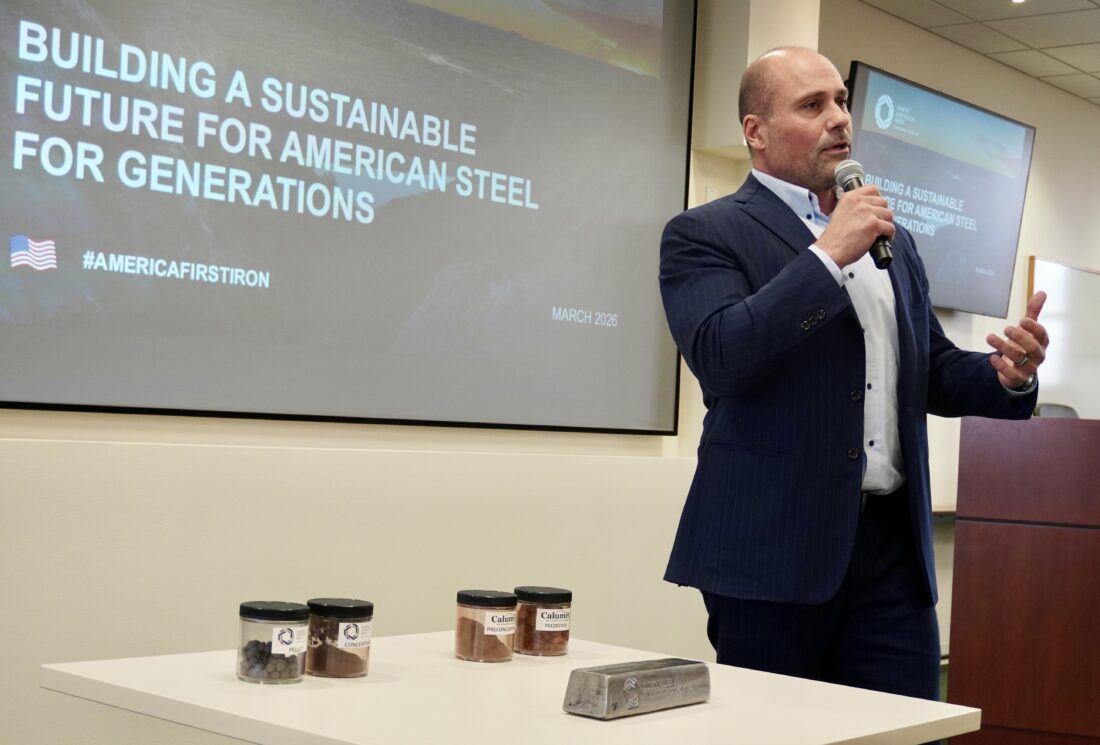
JILL SCHRAMM/MDN Jim Bougalis, CEO and founder of North American Iron, speaks at a Minot Area Chamber EDC Energy Committee meeting in Minot Tuesday, March 10. Next to him are jars of iron pellets like those that would feed a proposed pig iron plant, along with iron granules and a 16-pound pig iron ingot.
Minot could play an important role in the American steel industry and the military industrial complex with the realization of a proposed pig iron plant, North American Iron CEO Jim Bougalis told a crowd gathered at the Minot Area Chamber EDC’s Energy Committee meeting Tuesday, March 11.
“We really, truly are an American-first operation, an American-first company,” he said. “We’re a fully domestic product. Not only fully domestic, but we plan on feeding our own U.S. steel industry with this.”
Bougalis noted the United States produces about 100 million tons of steel a year but only about 20 million tons is made with virgin ore, primarily from Minnesota. The remaining American-sourced ore is mainly scrap iron, with a heavy dependence on imports for higher quality iron.
The United States is at the whim of world affairs that can disrupt markets, he said. It gets the leftovers from other countries after they build their own bridges and military equipment.
“That’s a pretty bad position for us to be,” Bougalis said.
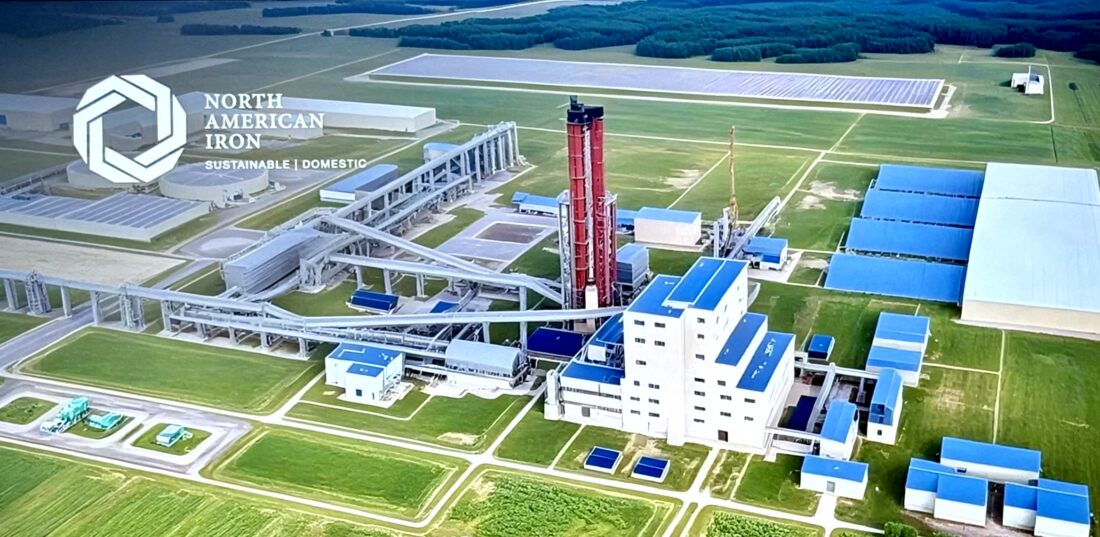
JILL SCHRAMM/MDN A rendering by Civil & Environmental Consultants shows the proposed North American Iron facility on about 700 acres at Minot.
“We’re a critical product for our military,” he said. “We can’t even rebuild our own military at this point. One of those reasons is because we don’t have the premium grade steel to do so. We don’t have premium grade steels because our main feedstock is scrap iron.”
The goal of North American Iron (NIA) is to build a plant capable of replacing many of those imports with American-made pig iron.
Bougalis said North Dakota, and particularly Minot, rose to the top in a year and half search for a plant site because of its location. It is only about 500 miles from NIA’s ore source, consisting of legacy stockpiles from past mining around Calumet, Minnesota. NAI would reclaim the ore and take it by rail to Minot to be processed into 2 million (metric) tons a day of pig iron, a primary ingredient in steel.
“To put that into perspective and contrast, last year, we imported about 4 million tons of pig iron. Over the last 10 years, the average has been 5 or 6 million tons. The Russian-Ukraine conflict had a big impact on that, but the demand for pig iron is what is really interesting. The demand is 13 million tons. So our demand is always higher. There’s never enough pig iron,” Bougalis said.
Minot’s location also offers access to BNSF’s rail line and affordable and plentiful natural gas to operate the plant.
“Our project will be accepting two unit trains every 24 hours for eight months out of the year. In addition to that, there will be two unit trains leaving the site each week with product,” Bougalis said.
Natural gas to power the plant would come by pipeline from the Bakken oil field.
Another attraction was North Dakota’s ability to offer sequestration of carbon dioxide from the combustion of natural gas without waiting for years of permits, Bougalis said. Potentially, the CO2 could be sequestered on the site, which is northeast of the Minot International Airport airfield in an industrial park.
The plant is expected to require about 2 million gallons of water a day, but a good share of it would be wastewater from the City of Minot, Bougalis said. It also would use aquifer water and a small amount of city treated water. The city anticipates switching from aquifers to Lake Sakakawea water from the Northwest Area Water Supply Project later this year.
“We’re low emission,” Bougalis said of the proposed plant. “We’re using a clean hydrogen-based processing – 96% fewer emissions than a blast furnace operation.”
The ore would be heated to 700 degrees in an enclosed, high pressure chamber that pulls out and emits oxygen, he explained. Removed impurities become concrete aggregate, which is desirable for road construction, he said. Aiming for zero waste, tailings also are being researched for use as fertilizer, with initial positive results, he added.
The project had received a $7 million grant from the North Dakota Clean Sustainable Energy Fund and an equity loan for a total of $10 million from the state, Bougalis said.
He noted permitting will be completed soon, and a third private investment phase has been initiated, with engineering and design to start later this year. Construction is forecast for 2027-2029. An estimated 2,000-3,000 construction jobs would be created, along with several hundred permanent jobs in operations.
“In Minnesota, we’re going to provide 150 jobs. There’s going to be right around $450 million just in royalties and production taxes,” Bougalis said. “But who really is going to benefit from this is the state of North Dakota. We’re going to provide over 650 jobs and over a billion in revenue to the state.”
He said those jobs typically will require two-year technical degrees and pay around $90,000 a year on average.
-
- JILL SCHRAMM/MDN Jim Bougalis, CEO and founder of North American Iron, speaks at a Minot Area Chamber EDC Energy Committee meeting in Minot Tuesday, March 10. Next to him are jars of iron pellets like those that would feed a proposed pig iron plant, along with iron granules and a 16-pound pig iron ingot.
-
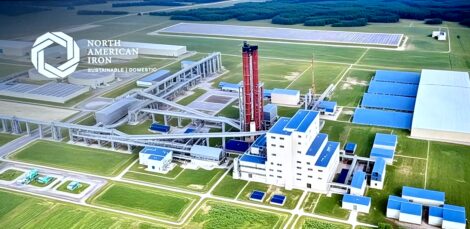
- JILL SCHRAMM/MDN A rendering by Civil & Environmental Consultants shows the proposed North American Iron facility on about 700 acres at Minot.
Local News
Bill reintroduced for increased water funding in ND
Occupants of two separate crashes identified
The North Dakota Highway Patrol has identified those involved in two separate crashes, one in the Burlington area ...
Planning board revokes permit for group home

Symphony to celebrate at multi-choir event
Research Center precipitation update
On Wednesday, March 11, at 8 a.m., 0.03-inch of moisture and 0.8-inch of snow was recorded at the North Central ...