Operation Epic Fury
Combined US military aviators fly thousands of combat flights
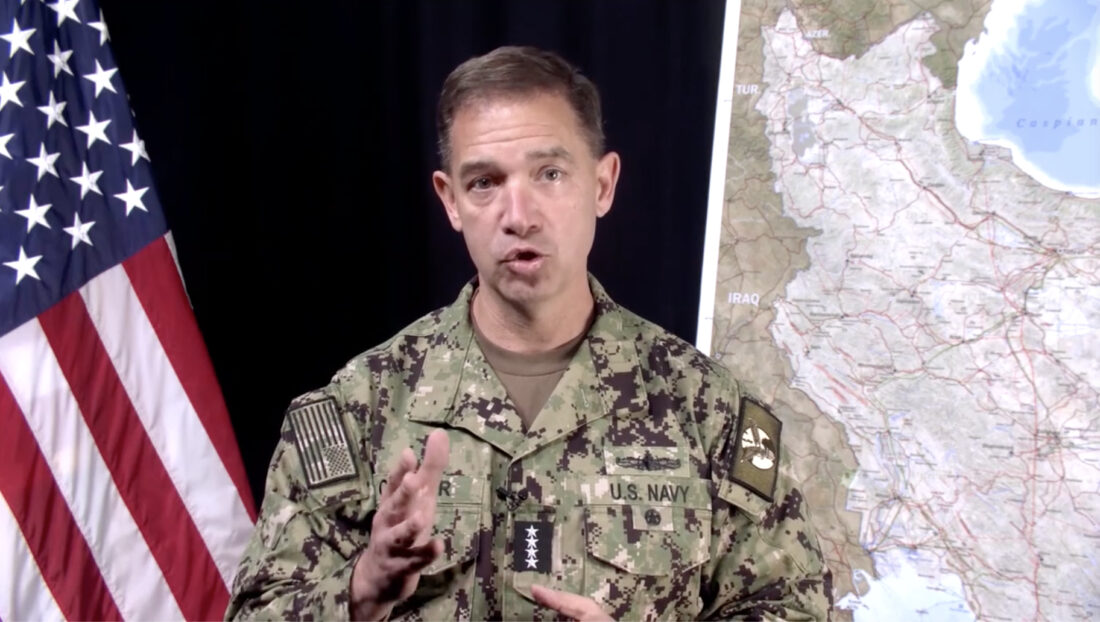
SCREEN PHOTO U.S. Navy Adm. Brad Cooper, commander of U.S. Central Command, said Saturday, March 21, during an update on Operation Epic Fury, that U.S. forces have flown more than 8,000 combat flights. Cooper is the top U.S. commander overseeing operations against Iran. Photo courtesy of Department of War.
U.S. Air Force, Navy and Marine Corps aviators have collectively flown more than 8,000 combat flights during the past days of the Iran War, according to the top U.S. commander overseeing operations against Iran.
U.S. Navy Adm. Brad Cooper, commander of U.S. Central Command, in a video address Saturday, March 21, to provide an update on operations, said, “U.S. forces maintain air superiority over Iran’s skies, having now flown over 8,000 combat flights. Our aircrews are performing exceptionally across the fight from tankers to fighters and bombers to land-based and carrier-based aviation doing a superb job. Tankers are extending our reach so that we can keep constant pressure on the enemy.”
U.S. Central Command (CENTCOM) began Operation Epic Fury Feb. 28, at the direction of the president of the United States. U.S. and partner forces began striking targets at 1:15 a.m. ET to dismantle the Iranian regime’s security apparatus, prioritizing locations that posed an imminent threat. Targets included Islamic Revolutionary Guard Corps command and control facilities, Iranian air defense capabilities, missile and drone launch sites and military airfields, according to CENTCOM information.
Several days later, in a March 3 video address, Cooper confirmed B-52 bombers are among the aircraft taking part in Operation Epic Fury.
Minot Air Force Base and Barksdale AFB in Louisiana have B-52 bombers. The home base or home bases of the B-52s taking part in the mission was not released.
In his update on Saturday, Cooper said, “Fighters and bombers are delivering precision strikes against our primary objectives, and our pilots across the board are dynamically hunting threats as well as finding and eliminating targets in real time. So far, we’ve struck over 8,000 military targets, including 130 Iranian vessels, constituting the largest elimination of a navy over a three-week period since World War II.”
“My operational assessment continues to be Iran’s combat capability is on the steady decline as our offensive strikes ramp up while U.S. forces continue to sustain overwhelming offensive firepower,” Cooper said.
Cooper showed examples during his earlier March 16 video address of how Iran’s defense industrial base is being dismantled, including a photo from March 1 of a naval drone storage facility located near the Strait of Hormuz before and eight days later when it was completely destroyed; an attack drone production factory in Tehran on March 5 and then six days later after a barrage of U.S. air strikes destroyed it, and the Yazdi Military Depot, pictured last month, where light and heavyweight torpedoes were produced, and now what is left of it.
“U.S. and partner strikes are doing exactly what they are intended to do – deliver on very clear military objectives to eliminate Iran’s ability to project power against Americans and against its neighbors,” Cooper said.
He said they are also zeroing in on dismantling Iran’s decades old threat to the free flow of commerce through the Strait of Hormuz.
Over the last two weeks (prior to March 16), he said Iran has launched attacks on many Middle East countries, naming Oman, Saudi Arabia, Israel, Jordan, Cyprus, Turkey, Azerbaijan, the United Arab Emirates, Qatar, Iraq, Kuwait and Bahrain.
“In each of these countries, they are deliberately attacking innocent civilians. They’ve done this more than 300 times, which demonstrates their true nature as a global leader of terror,” Cooper said.
In the past few days prior to March 16, he said the Iranian regime launched what he called “a reckless attack” against civilian neighborhoods in Tel Aviv with cluster bombs. He said cluster bombs are “an inherently indiscriminate type of munition.”
“We join countries across the region in condemning this aggression, and we stand shoulder to shoulder with our partners in bolstering our own defenses,” Cooper said.
Cooper said 50,000 “extraordinary” Americans are deployed across the Middle East region to carry out the mission.
“It’s long been my belief that every success we have begins and ends with our people,” Cooper said. In his March 16 video address, Cooper pointed out the sustainers (logistics members) who, he said, “enable America’s Joint Force to unleash devastating firepower 24/7.”
“To be clear, there’s no other military on Earth that does logistics like the U.S. military, and our team is at the top of their game today. They’re managing distribution networks that span thousands of miles to ensure that munitions, fuel and supplies reach warfighters on the front line on time, every time.
“To the entire Operation Epic Fury team – keep pushing, remain steady, fight to win,” Cooper said.
At the beginning of Operation Epic Fury, Cooper said, in his Saturday update, that he sent a letter to the more than 50,000 American service men and women serving in the Middle East and supporting the campaign. He said he reiterated three key points: be relentlessly lethal; be a great teammate; and steady your resolve, “for we stand on the shoulders of giants, American heroes who have served with tenacity, grit and honor.”
“I just could not be prouder of our warfighters, and I know that the American people share in the same pride,” Cooper added.
Local News
Gaming-style cybersecurity competition offered to students
BISMARCK — High school students who enjoy gaming, puzzles, coding, or exploring technology behind the scenes will ...
Student club to offer community crochet classes
The Magi Crochet Club at Minot High School is hosting crochet classes for the public on April 14-15. Classes are ...
Summer mentorship program returns for beginning farmers
The Foundation for Agricultural and Rural Resources Management and Sustainability (FARRMS) has announced the return ...
Operation Epic Fury
Candidates sought for ND Higher Ed Board
BISMARCK – State School Superintendent Levi Bachmeier on Monday is appealing to North Dakotans to consider ...