
Legislature’s ballot measures face opposition
Voters to consider constitution changes
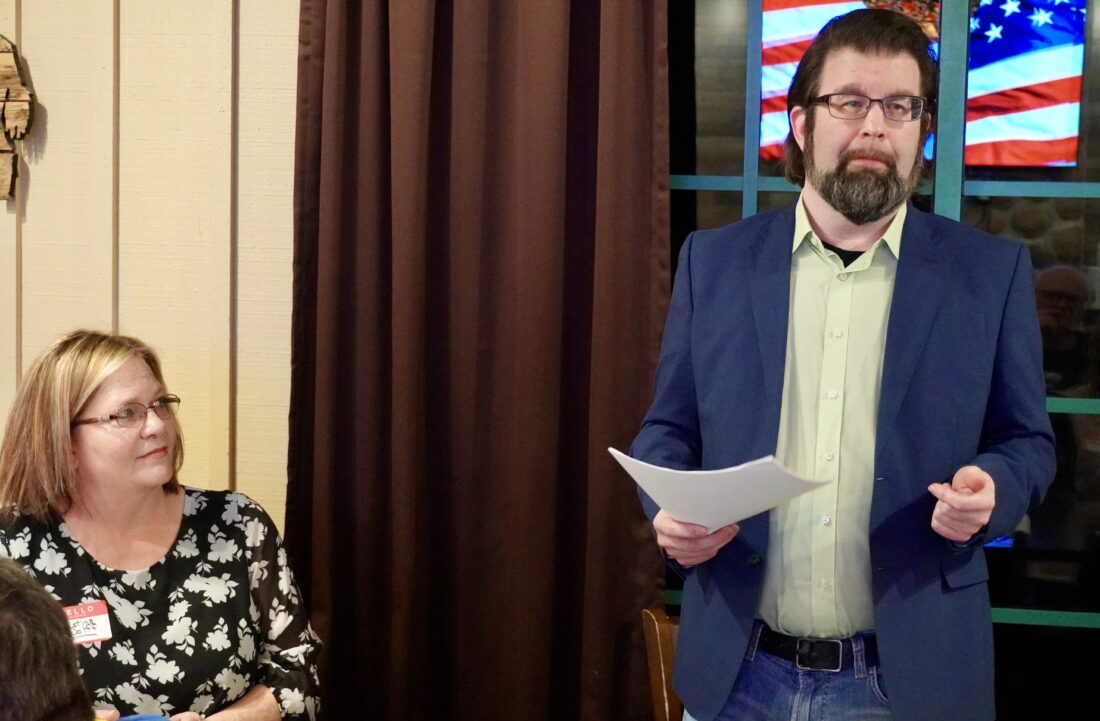
Jill Schramm/MDN Dustin Gawrylow with North Dakota Watchdog Network speaks at the North Central Republican Women meeting in Minot Thursday, Feb. 12. At left is Rep. Christina Wolff, R-Minot.
Three constitutional measures proposed by the 2025 North Dakota Legislature are running into opposition ahead of the June and November elections, including a challenge to one that could keep it off the ballot if successful.
Dustin Gawrylow with North Dakota Watchdog Network spoke at a meeting hosted by the North Central Republican Women in Minot Thursday, Feb. 12, to explain objections being raised over measures that require constitutional measures be contained to a single subject, raise the threshold for passing a constitutional amendment and alter the legislative term limits approved by voters in 2022.
Gawrylow called the single-subject rule in constitutional measure one on the June ballot a misnomer.
“They didn’t define what a subject is. They simply gave the Secretary of State unilateral power to determine what a subject is,” he said. “What happens if I want to eliminate the income tax and cut the sales tax by a penny? Is that one issue – taxes – or is it two issues – income tax and sales tax? We won’t know until the Secretary of State tells us. Luckily , he does have to decide on what his definition of that will be in any given year before people collect signatures.”
He recalled a lawsuit in 2023 brought by the North Dakota Retirement Board against the Legislature for passing a bill with 14 different subjects at the end of the session. The state Supreme Court disallowed that type of omnibus bill.
“So, the Legislature, literally, until two and a half years ago could not define what a single subject was for themselves, let alone expect the citizens to know what it is and how to enforce it at the Secretary of State level,” Gawrylow said.
He said he agrees measures should be to the point on one issue, but implementation is where the problem is.
“I don’t think that they’ve thought through the implementation of this process completely,” he said.
A November ballot measure raising the passage threshold from a simple 50% majority to 60% makes measures more difficult to pass and empowers the minority, Gawrylow said.
“You’re letting 40 percent plus one stop good things from passing as well, and so, it becomes a cost-benefit analysis of looking at whether you believe that the constitutional measure process is being used so much that you have to trade away our ability to do good things in the future,” he said.
If voters impose a 60% rule and ever want to remove it, it would take a 60% majority to do so, he added.
“When you’re trying to make things harder for the citizens, you’re also encouraging more money to come in,” he said. “When you make the process more difficult, you’re actually punishing the grassroots citizens that don’ t have a budget.”
In response to an argument that changing the constitution should be more difficult than changing a law, Gawrylow cited his support for creating an electronic signature system for ballot measure petitions while increasing the number of required signatures.
“I’m not completely opposed to the idea of raising the bar in general,” he said, noting the concern is the constitution prohibits hampering, restricting or impairing the powers reserved to the people.
Sen. David Hogue, R-Minot, contacted Friday, Feb. 13, said a single-subject requirement prevents measure authors from introducing unrelated issues with a “bait and switch” technique. He added the majority of states that allow initiated constitutional measures require single subjects.
“We are getting in line with the majority of states,” he said.
Regarding the 60% passage rule, Hogue said the current bar for amending the state’s constitution is too low and attracts out-of-state interests. A 60% rule is “reasonable but not unattainable,” he said.
“This is a very simple measure,” 2025 House Speaker Rep. Robin Weisz, R-Hurdfield, said of the 60% requirement. “It’s just saying there needs to be a higher threshold to put things in the constitution. It has nothing to do with initiated (statutory) measures. To me, our constitution should be a somewhat sacred document that shouldn’t be able to be changed, added to or taken away just by a simple majority because the intent is to protect the minority.”
A second constitutional measure set for the November ballot would revise language related to legislative term limits. Voters approved language restricting members to no more than eight years in each house, for a total of 16 years. The measure would change the restriction to four four-year terms, or 16 years, in the Legislature, and partial terms would not count.
The measure also removes the provision prohibiting the Legislature from proposing any amendments to term limits. Former Minot lawmaker Oley Larsen and Grand Forks County Commissioner Terry Bjerke filed a lawsuit, now before the state Supreme Court, that alleges the Legislature violated the provision when it passed the resolution creating the ballot measure.
“It’s really hinging on ‘What do regular English sentences mean?’ and “Can the citizens encumber the Legislature?'” Gawrylow said. “If the things the citizens pass won’t stand up in court, what will? How much of the other things in the constitution then become in question?”
Gawrylow said the term limits measure should have been initiated by citizens, which includes any legislator, rather than placed on the ballot by the Legislature.
Hogue noted out-of-state money backed the term limits measure and also is funding the current lawsuit.
If the lawsuit is successful, it would take the term limits measure off the ballot. The Supreme Court is expected to rule before the deadline for finalizing ballots, which Gawrylow estimated could happen by July or earlier.
Local News
Legislature’s ballot measures face opposition
Suicide prevent course offered in Minot
NDSU Extension is offering a free QPR Suicide Prevention Certification training on Wednesday, Feb. 25, from 3-4:30 ...
SWC approves Mouse River flood protection funds
BISMARCK – Souris River Joint Board was awarded $81.1 million for Mouse River flood protection for 2025-2027 by ...
Spirit of Hostfest lives on in shared memories of good times
Warm memories remain for many who worked on the frontlines and behind the scenes to make Norsk Hostfest happen ...
Caring for hearts in more ways on Valentine’s Day
As Valentine’s Day fills the calendar with reminders of love, connection and relationships, February also marks ...
Suspect charged with child abuse
A Minot man charged with felony child abuse made his initial appearance in North Central District Court on ...