
Legislator says free meals come with cost
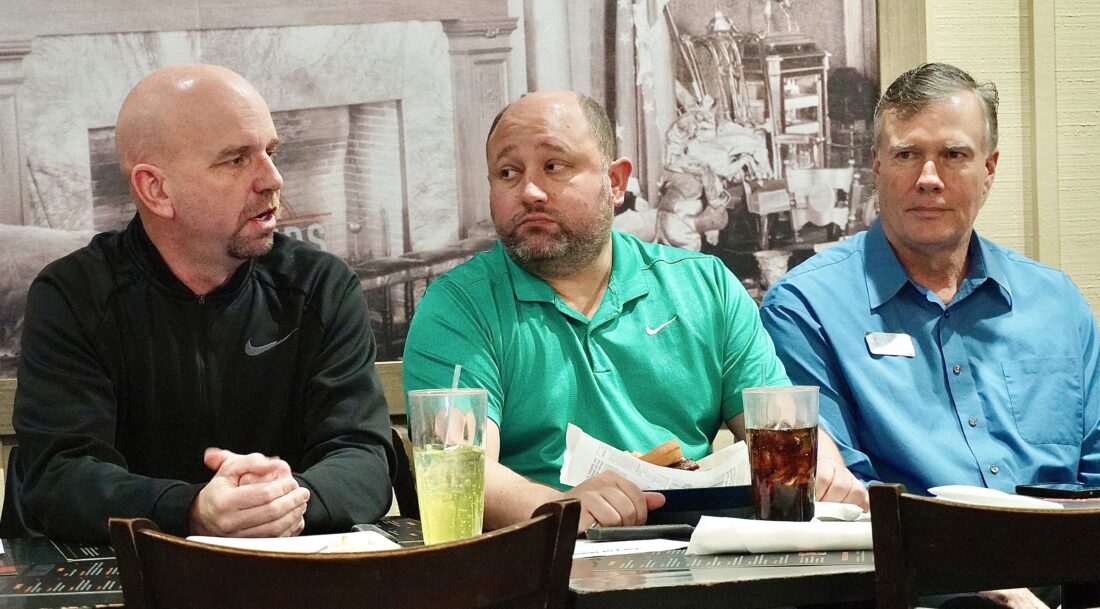
Jill Schramm/MDN Rep. Scott Louser, left, talks with the Minot-Ward County Liaison Committee about the concept of free school meals for all during the committee’s meeting at Badlands Bar & Grill Thursday, Feb. 19. Listening at right are City Engineer Lance Meyer, center, and Ward County Commissioner Ron Merritt.
State funding for school operations could be impacted if supporters of free student meals are successful in getting a constitutional measure on the November ballot and approved, Rep. Scott Louser, R-Minot, told members of the Minot-Ward County Liaison Committee Thursday, Feb. 19.
Louser, who also serves on the Minot School Board, said the Legislature in January was informed the state likely will see 2027-29 biennium revenue that is more than $1 billion lower than the 2025-27 biennium forecast.
“This would be a mandated spending bill in the constitution,” he said of the proposal for free meals. “The concern that some had was, will this impact K-12 funding? All revenue is going to impact funding.”
During the 2025 legislative session, a bill that would have provided free school lunches to all students failed despite an active lobbying campaign in support. A special session in January took up a similar bill, which passed the House but failed in the Senate.
The January bill looked much like the coalition’s proposed initiative, which would provide a daily free school breakfast and school lunch, Louser said.
“The fiscal note for that was about $65 million the first year. I don’t know if that was accurate, but that’s the number we were given,” Louser said. “If you compare that $65 million to the increase that we gave in the per pupil payment last session, which is the K-12 finding formula, that was about that same amount of money.”
Advocating for free meals, the Together for School Meals coalition states on its website that its ballot measure wouldn’t dictate where the funding must come from but ensures lawmakers will use the state’s Legacy Fund earnings if other resources aren’t sufficient.
The coalition states nearly half of food-insecure children in North Dakota are ineligible for federal programs. It notes families will save nearly $1,000 per student per year to use toward other needs, such as housing, health care, clothing or extracurricular activities.
The coalition needs to collect 31,164 signatures by July 6 to get the measure on the November ballot.
“My belief is they’re going to get the signatures to put it on the ballot, and I don’t think there’s going to be an organized opposition. So, it’s going to be up to everybody to make their determination if they think this is a good thing,” Louser said.
Another expected impact if the initiated measure passes is food options in school cafeterias will diminish, he said. Schools would be obligated to provide a free hot lunch, but students wouldn’t necessarily get free access to other cafeteria choices.
“Depending on the size of the school district and what’s available, that may be restricted – potentially eliminated in some districts,” Louser said of optional menu choices. “Then, you’ve got people that said, ‘I voted for that, and it’s supposed to be free. Why do I have to pay? Or, why don’t I have a choice? I would say that’s probably a couple years down the road, and it would be district to district, but that’s a real implication.”
He said legislators don’t lack concern for children on this issue.
During the 2023 session, the Legislature allocated $6 million dollars to public schools to cover the costs of providing breakfasts and lunches to students from households with incomes at or below 200% of the federal poverty guidelines, or about $64,000 for a family of four.
“About half that money got spent. And so here we are looking at spending $65 million when we didn’t even spend all $6 million,” Louser said.
Also in 2023, the Legislature passed an anti-shaming bill that requires all children get a hot lunch even if their lunch account is in arrears.
“Used to be, if they didn’t pay the bill, they got peanut butter and jelly sandwiches. Now, they still get a hot lunch, which in many cases leaves bad debt for the schools. We’ve been fortunate in Minot. It hasn’t been something that we can’t handle, and there’s oftentimes been somebody that comes and pays that debt – a portion of it – but there are some school districts that are in the six figures with that debt,” Louser said.
Laura Dokken, business manager at Minot Public Schools, said a reduction in families applying for federal meal assistance due to free meals for all won’t affect Title I funding, which no longer is tied to numbers receiving free and reduced price meals. Some programs still take federal meal assistance into account, though. The before and after school program is one that offers lower fees to families who apply for and receive free and reduced cost meals.
“I do think there’s a potential legislative solution,” Louser said of the meals issue. “In the event that I’m back in the Legislature, I’ll have another idea. But, I guess, we’ll see how this plays out in the summer and in the fall.”
Local News
Research Center Precipitation Update
On Thursday, Feb. 19, at 8 a.m., the North Central Research Extension Center, south of Minot, recorded 0.08-inch of ...
Legislator says free meals come with cost
Minot, area students named to Academic All-State team
The North Dakota Association of Secondary School Principals has announced the selections for the 2026 North Dakota ...
Williston Fire Department responds to residential fire
WILLISTON — The Williston Fire Department responded to a reported fire on the 1600 block of Sand Creek Drive in ...
Trinity foundation to host fundraising gala
Trinity Health Foundation will host its 5th Annual Fundraising Gala on March 20, at the Clarion Hotel in Minot. ...
Influenza drives seasonal respiratory illness in ND
Confirmed influenza cases declined in North Dakota last week, but influenza remains the primary, seasonal ...