Kenmare seniors earn CDL experience at Minot academy
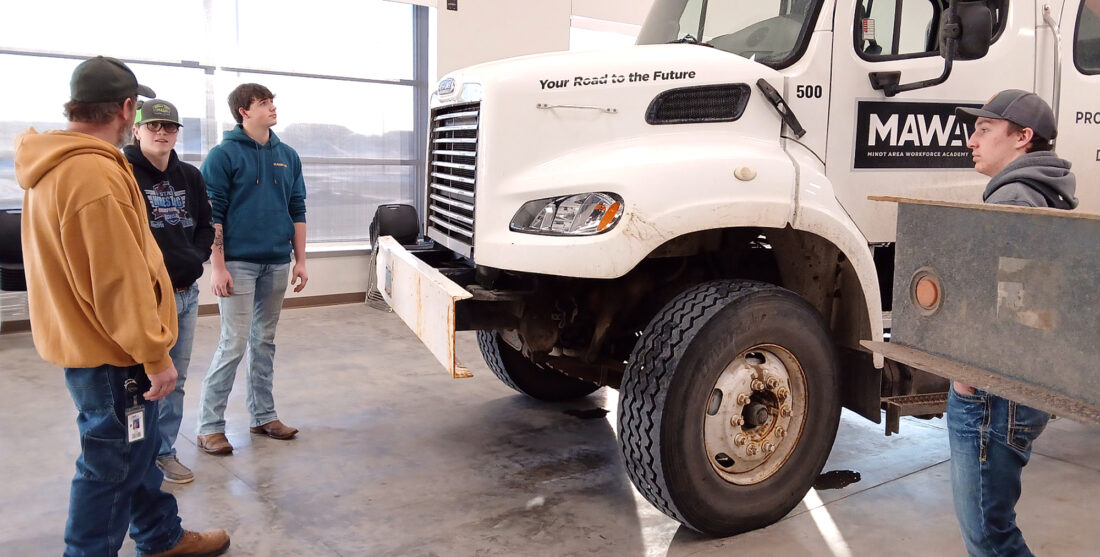
Wendy Harper/MDN Adam Duzick, CDL instructor, left, works with, left to right, Kenmare High School seniors Gage Holter, Sloan Ethan and Cole Herman during a hands-on training session at the Minot Area Workforce Academy in Minot on Friday, Jan. 9.
At the Minot Area Workforce Academy, commercial driver’s license instruction is built around patience, repetition and real-world responsibility, especially for students still navigating high school hallways.
Adam Duzick, a CDL instructor at the academy, works primarily with younger drivers who are new to commercial vehicles and often intimidated by the weight of the equipment and the complexity of federal regulations.
“If they don’t understand something or I see that they’re confused, I explain it more,” Duzick said. “I don’t want to say dumb it down, but I explain it in simpler terms until it makes sense.”
Duzick said keeping students engaged is key, particularly during long instructional days. He limits classroom instruction to about an hour before transitioning students to hands-on learning.
“We do have long lessons in the book, but I only teach for maybe an hour or an hour and 15 minutes,” he said. “Then we go on the simulator so they don’t get too bored, especially later in the day.”
Before students ever get behind the wheel of a truck, they complete between 10 and 15 hours on driving simulators designed to replicate real-world scenarios, including vehicles cutting them off or running red lights.
“The simulators give them scenarios they’re going to see in normal life,” Duzick said. “They have to complete that time before we even get into the truck.”
Duzick brings prior military instruction experience to the classroom, having trained drivers while serving in the United States Air Force.
“I did this job when I was in the Air Force,” Duzick said. “I taught young airmen how to drive tractor-trailers and other vehicles on base.”
In addition to instruction, Duzick served as a certifier, evaluating and approving CDL qualifications for personnel who required licensure.
“There were only a few of us on base who could certify drivers,” he said. “Anyone who needed their CDL came through us.”
He said the transition from military training to teaching high school students felt natural.
“It was pretty much the same thing I was doing in the Air Force,” he said.
Among the students enrolled in the CDL program are three seniors from Kenmare High School: Gage Holter, Cole Herman and Sloan Ethen. The yearlong program requires the students to travel to Minot every other Friday, balancing regular coursework with intensive CDL instruction.
“There’s a lot of hours and a lot of preparation for them to do something like this for us,” Herman said. “They only take a certain number of students so it stays manageable.”
Once students begin driving, Duzick said maintaining a calm environment is critical, particularly when mistakes occur.
“If I get anxious, they’ll get anxious,” he said. “Everybody messes up. You’re okay. We just keep pushing on.”
That approach resonated with the students, who said learning to stay calm behind the wheel has been one of the most valuable lessons.
“If you miss a gear or miss a turn, you just keep going,” Ethen said. “You stay calm and think about how to fix it.”
Safety is emphasized throughout the program, from seat belt use and pre-trip inspections to more complex systems such as air brakes.
“You’re not going to move the truck if you don’t know how to release your air brakes and how that whole mechanism works,” Duzick said. “That’s the basics of the truck.”
Students echoed that focus, describing air brake inspections as one of the most critical components of their training.
“Air brakes are life-or-death situations,” Herman said. “You go through the whole inspection list before you even take off down the road.”
Herman said he plans to use his CDL on his family’s farm, where hauling grain and moving cattle are routine parts of the operation.
“I’ll probably use it hauling grain to the elevator or moving cattle to the stockyard,” he said. “It probably won’t be over-the-road trucking, but it’s something I can use right away.”
Holter and Ethen plan to attend lineman school after graduation, pursuing careers as electrical linemen. Both said earning a CDL now provides a valuable advantage in a field where commercial driving is often required.
“Even if I don’t use it right away, it’s something I can fall back on,” Holter said. “It transfers to other jobs and gives you more options.”
Students also learn federal regulations, including hours-of-service requirements, and maintain logbooks to track driving and rest time.
“When you’re tired, you pull over,” Herman said. “You don’t put other people at risk. You’re driving a lot more weight than a car.”
When asked about challenges facing new drivers, students pointed to terrain differences outside North Dakota.
“North Dakota is flat,” Holter said. “You go into other states and you’re dealing with hills and mountains. You have to know when to downshift so you don’t lose control.”
Duzick said watching students gain confidence over time is one of the most rewarding parts of the job.
“I keep reminding them they’re not there yet, but we’ll get them there,” he said. “By the third or fourth time, they can really see how far they’ve come.”
For the instructor and the students alike, the program offers something tangible as graduation approaches: real skills, real responsibility and a clear pathway forward.
“It gives you real-life experience,” Holter said. “Stuff you can actually use.”
Local News

Animals rights group proposes ad on Third Street Bridge
Women Connect to host Intentional Collisions event
The Minot Area Chamber EDC’s Women Connect team is inviting those in the Minot area to its inaugural Intentional ...
Kenmare seniors earn CDL experience at Minot academy
Lake Sakakawea campground reservations open
RIVERDALE – Campground reservations for Lake Sakakawea in North Dakota are now being accepted for the upcoming ...
IRS marks Jan. 26 as first day to file
WASHINGTON — The Internal Revenue Service has announced Monday, Jan. 26, as the opening of the nation’s 2026 ...