
Council deals with efforts to limit ALPR technology
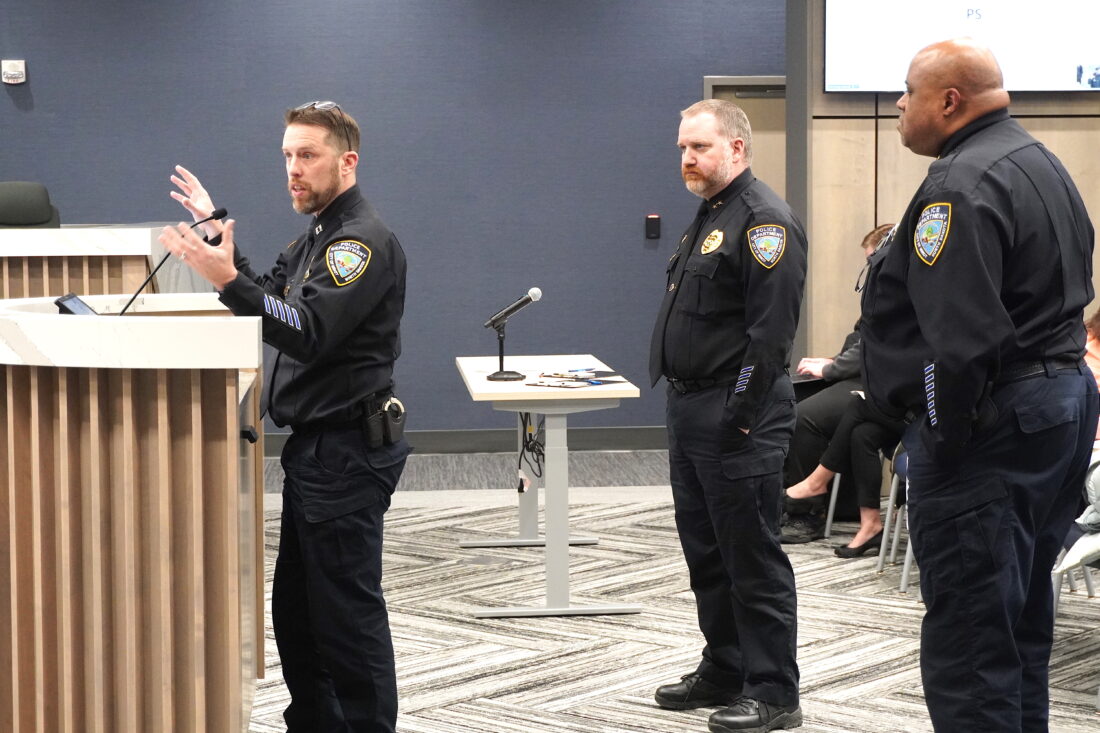
Jill Schramm/MDN Capt. Justin Sundheim addresses the Minot City Council regarding automatic license plate readers as Deputy Chief Dale Plessas, center, and Chief Michael Frye, right, stand by on Tuesday, Jan. 20.
After narrowly approving the police department’s use of automatic license plate readers Tuesday, Jan. 20, the Minot City Council considered a series of motions from council member Mike Blessum to limit the use of the system.
Minot Police will be able to turn on the ALPR system already in the patrol vehicles with the council’s 4-3 vote to approve implementation and a use policy. Voting against were council members Blessum, Rob Fuller and Scott Samuelson. In support were Mayor Mark Jantzer, Lisa Olson, Paul Pitner and Mike Hayes.
“This sets us on a path toward a surveillance state,” Blessum said. “This sets us down a path that is not tenable, in my opinion, as Americans.”
“This is a tool that the MInot Police Department feels is a necessary tool to be able to do their job safely and effectively,” Olson said. She added the policy can be changed if issues arise in the future that currently aren’t anticipated.
With implementation approved, Blessum said, the council must start protecting the public. His first motion sought to disable the storage of data within the system, allowing no storage rather than permit the 30-day retention period in the policy. The 30 days would mirror the department’s body camera data retention period.
“It needs to be gone as soon as possible within the system to facilitate the public’s privacy under the law,” Blessum said.
Police Chief Michael Frye said the system records only license plates and isn’t tracking individuals. The system issues a notification if a plate comes up as connected to a crime, such as a stolen vehicle, but an officer must verify the plate before proceeding with a stop. Frye said lack of retention will impede investigations.
“This is a tool to help us to do our job. That’s it,” Frye said.
He offered to compromise in shortening the 30 days to 10 days in the policy.
Blessum’s motion to immediately remove data failed 3-4, with dissent from Hayes, Jantzer, Olson and Pitner. Fuller, who moved for 10-day retention, called it not ideal but a compromise he can live with. The motion passed 4-3 with dissent from Olson, Pitner and Samuelson.
Blessum then moved to require warrants for Minot police to search the ALPR database.
“Everything that I’m doing is a limiting factor. It’s meant to protect the public and their privacy and their ability to move about the city freely without being tracked in a database and searches looked at for whatever reason. A warrant has a much higher level of scrutiny,” Blessum said.
Deputy Chief Dale Plessas questioned whether a judge would entertain a warrant request for the department’s own data. City Attorney Stefanie Stalheim suggested open records might come into play, enabling the public to access the records even if police need a warrant.
Blessum indicated his interest is not requiring a warrant for data but requiring a warrant for a person in order to search the database for information related to that person.
However, he withdrew his motion and went on to request a policy change related to who approves database searches within the department. With input from the police chief, he crafted a motion to require approval by an officer with the rank of captain or higher and the investigations lieutenant, with the approval of the chief or deputy chief, before the search.
“We need high level people performing these searches, and we need approval all the way at the top of the department,” Blessum said.
Frye said investigators will be doing the searches, but having high level oversight on matters of this sort is not unusual in the department.
Blessum noted he just wants the safeguards in the policy.
“These are real motions where I believe this will make the system better than if we don’t do it,” he said.
The motion for the oversight passed 5-2, with dissent from Jantzer and Pitner.
Blessum also wanted an oversight board to meet monthly to review the department’s searches of the data and make recommendations for possible policy changes. The board chair would be the council president, a position held by Blessum.
“Yes, this is very self serving. It’s me because I am the main person fighting right now,” he said. Also on the board would be another appointed council member and three members from the community agreed upon by the mayor and council president and approved by the council. City staff would serve in advisory roles.
“We are not elected to micromanage our staff,” Olson protested. “We have hired professionals to do the jobs. We are elected to create policy. We are not elected to micromanage.”
Hayes said he can support creation of the board, but he hopes it eventually gets to quarterly meetings and, ultimately, annual audits.
The motion passed 6-1, with Olson dissenting.
Blessum’s final motion was to prohibit data sharing with other government agencies, although the police department could aid another agency with information from its data if there is an active investigation into a particular case.
That again raised discussion on open records. Stalheim asked for time to request information from the North Dakota Attorney General’s Office to clarify the extent of freedom of information laws before going further. The council voted 7-0 to direct staff to obtain information and report to the council by its Feb. 16 meeting.
Local News

Blood Moon
Pursuits, domestics top Ward County Sheriff concerns in 2025

Committee discusses plate reader parameters
Bottineau woman submits winning ‘I Voted’ design

Base leader asks to keep military members, families in mind
Drone light show postponed to May
Cold weather proved to be too much for the drone light show that was to take place Wednesday, March 4, at the Magic ...