
City Council debates future of northwest street, bypass
Freeway concept, Sunset Blvd. tied to NW development
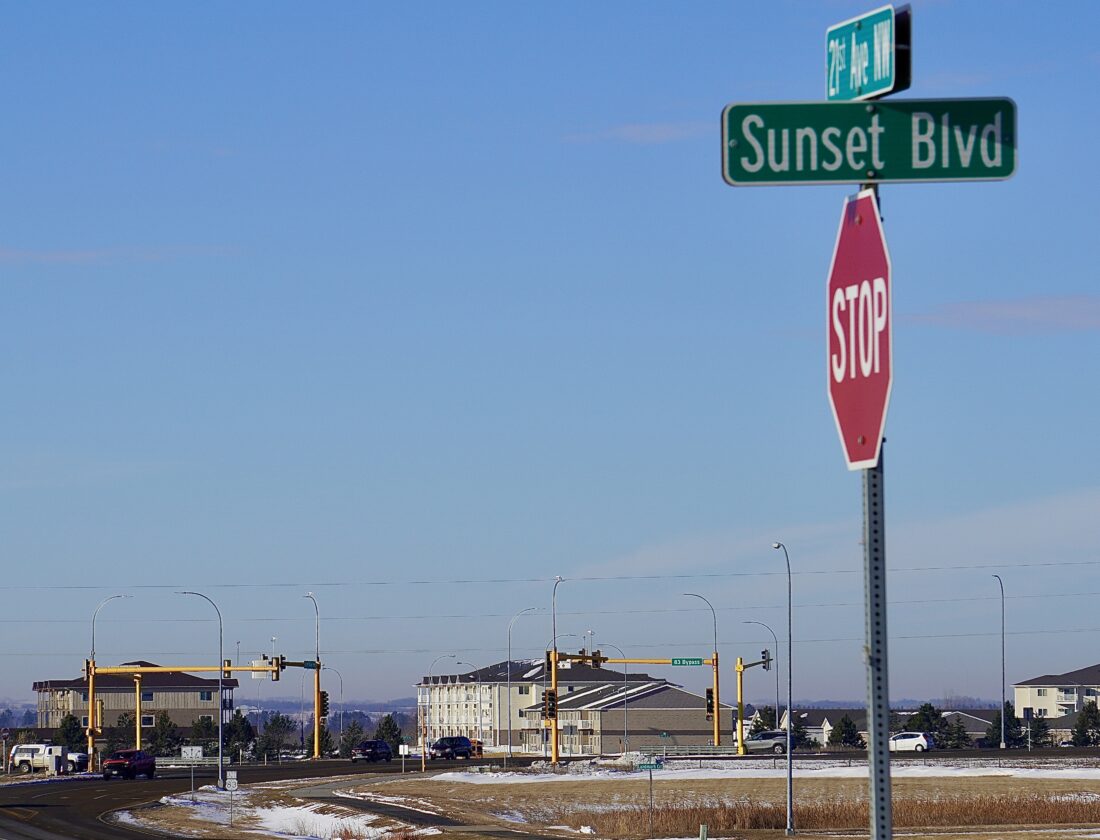
Jill Schramm/MDN 21st Avenue Northwest from Sunset Boulevard to the nearby intersection with the U.S. 83 Bypass, shown Monday, Jan. 5, is a key corridor for potential future development.
Mark Whitman, who is looking to commercially develop about 65 acres of land south of 21st Avenue Northwest and east of the U.S. 83 Bypass, has asked the City of Minot to pave the short, graveled section of Sunset Boulevard next to his property.
His request joins a community chorus calling for paving Sunset, and it prompted considerable discussion at the Minot City Council’s meeting Monday, Jan. 5, regarding street investments, freeway interchanges and the economic future of northwest Minot.
The city typically requires developers to install streets in their proposed subdivisions. The very preliminary cost estimate to pave Sunset between 19th Avenue and 21st Avenue Northwest is $1.8 million. Whitman has offered to donate the required right of way.
While the council voted narrowly to pursue the paving, based on finding the money, the broader issue centered on how northwest Minot should develop.
During the oil boom in 2013, when there was interest in developing about 600 acres in northwest Minot, the city adopted a policy to prevent the U.S. 83 Bypass from having additional access points. The policy requires landowners platting land to dedicate right of way to allow for a future freeway concept, with construction of interchanges on the bypass.
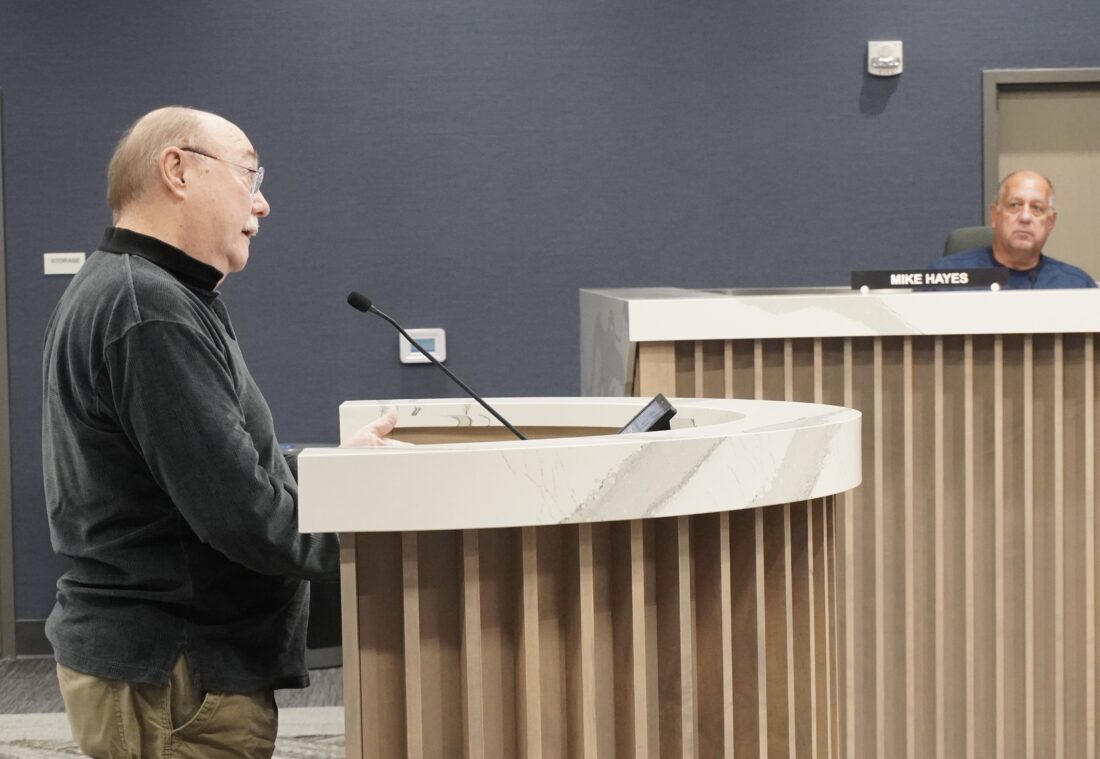
Jill Schramm/MDN Mark Whitman speaks to the Minot City Council Monday, Jan. 5, regarding paving Sunset Boulevard, which runs along property he hopes to develop. At right is council member Mike Hayes.
Since then, growth and development in the area has slowed significantly, and most of the areas expected to develop have not done so, according to the city Engineering Department.
City Engineer Lance Meyer recommended maintaining a policy for the area that addresses access management, even if it no longer preserves the freeway concept with interchanges.
“The more access points you put on arterials, the more congested they become, and so those policy elements are good to retain. I think what the council should probably decide on soon is ‘do we abandon the freeway concept and potentially go to an expressway someday,'” he said.
Meyer said interchanges are extremely expensive to build, and the North Dakota Department of Transportation will not support an interchange at 21st Avenue and the bypass unless traffic volumes reach a level at which current service breaks down.
Council member Mike Hayes voiced concerns about the impediments to development created by the existing policy. Encumbrances on where development can occur would put limits on Whitman’s property, stopping any big box store or large interest, he said.
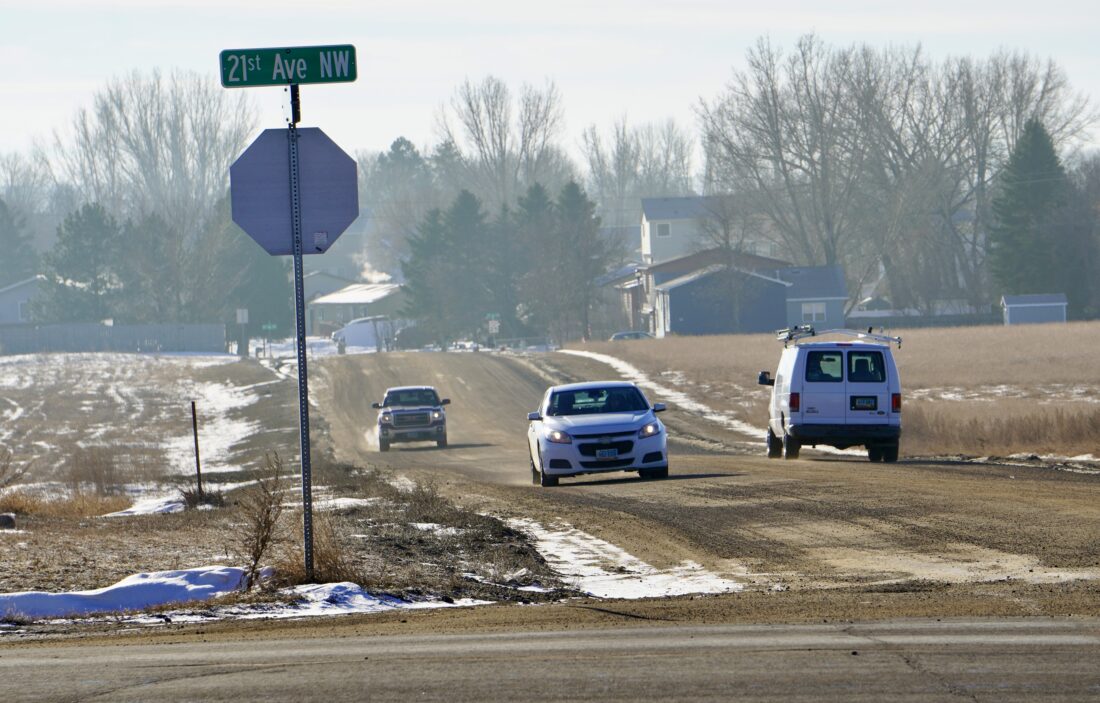
Jill Schramm/MDN Traffic travels Monday, Jan. 5, on Sunset Boulevard in northwest Minot. The City of Minot is considering paving the busy but unimproved street.
Council member Rob Fuller questioned whether the city should remove the freeway protections in the policy to instead pursue an expressway, taking the encumbrances off the nearby land.
“As I see it right now, we wouldn’t need a freeway there for the foreseeable future,” Meyer responded. “Just keep in mind that if land development happens along where these potential interchanges are, that might restrict us from being able to adopt that concept in the future.”
Once developed, the land becomes expensive to acquire and can make interchanges unaffordable. However, Meyer said, the city could buy the land needed for a potential freeway before development occurs as another option.
Fuller moved to direct staff to bring the council proposed policy language that exchanges the freeway concept for an expressway and requires the city to purchase any needed right of way. The council adopted the motion 7-0.
Hayes also advocated for the improvement of Sunset Boulevard, which he said will kick off economic development in that area.
“If the city sees their way to fund that, that’s the mechanism to get that growth started there,” he said. “No doubt on North Hill, it’ll help with traffic control, with sidewalk safety for kids.”
Given the cost, though, Hayes questioned the ability of the city to move forward at this time.
City Finance Director David Lakefield said city sales tax dollars for infrastructure could be a potential source of funds, but there are other avenues that can be investigated. He mentioned special assessments as a possibility.
“I wouldn’t be in favor of the city paying for this,” Fuller said. “I would be in favor of the city paying for it with special assessments on the lots, with caveats that, in three to five years, if we haven’t been paid back, the developer pays us the remainder, and then he can collect as he sells the lots.”
Whitman responded Fuller’s proposal puts more risk on him than he is comfortable with.
“There’s a lot of people that benefit from having that road, other than me. First off, would be all the people that are driving on that road every day. They don’t have to have the ruts. They don’t have to have the washboarding. They could have city lights. It would be a better road for them,” Whitman said.
“I think that entire quadrant of Minot would appreciate having that street paved. It gets used on a regular basis,” council member Lisa Olson said. “It is a different concept for us to pay for it instead of a developer, but I would be amenable to looking at some sort of funding method to make it happen.”
County member Paul Pitner proposed the city work with Whitman and his consulting engineers to pave Sunset Boulevard using sales tax infrastructure dollars and donated right of way by the developer.
“This lends itself to, one, not only improving that corridor of Minot but lends itself to further development within the city,” Pitner said.
“I can’t see voting for this. It just doesn’t make any sense,” Blessum responded. “We’ve just watched a presentation where we’ve got a bridge that is literally falling apart. If we’ve got $1.8 million to use, we might want to fix the bridge.”
Fuller said approving the motion would spur numerous similar requests from developers.
Everybody will expect us to pave their roads,” he said. “We have no room, no budget, no extra left over. We’re worried about spending funding out of our reserves, and here we are talking about fully financing a $1.8 million road.”
Predicting a roundabout at 21st Avenue and Sunset Boulevard in the foreseeable future, Hayes agreed with Whitman that at some point, Sunset Boulevard must be improved, regardless of whether development is occurring, due to the level of traffic.
The council voted 4-3 to approve pursuing the paving, with Blessum, Fuller and Samuelson opposed.
The council also approved a lane reconfiguration of 21st Avenue Northwest between 16th Street and North Broadway, to be completed as part of a roadway resurfacing project in 2026-2027.
The plan is to reconfigure 21st Avenue from 16th Street to North Broadway as a three-lane roadway, with the center lane for turning. Allowed parking between Eighth Street Northwest and Broadway would be eliminated after the 2027 project. Currently, 21st Avenue between 12th and 16th Streets has four or five lanes, while the remainder from 12th Street to Broadway is two-laned.
-
- Jill Schramm/MDN 21st Avenue Northwest from Sunset Boulevard to the nearby intersection with the U.S. 83 Bypass, shown Monday, Jan. 5, is a key corridor for potential future development.
-
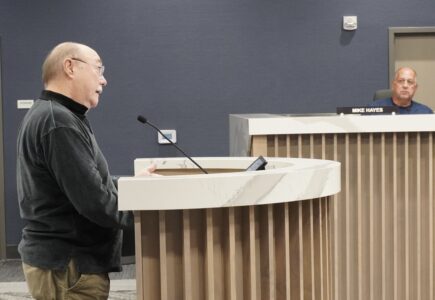
- Jill Schramm/MDN Mark Whitman speaks to the Minot City Council Monday, Jan. 5, regarding paving Sunset Boulevard, which runs along property he hopes to develop. At right is council member Mike Hayes.
-
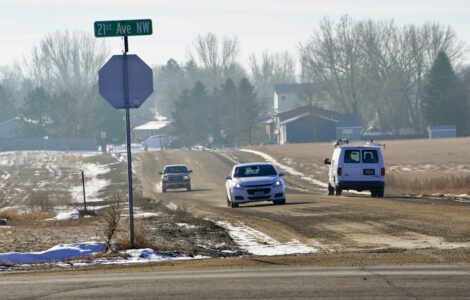
- Jill Schramm/MDN Traffic travels Monday, Jan. 5, on Sunset Boulevard in northwest Minot. The City of Minot is considering paving the busy but unimproved street.
Local News
AARP ND accepting challenge grant applications
BISMARCK – The deadline is March 4 at 4 p.m. for nonprofit organizations and governments to apply to the 2026 ...
Minot council approves changes to downtown facade program
Minot’s downtown Facade Improvement Program has two new deadlines that ultimately will bring the program to a ...
Minot candidates announce joint run for ND House in District 3
Tim Mihalick and Blaine DesLauriers have announced their joint candidacy for the North Dakota House of ...
City Council debates future of northwest street, bypass
Charge dismissed against third person in hotel shooting trial
A district judge dismissed the charge against the third man accused in an Oct, 6, 2024, Minot hotel shooting in the ...
Ward County tables fireworks shows proposal
Ward County commissioners want to hear from the county’s insurer before taking action on a request for fireworks ...