Red Cross brings support to region: Volunteers fill gaps to meet armed forces’ needs
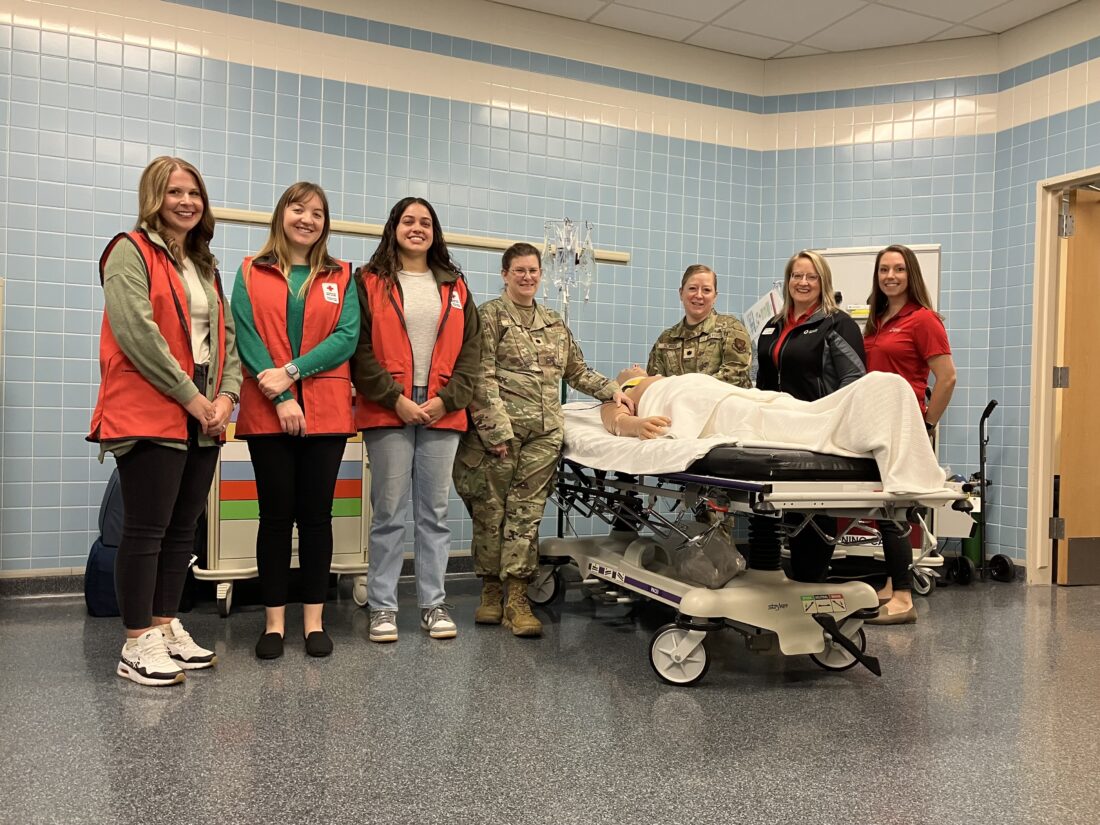
Submitted Photo Shown March 19 during orientation day for medical group volunteers at Minot Air Force Base are, from left, Red Cross volunteers Kristin Settersten and Amanda Conte, Red Cross volunteer and 1st Lt. Ashley Manzano-Latorre, 5th Medical Group Chief Nurse and Lt. Col. Donna Eaton, 5th Medical Group Nurse and Lt. Col. Jessica Scirica, Red Cross Services to Armed Forces Regional Manager Lorie Herbal and Red Cross Executive Director Zoe Wergeland Manstrom with the western North Dakota chapter. Photo from the American Red Cross.
From mental health support for military personnel to food pantry stocking, local volunteers with the American Red Cross are helping their neighbors at Minot Air Force Base.
While better known for its disaster relief services, the Western Dakota chapter of the Red Cross also is engaged in activities at the base through the organization’s Services to the Armed Forces (SAF).
“The SAF side is the oldest line of service and is why the Red Cross came to be,” said Jessica Springfield Edwards. American Red Cross founder Clara Barton was a nurse who tended to the ill and injured during the Civil War.
Springfield Edwards is behavioral health lead for several states in the North Central Division of the American Red Cross but also volunteers with behavioral health programs through SAF at Minot AFB.
Working with Minot AFB commanders, Red Cross volunteers deliver services that fit specific needs identified at the Minot base.
“One of the things we identified in the last year, with Minot in particular, is that mental health services are limited and they’re extremely fractured,” Stringfield Edwards said.
In response, the Red Cross is planning a free lunch-and-learn in January for anyone in the community interested in discussing mental health resources.
One topic will be finding mental health-related internships for graduate students who are affiliated with the military. A choke point in the pipeline of military-competent clinicians is locating internships that allow students to finish their degrees, Stringfield Edwards said. Those students might be veterans, National Guard or Army Reserve, active duty military, spouses or dependents up to age 24.
Additional conversation could be had around lifting other barriers for graduate students who get their degrees, Stringfield Edwards said.
The Red Cross has been involved in mental health activities at Minot AFB for some time. The organization is in need of licensed mental health professionals to serve as volunteer facilitators in conducting its resiliency workshops at Minot AFB, using the federally approved curriculum for military personnel and their families.
The program meets people where they are at, whether they need stress solutions or help coping with deployment, Stringfield Edwards said. With children, the conversation might center on changes that come with the military lifestyle, such as frequent moves.
“We have about 30 different modules available to come and have a discussion for about 90 minutes,” Stringfield Edwards said.
Resiliency facilitators often have some military affiliation, either as a veteran, a spouse or a parent, or they have experience in working as a professional with the military, she added.
“A lot of people who want to work within the military community usually have attachment somehow, and it’s a good way for them to give back,” she said. “That’s the cool thing with the Red Cross, in general, is you can take your current skill set and build on it. You can also try other, new things and you also can get really good networking and exposure to things you didn’t realize are within the umbrella of what is within your own profession or maybe an adjacent profession.”
In the past year, there’s been discussion around the federally approved pharmacy tech and dental tech programs at the Minot AFB clinic. Stringfield Edwards said individuals who are pursuing or have achieved educational qualifications in these technical areas can get experience through volunteer placements at the clinic.
The Red Cross also works with base commanders to find areas where its volunteers can reduce strain for military members. For instance, during the government shutdown, the Red Cross chapter stepped in to bolster the availability of baby supplies at the First Sergeant’s Food Pantry.
The Red Cross also has assisted the Veterans Administration in setting up its Veterans Stand Down event.
“The big thing is really knowing our community locally. What do we need and how can we help address that? And also, how can we help do community mobilization,” Stringfield Edwards said. “We don’t need to be duplicating efforts. We need to be supporting and understanding the resources that already exist, where the gaps are and where we can help fill them.”
Additionally, the Red Cross is looking into organizing and hosting a program to provide continuing education in Minot around mental health. Stringfield Edwards said often the training needed by professionals such as counselors, therapists and social workers requires travel to other communities, so the Red Cross aims to make those educational credits more available through local training.
Additionally, the Red Cross seeks volunteers who are comfortable speaking to groups. Volunteers are needed to conduct regular briefings for military members and their families to acquaint them with the Red Cross and its resources.
However, Stringfield Edwards said, the Red Cross welcomes volunteers of all interests and abilities because the more capacity it has to provide services, the more it can meet different types of needs.
Local News
Alzheimer’s Association to offer presentation
GRAND FORKS – The Alzheimer’s Association will offer a free virtual presentation, “The Empowered Caregiver: ...
League of Women Voters of ND elects leaders
Jannine Paulson of Stanley and Cheryl Bonebrake of Minot were among individuals elected recently to the state board ...
Red Cross brings support to region: Volunteers fill gaps to meet armed forces’ needs

Embrace North Dakota’s early winter
Minot Police investigating another hit-and-run downtown
The Minot Police Department has announced it is seeking information regarding a hit-and-run incident downtown ...