
Minot’s new police chief believes department headed in right direction
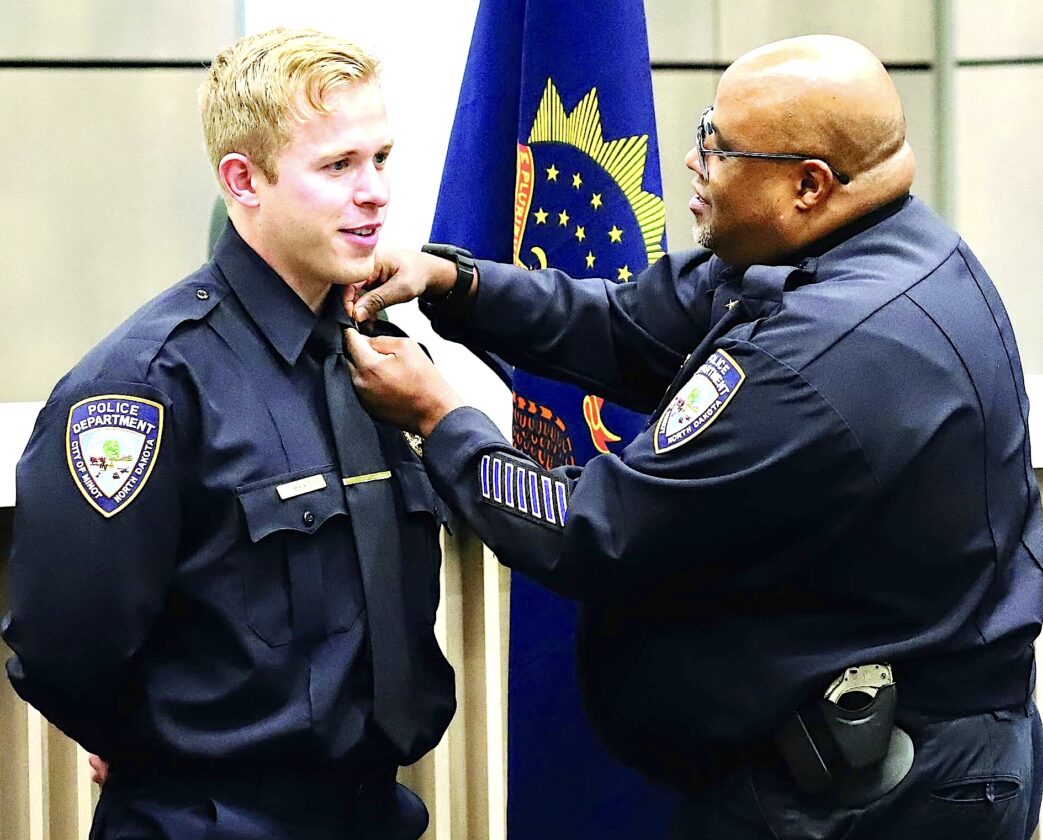
Submitted Photo Police Chief Michael Frye, right, pins Justin Maasjo as a new officer with the Minot Police Department during a swearing-in ceremony Dec. 1. Photo from the City of Minot.
Minot’s new police chief has honed in on officer training and department processes as he looks for improvements to an organization he considers to be already in a good position.
Police Chief Michael Frye was sworn in July 14 to fill a vacancy that opened in January. He had retired as a lieutenant with the City of Minneapolis Police Department in 2024 and worked in public safety education and training at Bismarck State College before coming to Minot. When Frye arrived six months ago, the department was greatly understaffed, with projections for unfilled positions to increase.
“We were to the point we’re about to go to 12-hour shifts across the board,” Frye said. Shifts are 10 hours now for patrol officers and eight hours for investigators.
“I’m a very aggressive recruiter as well,” he said. “I changed how we recruit and how we make offers.”
Placing value on assets such as having a degree, a military background or second language fluency, the pay plan became more attractive and drew more candidates, he said. More applicants came forward because the department offered what they were looking for, such as training, more pay, stability, a fresh start, he said.
Just before Christmas, the department had filled 77 of its 85 slots, with about 15 of those officers in some stage of training. Frye said he expects the department to be at 80-82 officers in January.
“I know the department’s going in the right direction. Morale is up. There’s always going to be some issues, things that we’ve got to work at. But I see the smiles. They feel comfortable coming in and talking to me. I want to hear from my folks,” he said.
Frye said his top priority is to ensure the department’s patrol staff are cared for because they take care of the public. His second priority is beefing up emergency response, which he is addressing by making sure officers who must respond to emergencies have vehicles and equipment where they live. Eliminating the need to stop at the station before responding to a call can significantly shorten response times, he said.
Frye noted the changes he is bringing to the department are largely related to structures and procedures.
“You have to have someone that comes with a different lens, that’s seeing it from a different perspective,” Frye said. “I identified gaps, but that doesn’t mean that they weren’t doing a great job, because they were. We have some phenomenal officers.”
Frye said he places a great emphasis on training and saw room to develop a process for enhancing existing training.
“Making sure that your officers are trained is the key to success,” he said.
His goal is to have multiple trained instructors on the force, including master instructors in some areas, which would allow for a high level of training to be conducted locally.
Another future initiative is expanding the K-9 team. The department currently has four police dogs.
Frye intends to send a sergeant to a K-9 instructors course to develop the capacity to train in-house and help area departments build and maintain their K-9 units as well. Going out of the area for K-9 and handler training is expensive, so investing money in a local program will save dollars in the longer term while benefiting the region, he said.
Frye also examined the department’s processes with its SWAT team and is making changes to ensure adequate training and that SWAT-trained officers are handling situations that could be of higher risk for the department.
“I’m really big into less lethal options for my officers, so we’re going to be adding more less-lethal options on the street,” he added.
He said another goal is to develop officers’ skills to be able to handle cases from beginning to end. He has been working with the state Bureau of Criminal Investigations to develop a condensed basic investigations course that every officer can take.
Restricting promotions to those credentialed to provide field training also encourages more officers to step into those instructor positions, filling a current need in the department while also looking to the future, Frye said.
“We’re preparing you to be a leader. And, I truly believe that you have to develop everyone to be that next generational leader. That’s the biggest thing within our department,” he said. “Everyone knows this. Next generational leaders – that’s what we’re looking at.”
Additionally, there is a focus on a future police station remodel and on ensuring mental health services remain adequate for officers, he said.
The station remodel is a big bite for the department to accomplish, but Frye pointed out the philosophy from the city manager’s office on down is planning to eventually get to the “yes.”
“Too often, the first thing that comes out of people’s mouths, especially leaders, is’ No.’ Why? Because it’s tough. Everything’s tough. How do we get to yes? And yes may not happen right now. It may not be feasible, but if you’re planning for a year from now, then yes might be possible,” he said.
When the day comes that a department fitness gym is completed in the station, he wants to have officers certified as fitness instructors to help other employees, which is part of the planning for “yes.”
“It’s a vision, but you have to think ahead,” Frye said.
Local News
Former ND governor, Allen Olson, dies Friday

Marks on the wall
Concurrent sentence for corruption, luring minor
A Minot man has been sentenced in North Central District Court after entering an Alford Plea to charges of ...

MSU to offer multiple ceramics classes
Minot’s new police chief believes department headed in right direction
ND VOAD’s revival caps off record year of extreme weather
After struggling with low capacity since the COVID-19 pandemic, the North Dakota Voluntary Organizations Active in ...