
Council contemplates city’s next roundabout
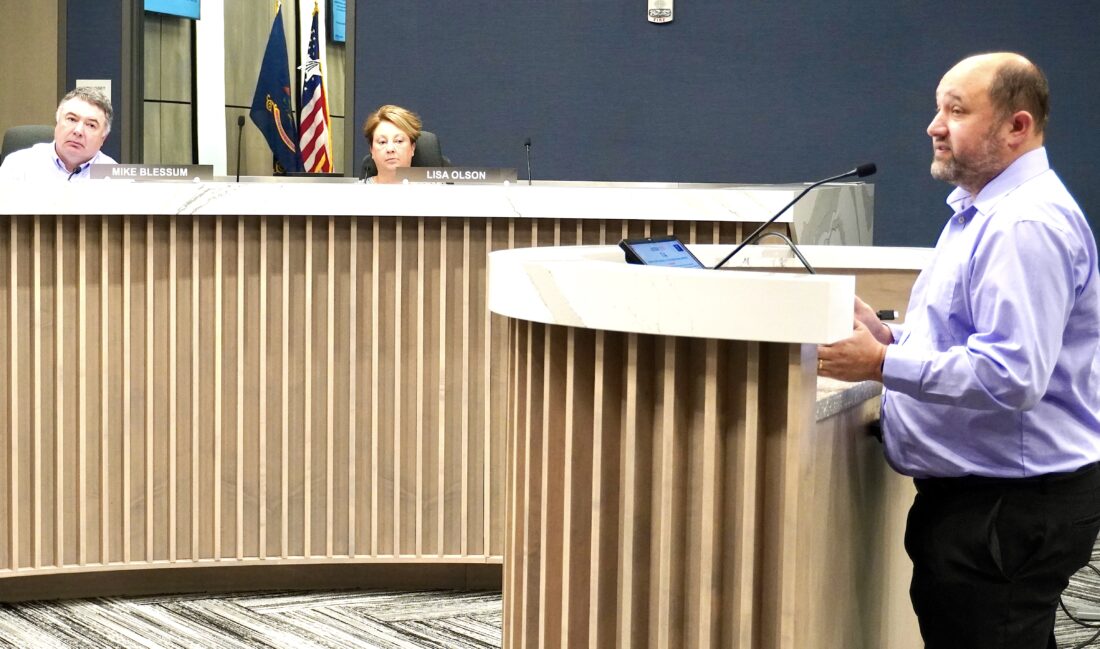
Jill Schramm/MDN Minot City Engineer Lance Meyer, right, describes the rationale for a roundabout at Sixth Street and Second Avenue Southwest to the Minot City Council Monday, Dec. 1. Council members at left are Mike Blessum and Lisa Olson.
A roundabout could be built in southwest Minot as a traffic solution for an intersection within the Maple Diversion project area.
The Minot City Council voted 6-0 Monday, Dec. 1, to allocate funds to cover the additional, estimated cost of $272,000 to adjust Maple Diversion design plans to add a roundabout at Sixth Street and Second Avenue Southwest. Design plans for the Maple Diversion are about 65% complete, according to information provided to the council. The intersection will be near a flood wall to the east.
Council member Rob Fuller, who lives near the city’s existing roundabout at 13th Street and 31st Avenue Southeast, spoke of a number of issues experienced by his neighbor and himself.
“People come around that thing – they use like a slingshot around the moon to get back to Earth, and they’ve gone through his fence twice, my fence once and a half times,” Fuller said, adding that others drive around in circles for fun. “People use them as play toys.”
He also questioned whether truck traffic should be going through the roundabout as it has been.
City Engineer Lance Meyer said the roundabouts are designed for trucks to use the colored portion of the roundabout for extra turning space.
He added the roundabout proposal is meant to accommodate traffic over the next 30 years. Investing money in a shorter term solution can interfere with the city’s ability to afford a correction if something different is needed for the long term, he said.
“It’s probably not going to get the volume needed for traffic signals someday, but as the city would continue to grow and traffic volumes grow, those turning movements coming from Second onto Sixth Street, we’re going to have more delays. So, that’s why staff is recommending a roundabout here – to help futureproof that intersection. We think it’s a good investment,” Meyer said.
Because the addition of a roundabout would be considered an improvement outside the scope of the flood control project, it is not eligible for state funding. The $272,000 price reflects the city’s cost above the standard intersection as originally proposed in the design.
City traffic engineer Stephen Joersz said the increased cost comes from a combination of factors, including revised street lighting, revised pavement markings and more concrete due to the larger footprint of the intersection with a roundabout.
Blessum said being strategic about where the city’s next roundabouts are placed creates an opportunity to educate people about their use and also sets the city up with roadway solutions that are less costly than traffic signals.
“That’s my hope with all this is that we start moving toward this. Get people used to it, so they’re not as novel. And I think, for me, this is a good spot. It gives me heartburn with the money, but if it’s the right solution and we can make it happen and it’s good long-term – maybe more cost neutral long term – that’s probably a good thing,” Blessum said.
Meyer called roundabouts important tools when used in the right situations.
“And in this situation, where you have two minor arterial roadways coming together, that’s a great solution,” he said.
Council member Paul Pitner agreed a roundabout is the right solution.
“Studies have shown that roundabouts are just consistently safer than four-way, three-way intersections,” he said. “I think it’s a good, forward-looking move.”
Local News
Legislature’s ballot measures face opposition
Suicide prevent course offered in Minot
NDSU Extension is offering a free QPR Suicide Prevention Certification training on Wednesday, Feb. 25, from 3-4:30 ...
SWC approves Mouse River flood protection funds
BISMARCK – Souris River Joint Board was awarded $81.1 million for Mouse River flood protection for 2025-2027 by ...

Spirit of Hostfest lives on in shared memories of good times
Caring for hearts in more ways on Valentine’s Day
As Valentine’s Day fills the calendar with reminders of love, connection and relationships, February also marks ...
Suspect charged with child abuse
A Minot man charged with felony child abuse made his initial appearance in North Central District Court on ...