Natural resources require care, education
Tribal agency preserves Turtle Mountain amenities
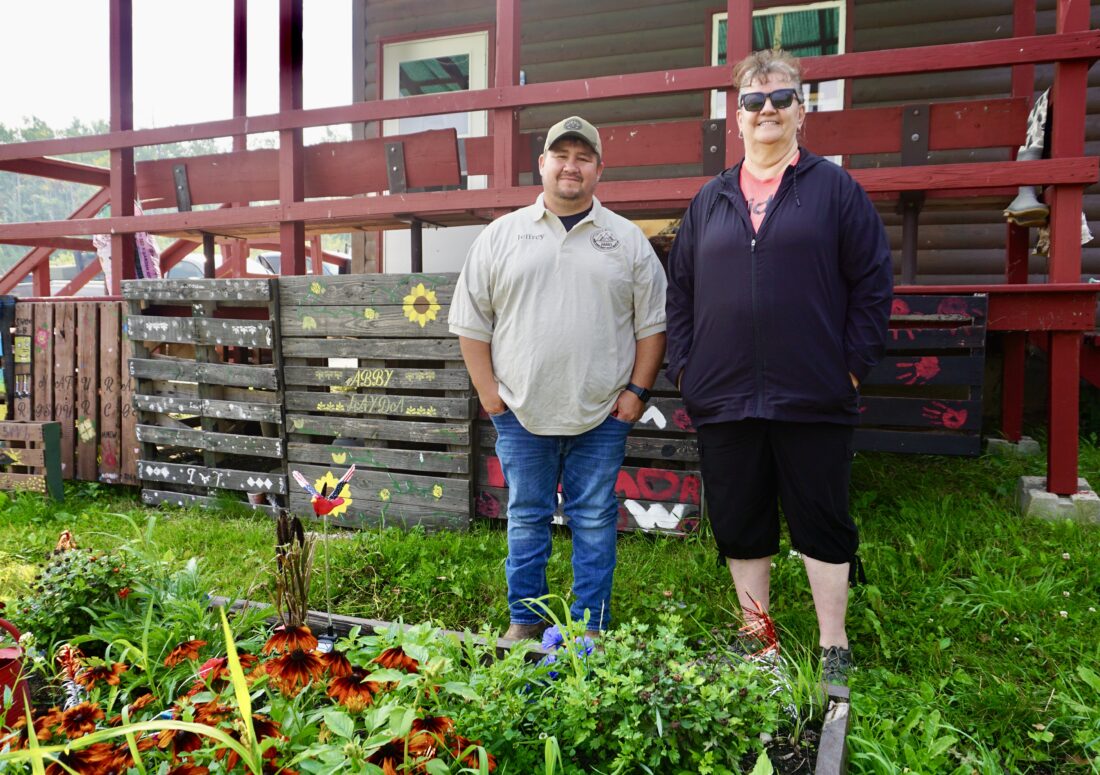
Natural Resources Director JJ Desjarlais and Park Ranger Susan Delorme stand outside the Turtle Mountain Natural Resources headquarters, where flowers were in bloom Tuesday, Aug. 12, and youth art was on display.
BELCOURT – The son of a biologist, Jeffrey “JJ” Desjarlais Jr. recalls his father talking about the importance of natural resource management to preserve the assets for future generations.
“That’s why as a kid I became really interested in this and love it now today,” said Desjarlais, also a biologist and director of Turtle Mountain Natural Resources.
Desjarlais grew up in the Turtle Mountain area, returning after college.
As director for the tribe’s Natural Resources Department, he provides oversight to about 40 full-time and seasonal employees who perform a diversity of tasks ranging from park maintenance to sawmill operation and buffalo ranching.
The department oversees a buffalo herd that currently numbers 50 head and manages both pastures and hayland.
“The big, shiny movie star right now is our big white buffalo,” Desjarlais said of the bull acquired four years ago. The white buffalo produced more light-colored calves than statistically would have been indicated, allowing the Turtle Mountain Band of Chippewa to gift calves to other tribes.
The tribe started its Plains Buffalo herd in the early 2000s with 30 head obtained from Wind Cave National Park in South Dakota, Desjarlais said. To keep diversity in the herd and avoid inbreeding, the tribe works with a tribal buffalo council in Rapid City, South Dakota, to bring in new stock.
Unlike domestic cattle, buffalo are largely self sufficient when it comes to birthing.
“Honestly, since I’ve been here, we’ve never lost a buffalo calf,” Desjarlais said.
The buffalo handlers take care of vaccinations and other preventive treatments, essentially ensuring the herd is well cared for, he said.
He added the herd has become comfortable around humans due to contact with their department staff, who bring them treats, but it’s still nerve-wracking to be among such large animals when they are snorting and grunting.
“But it’s pretty neat,” he said.
The tribe has kept a remnant of the herd along N.D. Highway 5, where it is visible to the public, but the majority of the herd is located on the tribe’s other grazing meadows.
Desjarlais said the grazing management plan indicates enough property exists to expand to about 65 head, which is the eventual goal.
The department culls several buffalo, typically bulls, each year, either through sales or processing into meat. Much of the meat is served at major powwow events.
Herd manager Merton Davis also conducts an educational program in which high school students are taught about field processing of buffalo.
Along with attracting visitors to see the buffalo, the Natural Resources Department has developed a strong following from the fishing community by keeping fish stocked in seven lakes with the help of the U.S. Fish and Wildlife Service.
“We’re actually going to expand. We surveyed a few more lakes that can hold fish,” Desjarlais said.
Additionally, the Natural Resources Department works with Fish and Wildlife on endangered species protection. It also has pollinator studies that are ongoing.
Another branch of the department is the tribe’s Historic Preservation Office, which gets involved whenever there are construction projects that could impact archeological artifacts.
The department has its own conservation law enforcement officers and a park ranger division that provides 24-7 security and educational interpretation for visitors while caring for park and recreation areas.
Susan Delorme, lead park ranger, grew up in the area and spent 43 years working locally in education and with an alcohol and drug treatment program. However, she said, she always wanted to be a ranger. The opportunity came at Lake Metigoshe, where she worked about five years before Desjarlais recruited her to Turtle Mountain Natural Resources about four years ago.
Delorme and other rangers provide park programming, including youth day camps with outdoor and educational activities, fishing derbies, the annual Haunted Trail event in October and sleigh rides and Santa visit in December.
In the winter, parks are open for snowshoeing, cross country skiing and ice skating. In the summer, the parks host corn hole tournaments, frisbee golf and canoe and kayak races.
The department frequently surveys the public to find out which activities the public wants to see.
“We just finished a master park plan with the National Park Service, and we did 10-15 surveys of the community of what they’d like to see. A lot of it had to do with fishing access. So, people are big into fishing around here,” Desjarlais said.
Desjarlais said the department has been working with local manufacturers to create accessible areas for people with disabilities, including accessible docks. New boat ramps also are an upgrade on the horizon, and shoreline restoration is underway. Efforts are being made to eventually construct a large building that will increase programming capacity.
Desjarlais said another goal is to bring electrical hookups and water to more camping areas without taking away from the primitive feel.
He added the department received a grant last year for a trail linkage project, allowing construction of bridges to make trail connections without obstructing waterways.
“It added another almost two miles to our trail system within the park,” he said. “It’s all within a confined area, obviously, but it just loops around a lot.”
The Natural Resources Department is working with schools to bring the trail into compliance to host cross country races.
Natural Resources staff also works with area schools to offer ecosystem education. On Arbor Day, the department purchased hundreds of evergreens and distributed them to fourth graders in partnership with the National Resource Conservation Service.
Within its parks, the department conducts forest management projects, systematically removing old forest and diseased trees to promote new growth.
“Since the root system is still in the soil, we get this nice regeneration. We get all these sprouts and get a brand new forest, hopefully, in the next 30 to 40 years. So, we’re not thinking about ourselves now. We’re thinking about our kids,” Desjarlais said.
In conjunction with the tree removal, the department’s sawmill operates as part of a wood utilization project.
“Anything that gets taken down gets utilized,” Desjarlais said. “A majority of it is given away.”
Delorme said they plant many trees, and her focus is getting more berry trees that are native to the area, such as Juneberries, chokecherries, plums, cranberries, gooseberries and blackberries. In that regard, the department works with a local nursery and with U.S. agriculture and conservation agencies. It also has started young trees in its greenhouse.
Along with its park duties, Natural Resources staff step in if needed by the tribal government or community.
“It’s a pretty tight knit community so if people need help, we go help,” Desjarlais said. “We do whatever is needed for the community.”
They’ve moved trailers, provided weed spraying and performed ground work outside the parks. They have harvested trees in clearing property for home construction and utilized the wood. They’ve also helped with community events.
“We keep getting grants to where we can hire additional staff, too. We’re still expanding. We’re expanding our ranger department, expanding our forestry department,” Desjarlais said.
To encourage additional tourism, Desjarlais said, the tribe has proposed a project to pave the lake access road, which serves a good portion of the parks, including to the tribe’s premier Sky Chief Park.
Sky Chief Park is popular for family reunions and birthday parties. Delorme added a park pavilion also has been used for weddings.
Without the people, funds and tribal support behind the parks and fisheries, the natural amenities of the area could be lost, according to Desjarlais and Delorme. Without oversight and people to care for the area, the resulting uses could be more detrimental than beneficial, they said.
“It has to be managed,” Desjarlais said, noting that concept was a challenge for people to grasp at first. “People fought a little bit on it. Now they’ve learned to accept it, and they’re kind of thankful now that we’re doing it.”
H
Local News
ND company sentenced on Clean Air Act violations
BISMARCK – U.S. Attorney Nicholas Chase announced Friday, Dec. 5, a North Dakota company has been sentenced for ...
Governor sets tentative date for special session
BISMARCK — Gov. Kelly Armstrong informed legislative leaders on Friday, Dec. 5, that he has identified Jan. 21 as ...
PSC sets public hearing for energy project
BOWBELLS – The North Dakota Public Service Commission will hold a public hearing on Friday, Dec. 19, regarding a ...
Library drops Hoopla digital platform
Minot Public LIbrary has announced that starting Jan. 1, it will no longer be offering Hoopla, a digital media ...

Public input sought in health unit survey