
Update assesses rural economy
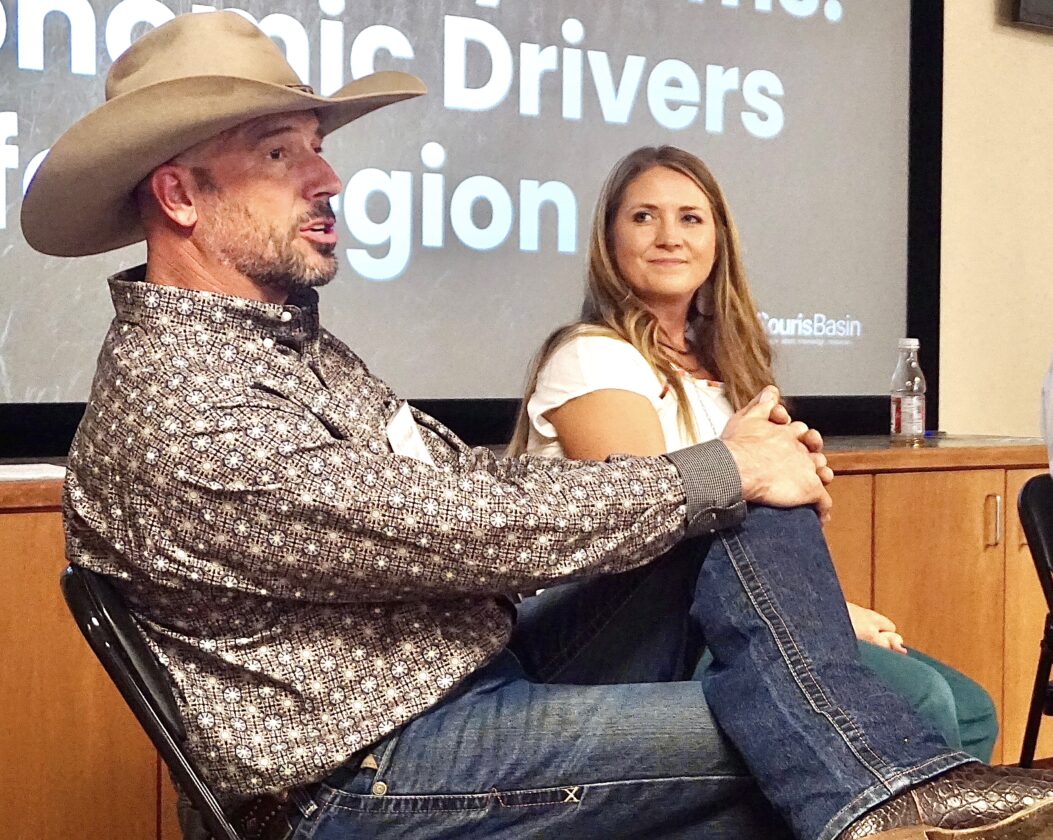
Jill Schramm/MDN Phillip Newman with Mema’s Meats in Berthold speaks about local foods on a panel with Ashley Bruner, right, with Dakota Angus Beef in Drake at Souris Basin Planning Council’s State of the Region event in Velva Thursday.
VELVA – Child care, refugee resettlement and local foods were highlighted at a State of Region 2 meeting on rural economic development, hosted by Souris Basin Planning Council in Velva Thursday.
As the regional Economic Development District through the U.S. Department of Commerce, SBPC, led by a local advisory board, is responsible for developing a Comprehensive Economic Development Strategy. Thursday’s report on where Region 2 stands economically indicated positive strides but a need to do more. Region 2 includes Mountrail, Burke, Renville, Ward, Botitneau, McHenry and Pierce counties.
Deb Nelson, administrator for Vision West, Dickinson, and Verla Jung, start-up and community engagement coordinator with Child Care Aware, Jamestown, noted that despite $66 million in state aid for childcare in the 2023 legislative session, Mountrail and Renville remain among 15 North Dakota counties considered child care deserts.
The goal is to have 50% capacity based on licensed child care spots and potential demand. Mountrail is at 8% and Renville 20%.
Jung and Nelson said state programs to assist child care facilities increase capacity are out of money. The Regional Workforce Impact Program created more than 2,400 childcare slots, but issues remain with capacity, especially in rural areas, they said.
The success of a program that matches employer dollars to help cover the cost of childcare for qualified employees has been mixed, Nelson said.
“The problem is, most of the companies, most of the businesses that are providing this wonderful benefit are larger companies, companies that have HR departments, who can afford to give that,” she said. “So this program is not helping our rural communities at all.”
One of the largest employers using the program is the State of North Dakota, she said.
Jung also sees discrepancy between state funding for childcare centers, which has sustained most of the benefit, and home daycares.
“There wasn’t much for the little guy,” Jung said. “In small communities, if you could get two people to open up a family child care, that’s maybe all you need to solve a small town issue.”
Nelson added it also is unknown how many of the 2,400 childcare slots created actually are filled.
“We do know there are centers who are licensed for maybe 60 and are taking in 30 because they don’t have child care workers. And the reason they don’t have child care workers is because they’re getting an average of $11.68 an hour,” she said. “In Dickinson, they’re getting a little more than that. They’re getting anywhere from $12 to $15, but they can still go to work at McDonald’s, starting at $16.”
Derrick Gross, executive director for Communities Acting Together for Change and Hope (CATCH), addressed the need for private sponsorships to support refugee resettlement and grow communities. The Welcome Corps, a program of the U.S. State Department, provides for private sponsorships, which CATCH looks to facilitate in North Dakota.
The federal government’s 2024 numbers show 678 legal immigrants coming into North Dakota, Gross said. Of those 325 are refugees. Another 62 have special immigrant visas, largely representing people from other countries who served in the U.S. military during the Afghan war. A Cuban-Haitian entrance program accounts for 202 people and Ukrainian humanitarian numbers stand at 89
In North Dakota, about 55% of refugees are from Latin American, 24% from Africa, 19% from the Near East and South Asia and 14% from Europe and Central Asia, Gross said.
A geographic shift has occurred in where refugees are settling, he said. At one time 85% of refugees were in Fargo. Between 2022-24, 53% settled in Fargo, 16% in each Grand Forks and Bismarck and 13% in Minot, Dickinson and Williston combined.
The rural area attracts about 2% of refugees.
Resettlement can be part of the solution to workforce and rural population decline, Gross said.
“North Dakota’s tried this in a number of ways through workforce initiatives. The problem that I’ve seen there is they’re focused on the job and the employee. They’re not talking about the family. They’re not bringing the whole family there, settling them, sponsoring them, making them integrate as part of the community so that it lifts everybody up,” he said.
He cited a positive example of resettlement that occurred in Bottineau, which settled two families from the Ukrainian program through CATCH.
“Those two families have eight students in the Bottineau school. That’s about $120,000 added to the Bottineau school budget,” he said of the state aid. “Those two families are now paying rent, trying to get a mortgage, shopping at the local grocery store, all those types of things. So, it’s building up the whole community.”
Carrington also brought in a handful of Ukrainian families, providing employees for the nursing home and adding children to the school, Gross said. The resettlement has been more successful than a previous effort by Carrington’s pasta plant to bring in workers from Venezuela through a recruiting agency, which took the community by surprise.
“It can be a difficult thing if it’s not handled properly. And that’s where CATCH wants to come in. We want to work with private sponsorship, where groups of local citizens are sponsoring family units that want to settle here, want to become a thriving, integrated part of your community,” Gross said.
Phillip Newman with Mema’s Meat in Berthold and Ashley Bruner with Dakota Angus Beef in Drake spoke about the impact of their operations in their rural communities and the need for local foods.
Operational logistics has been the biggest challenge, Bruner said. Pricing is part of that, she said.
“I know there’s the demand for sourcing local,” Bruner said. “They want to use our product, but when it comes down to pricing, we cannot compete off the truck.”
However, Newman said buying locally also is about purchasing a higher quality product.
“The difference is in the handling,” he said. “Food’s expensive enough in the grocery store. If you’re going to eat, you might as well eat good, in my opinion.”
Supporting local also provides food security, he said.
“If you’re supporting your local shops, local farmers, local ranches, if the rest of the world falls apart, we still have a chance of eating around here because we have such a rich agricultural background,” he said. “If we don’t support local and we don’t establish those food supply chains, they will fall by the wayside.”
Bruner noted the pending closure of Drake’s grocery store in discussing rural communities struggling to thrive.
“How do we keep rural grocery stores alive? How do we keep rural anything alive?” she said. “I think it’s ‘together.’ We all have to work together to keep the conversation going, to keep the ideas flowing. Some of them are going to work.”
Local News
Funds available to improve maternal health in ND
FARGO – Organizations supporting maternal health care in North Dakota are invited to apply for a Maternal Health ...

Western Plains Opera, MSU Theatre to present ‘Chicago’
Minot to escape worst of snowstorm
Parenting book study begins April 8
A free book study on “Raising Good Humans” will be held online on Tuesdays from April 8 through May 6 at 6:30 ...

Local event benefits military members at Minot AFB
Minot Symphony Orchestra to present ‘Pirates of the Caribbean’
The Minot Symphony Orchestra will present Disney’s "Pirates of the Caribbean: The Curse of the Black Pearl" in ...