
Council prioritizes future talks on former city hall
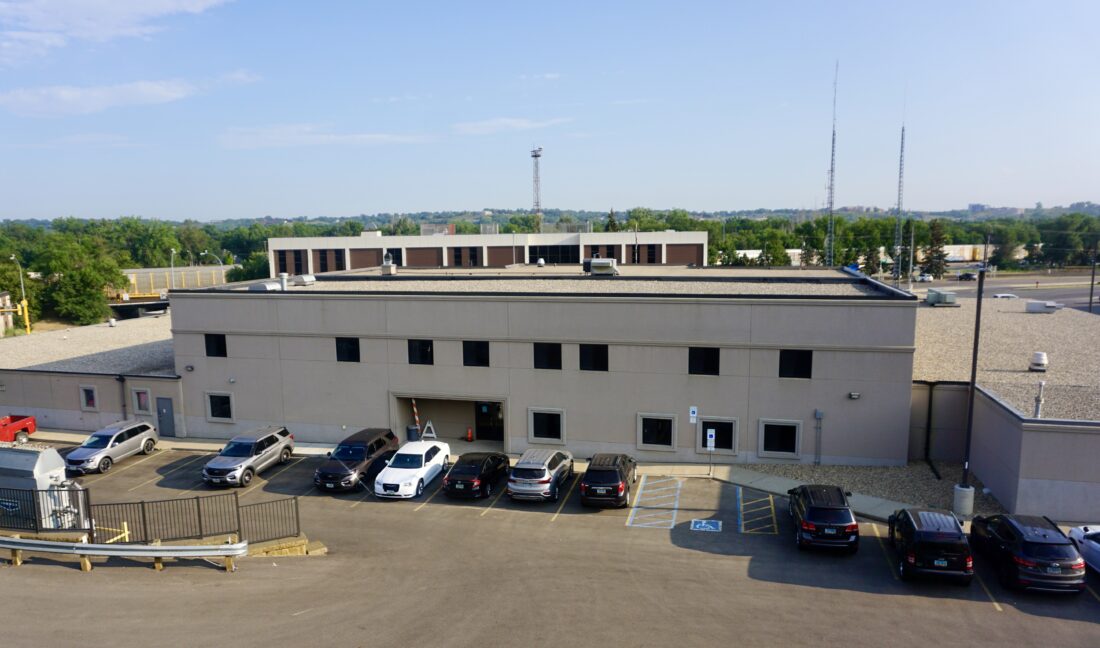
Jill Schramm/MDN Minot’s former city hall, with the city library in the background, is in line for conversations about its future and whether it might be able to better serve the Minot Police Department, which expanded from its headquarters last year to utilize vacated space in former city hall.
The future of Minot’s former city hall, now known as the legacy building, will be a topic of discussion in coming months, according to Minot’s city manager.
City Manager Harold Stewart said Tuesday that discussion about the building was put on hold until the new council could be seated in June and remains on hold until the 2025 budget can be solidified. But he noted the building is a priority conversation the city wants to have with the community, possibly this fall. The conversation would include alternatives and how improvements might be paid for, he said.
The Minot Police Department expanded into the former city hall from its attached headquarters after the new city hall fully opened on May 1, 2023. The building was constructed in 1956 and renovated in 1989 and 2003.
A consultant’s report presented an option for renovating and expanding the building, estimated to cost $46 million to $52 million. Another option is finding a different site to accommodate new construction, costing an estimated $62 million to $70.7 million, according to an Oct. 11, 2023, article in The Minot Daily News.
Council member Scott Samuelson, during Tuesday’s budget meeting of the council, said the building is a priority.
“I’m not in favor of building a new building. I’m not in favor of maybe going as extensive as what the consulting maybe came up with for the facility, but I do know something needs to be done,” said Samuelson, who had toured the building during an open house last fall. He said there’s nothing wrong with the building itself, but it is inadequate for police functions.
The consultant’s report found the building’s use disjointed, the October 2023 news article stated. The police station has thousands of pieces of evidence and other stored items in multiple locations around the building and additional multiple locations in the building used for patrol operations. The police chief also noted in the article that the department’s location was affected when anhydrous ammonia drifted from a train derailment west of the city in 2002, and the building needed a 25-foot barrier wall to protect it during the 2011 flood. The department sits at a lower level than nearby ground, creating potential vulnerability for officers and high-value police vehicles.
“I could not believe that the City of Minot has left a facility like that for the police department when we’re sitting in this building,” Samuelson said of the current city hall. “For what we expect our police to do and the facility that they have, I think it’s a priority, and I think it’s sad that we left them with that.”
City council member Lisa Olson agreed the building needs to be a priority. She explained the new City Hall was built for administration and dispatch because funds were designated for that purpose in the National Disaster Resilience application for which Minot received a grant award.
“It was not available for the police department, but I agree, it’s a priority and I hope we can take action on this,” she said.
Stewart said a proposed measure to eliminate property tax could influence any action if the proposal gets on the ballot and is approved by voters.
Local News
Funds available to improve maternal health in ND
FARGO – Organizations supporting maternal health care in North Dakota are invited to apply for a Maternal Health ...

Western Plains Opera, MSU Theatre to present ‘Chicago’
Minot to escape worst of snowstorm
Parenting book study begins April 8
A free book study on “Raising Good Humans” will be held online on Tuesdays from April 8 through May 6 at 6:30 ...

Local event benefits military members at Minot AFB
Minot Symphony Orchestra to present ‘Pirates of the Caribbean’
The Minot Symphony Orchestra will present Disney’s "Pirates of the Caribbean: The Curse of the Black Pearl" in ...