
Keep It Local ramps up for campaign
Opposition prepares to take on property tax measure
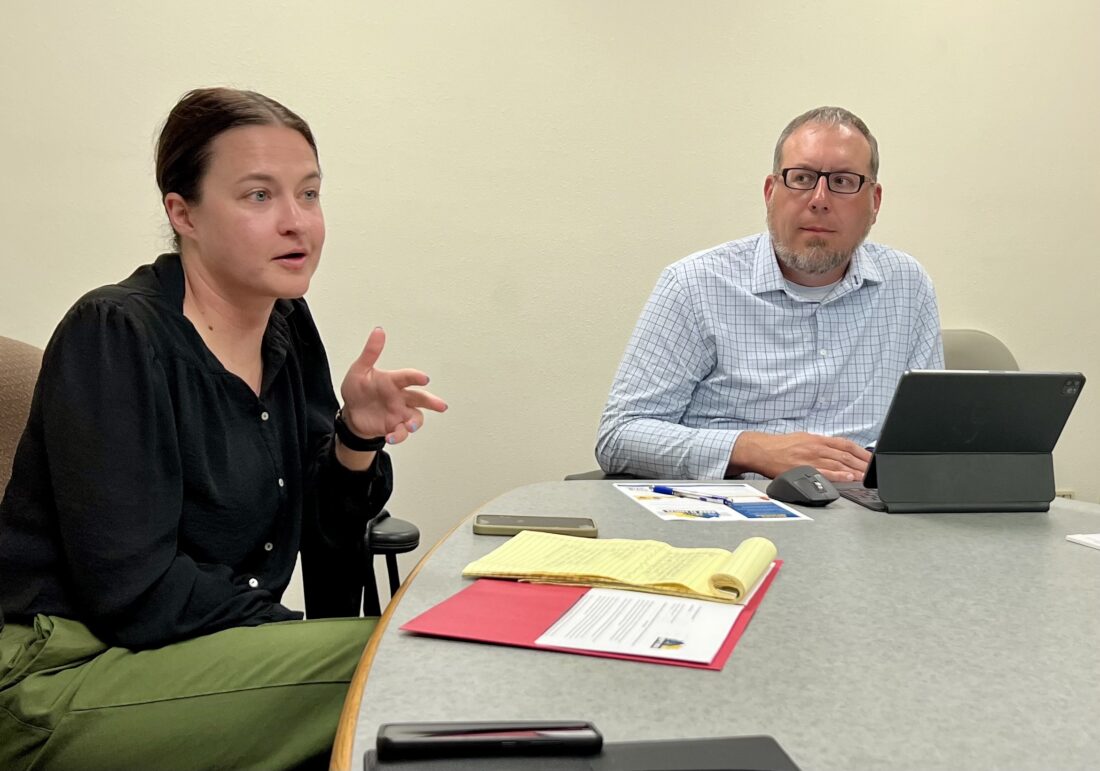
Jill Schramm/MDN Ali Hoffman, campaign manager for Keep It Local, speaks about opposition efforts against a proposed property tax measure at The Minot Daily News Tuesday as Jeff Haider, a local representative for builders associations, listens at right.
Opponents of an initiative to eliminate property taxes in North Dakota say the proposal charts off into the unknown, without a plan to guide where it takes the state.
A coalition of more than 65 organizations is gearing up to fight a proposed constitutional measure that asks voters to eliminate the state’s property tax. Aiming to get the measure on the November ballot, sponsors with End Unfair Property Tax turned in petitions with more than 40,000 signatures to North Dakota Secretary of State on June 28. The office has until Aug. 2 to complete signature verification.
Coalition campaign manager Ali Hoffman, policy director for North Dakota United, said if the measure makes it to the ballot, Keep It Local will be working to ensure voters understand the impacts of eliminating property taxes.
“We need to do the work to educate our membership,” she said, “but also making sure we’re speaking at large to the public about what this actually means, that it’s not just getting rid of property taxes and everything will be fine, that it would have long-term, short-term, severe ramifications for our communities and the quality of life here in North Dakota,” Hoffman said.
“The concern throughout the coalition is this will leave a $1.3 billion hole in the budget that the state Legislature would be in charge of figuring out to fund, with absolutely no plan written into the measure that would give any guidance as to how this would be funded,” she said.
A concern of the coalition is the measure requires the Legislature to fund political subdivisions at their 2024 levels but lists no mechanism for inflationary increases over time.
Arik Spencer, president of the Greater North Dakota Chamber, said his organization opposed eliminating property taxes when it was proposed in 2012 but still gave it a fresh look this time around. Although its members come from different industries, businesses sizes and parts of the state, they all have concerns about the latest measure, which requires legislators to find $2.6 billion a biennium to fund political subdivisions, he said.
“This represents a 40 percent increase in the general fund budget,” he said. “We don’t know where that 40 percent is going to come from.”
He noted some of the state’s revenue are federal funds or special funds that can’t be diverted to use for property tax relief.
“The one thing our businesses don’t like is uncertainty about what the tax environment is,” Spencer said. “They’re on board with this because they want the certainty that is provided by the current system, not that it can’t be improved. They also want to make sure that when people are hired around North Dakota, they’re living in communities that provide the quality of life that citizens in any given community decide they want to have.”
Matt Gardner, executive director for the North Dakota League of Cities, a coalition member, said eliminating property taxes constitutionally also will be difficult to tweak or change if issues arise.
The Minot Association of Builders, North Dakota Association of Builders and North Dakota Retail Lumbermen’s Association are part of the coalition because they want to keep decisions about budgeting and spending local, said Jeff Haider, who represents the groups.
“If we had a definitive plan in place – where the money is going to come from – I think it would be a little bit easier to swallow. But taking power from the locals and giving it to the state is not something that any of our members are for,” he said.
The coalition includes a diverse collection of statewide groups. The Minot Area Chamber EDC and Minot Board of Realtors are among them.
“One thing we have in common is we love this state, and we think that it’s on a trajectory to do well and to do better. This measure, should it pass, will change that, because they haven’t answered the questions about the long-term funding,” said Nick Archuleta, president of ND United, a member of Keep It Local.
North Dakota would be the first state to do away with property taxes, Hoffman said.
“So, there’s no roadmap for what this would look like or what would happen,” she said. “We want to be number one in a lot of ways but we don’t want to be number one in this. There’s no plan. There’s nothing to look towards to see what would happen with this.”
Rick Becker, chairman for End Unfair Property Tax, described the opposition campaign as fear mongering.
“As far as having no plan, that’s something that is a platitude that is intended to resonate with voters who probably aren’t going to have access to more information,” he said.
He noted legislators could simply allocate the first $2 billion from state revenue projections to political subdivisions, using interest from the Legacy Fund, carryover funds from the previous biennium or other appropriate revenue. But a spending plan needs to be established by legislators, not written into the state constitution, he said.
While the proposed measure provides future funding at the tax level set in 2024 for 2025 budgets, political subdivisions have other methods to raise more money as needed in coming years, Becker said. Examples would be sales tax or fees charged residents for government administration, road maintenance or other services.
“It reforms property taxes into a tax for services that people understand,” he said.
“The proponents of this are over-promising,” Archuleta said. “There are restrictions on what political subdivisions can do and how they can raise money. And so, we have to be very, very careful that North Dakotans are getting the full picture as to the ramifications.”
The coalition states the Legislature will need to pass bills to enable political subdivisions to raise money in other ways if the measure passes.
“The $2.6 billion is going to get paid, and it’s going to get paid by the taxpayers in just another way,” Archuleta said. “I think the proponents of this need to be honest about that.”
Local News
House Armed Services Committee staff visit Minot AFB
Mayor, base leaders honor military children
Minot watermain projects receive state funds
BISMARCK – The North Dakota State Water Commission announced approval of more than $20.6 million in funding for ...
History-based book club to met at Confluence
WILLISTON — “Reading on the Frontier,” a history-based book club, will meet Saturday, May 2, from 1-2 p.m., ...
Visit Minot awarded funds for hospitality strategy
BISMARCK — Minot Convention and Visitor's Bureau (Visit Minot) has been awarded $80,960 to support a hospitality ...
Dakota College named the Tree Campus USA -l
BOTTINEAU — The Arbor Day Foundation has designated Dakota College at Bottineau (DCB) as a Tree Campus Higher ...