Questioning the global beef about beef
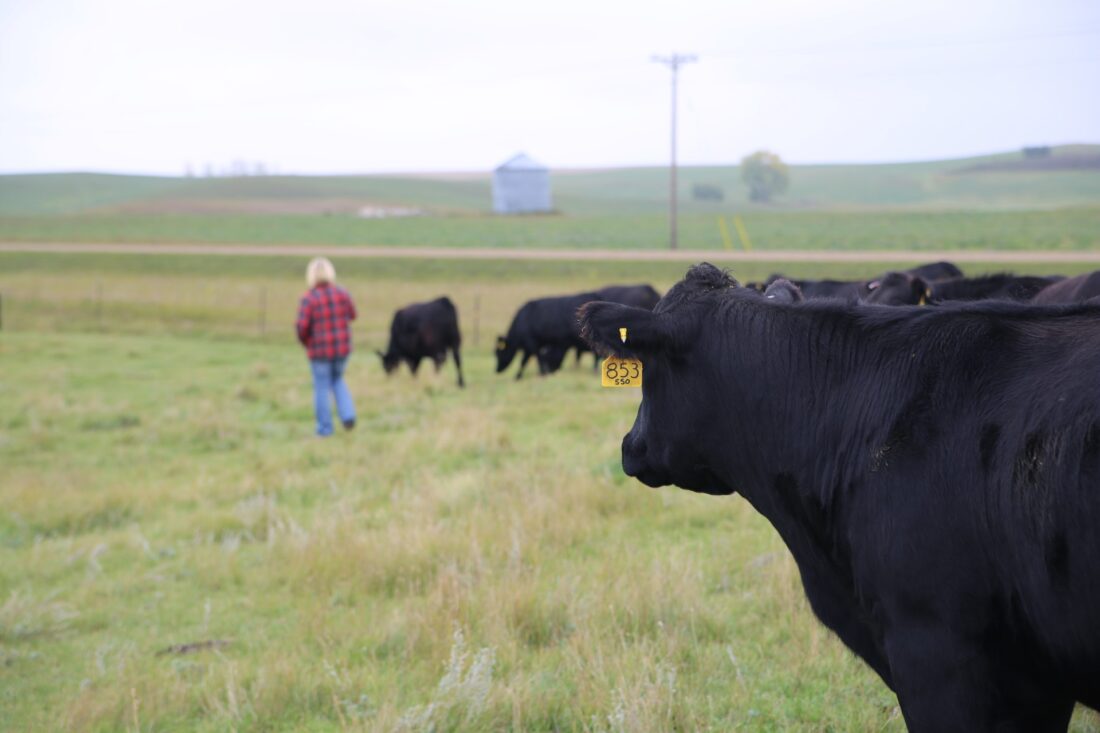
Submitted Photo A yearling heifer watches Sydney Glasoe Caraballo as she checks the herd and the condition of native grasslands during a rain shower in the fall of 2019.
Caraballo is a fifth-generation rancher and farmer who manages Glasoe Angus near Wildrose. Her columns appear monthly in The Journal and The Tioga Tribune.
Do a website search with the question: is beef bad for the planet? Multiple headlines populate with a resounding yes. The first statement topping a web browser courtesy of a columnist on a website reads: “It’s no longer news that eating meat is bad for the planet. Study after study confirms how much pollution comes from the food system – emissions from meat and dairy make up around 14 percent of all global emissions.”
One point of contention I have – the author used a 2013 UN Food and Agriculture Organization [FAO] report for that percentage. Global animal agriculture emissions have decreased to 11 percent of emissions, according to the 2022 report published by the FAO. Furthermore, emissions from animal agriculture would also include chickens, ducks, pigs, buffaloes, horses, sheep and goats, which the author fails to mention.
While the American cow is not a sacred cow in the conversation regarding greenhouse gas emissions, she should not be the scapegoat either.
I’ll admit I’m biased. I raise cattle. But such bias absolutely exists on the opposing side. Plant-based “meat” sales are expected to grow to $74 billion in ten years with some estimates exceeding $118 billion by 2030, according to projections from research analysts. The global renewable energy market was estimated at $1.21 trillion in 2023. All of this is fine except that these industries make money with fear-mongering and morality marketing. The message is to eat plant-based protein, drive an electric car, rid the world of cattle, and our world will be a better place. But will it really?
Morality marketing is an age-old snake oil driven by profit margins but not necessarily comprehensive and beneficial solutions.
The Environmental Protection Agency calculates that all livestock production in the U.S. totals 4.2 percent of greenhouse gas emissions in our country. Emissions from beef cattle account for 2 percent. U.S. transportation accounts for 25 percent, power plants and electricity account for 29 percent and “other sources” are nearly 41 percent. Globally, the energy industry accounts for 73 percent of greenhouse gas emissions, according to Climate Watch. Energy use in commercial and residential buildings, transportation (aviation, shipping, and road transport) and energy use in industry all add up to the total.
The U.S. cow gets scapegoat coverage, but very little credit for how much American cattle producers have already reduced her collective carbon hoofprint in comparison to other national herds, much less the carbon footprint of other industries that are much larger contributors to global greenhouse gas emissions.
The U.S. produces 18 percent of the world’s beef with merely six percent of the world’s cattle, according to the North Dakota Beef Commission. Our national herd has one of the lowest carbon footprints in the world – 10 to 50 times lower than some nations.
U.S. cattle producers have focused on improved feed efficiency and productivity for decades, which equates to the U.S. herd reaching harvest weight in a shorter period of time than other national herds. The U.S. has the lowest cattle inventory since 1951 with a current 87.2 million head, according to the USDA’s January report.
“Between 1961 and 2019, the U.S. beef industry, through continued sustainability efforts and improved resource use, has reduced emissions per pound of beef produced by more than 40% while also producing more than 67% more beef per animal,” according to the North Dakota Beef Commission.
Geography, stewardship and regenerative goals also matter. There is a big difference between clearcutting Amazon rain forest for livestock versus managing native grasslands with ruminants. Here, cattle on the northern prairie serve a natural and beneficial purpose in carbon reduction. Here, ruminants have earned their natural and rightful place on the prairie for thousands of years.
“The reality is that the number of ruminants in [the] U.S. today is essentially the same as in [the] 1800s (bison and elk replaced with cattle), but the difference is that we now have 350 million people and 270 million vehicles,” according to Dr. Raluca Mateescu, a professor of quantitative genetics and genomics at the University of Florida.
Methane produced by ruminants (bison, elk, deer, sheep, goats, and CATTLE) is broken down in a biogenic carbon cycle. Biogenic carbon, or so-called cattle “burps,” is absorbed and stored and emitted by organic matter such as soil, grasses, plants and trees. Biogenic carbon takes about one decade to convert back to carbon dioxide whereas non-biogenic carbon (fossil fuels such as gas, coal and oil) can take thousands of years to complete its cycle.
Cattle don’t ruin the natural grasslands here; they actually enhance the local habitat while providing a beneficial protein source for human consumption.
Proper grazing from cattle benefits both soil health and the resilience of the prairie ecosystem, according to the U.S. Fish & Wildlife Service. Non-grazed grasses decay, lose nutritional value and create a layer of thatch that inhibits new grass growth. Then invasive species take over, which leads to loss of habitat for native plants and wildlife, as well as erosion, run-off, drought risks and fire threat. Grazed grass is healthy grass.
Herd hoof action also benefits by creating divots that hold seeds, water and beneficial organisms. Those same hooves also stomp on less desirable plants and weeds while improving biodiversity, which attracts diverse wildlife, migratory birds, insects and pollinators. (North Dakota is the number one honey-producing state in the nation). Finally, ruminant manure acts as a natural fertilizer and provides nutrient needs to the next generation of grass.
Here, any discerning human can step foot on the prairie and see cattle aren’t the problem but serve as an integrated benefactor in a thriving ecosystem.
Here, our national livestock production lands far below FAO’s 2022 estimated global 11 percent of greenhouse gas emissions from animal agriculture. U.S. cattle have the lowest emission intensity per pound of beef produced in the world since 1996, according to an online climate data data platform.
But if every American stopped eating animal protein, we would reduce U.S. emissions of greenhouse gases by 2.6 percent. Yet I wonder what our reductions would be if we set our thermostats 10 degrees lower in winter and 10 degrees warmer in the summer, if we drove 5,000 less miles per year, if we all lived in homes with less than 2,000 square feet, if we took one less vacation (by car or airplane) a year, or if we simply wasted less food.
Nearly 40 percent of the food brought home in the United States goes uneaten and to waste. That waste emits methane in landfills and contributes to greenhouse gas emissions. According to analysis from Project Drawdown sourced from the article I mentioned at the beginning of this column, “Curbing food waste could reduce 12.4 percent of global emissions.”
That is nearly five times more of an impact than if we stopped eating all animal meat, not just beef. And even if we stopped eating beef and replaced all the cattle with elk and bison and deer on our grasslands, those wild ruminants would still emit methane at comparable levels with comparable populations. Without ruminants and grassland management, the prairies would be on fire. Canada’s wildfires in 2023 released more greenhouse gases than the combined emissions of every other sector of its economy, including oil and gas, transport and agriculture.
Furthermore, if we replace livestock with plant-based agriculture to supply the global population’s need for a sustainable protein source, it would take vast swaths of acres worldwide, and what of that footprint?
I am a fifth-generation rancher; I consider it my life’s work to be a good steward of not just our livestock but the land – the soil systems, habitat and wildlife. American ruminants, their position in the prairie ecosystem and the protein source they provide are not the simple evil ruination of our planet. We owe it to ourselves and the planet to do better. But human nature, greed and the corresponding agendas promoted are of much more consequence than cows on the prairie. Agendas, land grabs and paychecks are firmly attached to the sentiment that beef is bad for the planet. My cows may not be sacred, but less than altruistic sentiments shouldn’t be either.
Local News
Felon charged after multi-agency investigation
A Minot man has been arrested and charged five felony counts for possession with intent to distribute marijauna and ...
Brine spill occurs near Killdeer
KILLDEER — A brine spill occurred at the Cougar 1 SWD site, about 20 miles northwest of Killdeer, Tuesday, March ...
Minot Municipal Court Dispositions
March 31 Talon Blake Hoaglund, 19, Minot, DUI/APC-first offense (Class B misdemeanor), chemical dependency ...

Air & Space Forces Association leader to speak at Minot AFB event
North Central District Court Dispositions
Mountrail County March 30 David Thomas Dwitz, 37, Tolley, DUI-0.16% or greater-first offense (Class B ...